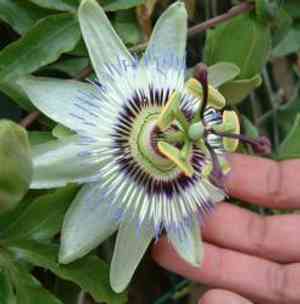
Golden bellapple (Passiflora laurifolia)
Also known as: Water lemon, Yellow granadilla
The golden bellapple features shiny, laurel-shaped leaves and striking, fragrant flowers with a detailed, signature design typical of passionflowers. This plant thrives in tropical and subtropical areas, often found clinging to forest margins and enjoying filtered sunlight. Its flowers, a captivating blend of purple and white, are followed by oval, orange-yellow fruits known for their tangy, refreshing taste.
In This Article
Attributes of Golden bellapple
Lifespan
Perennial
Plant Type
Vine
Plant Height
6-10 meters (20-33 feet)
Spread
1-3 meters (3-10 feet)
Leaf Color
Dark green
Flower Size
8-12 centimeters (3-5 inches)
Flower Color
Purple and white
Images of Golden bellapple
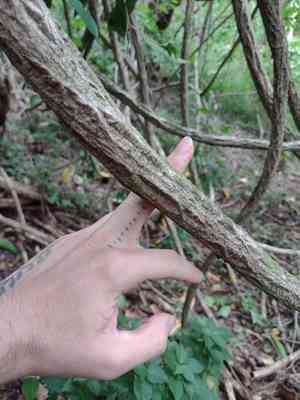
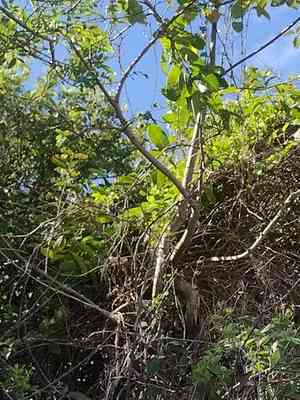
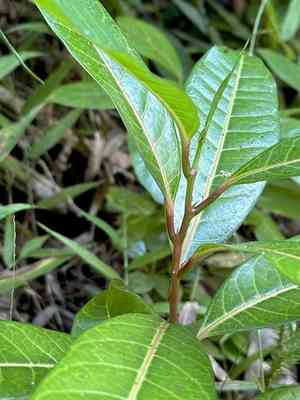

Quickly Identify Golden bellapple
1
To identify Passiflora laurifolia, look for a vine with leathery, dark green, elliptical leaves and striking purple and white flowers. The flowers are uniquely shaped with prominent corona filaments. Its fruit is oval to round, turning yellow when ripe.
Scientific Classification of Golden bellapple
Phylum
Vascular plants
Class
Dicotyledons
Order
Malpighiales
Family
Passionflowers
Genus
Passion flowers
Species
Golden bellapple
Planting and Growing of Golden bellapple
Care Difficulty
Easy
Watering Schedule
Every 2 days
Sunlight Requirements
Full sun
Sunshine Duration
6-10 hours
Ideal Temperature
68-86℉
Soil Type
Potting Mix, Peat Mix
Soil pH
5.5-7.5
Fertilizer Type
Balanced
Pruning Season
Spring, Summer
Pruning Area
Branches, Leaves
Pruning Frequency
2 times a year
Repotting Season
Spring
Pot Type
Plastic, Terracotta
 How to Water Golden bellapple?
For Passiflora laurifolia, the ideal watering amount is around 500 milliliters per session. This plant thrives best when the soil is kept consistently moist but not waterlogged. It is important to water in such a way that the soil is damp throughout the root zone. Water until you see slight drainage from the bottom of the pot to ensure that the roots have received adequate moisture.
What are the symptoms of an underwatered Golden bellapple?
›
What should I do if my Golden bellapple is not getting enough water?
›
What are the symptoms of an overwatered Golden bellapple?
›
How to save an overwatered Golden bellapple?
›
 What Are the Sunlight Requirements for Golden bellapple?
Passiflora laurifolia thrives in partial to full sunlight, requiring about 6-8 hours daily. Such lighting conditions enhance its flowering potential and ensure vibrant and lush growth, supporting its overall vigor and resistance to stress.
Optimal Sun Exposure
›
Positioning for Sunlight
›
Adapting to Seasonal Changes
›
 What Is the Ideal Temperature Range for Golden bellapple?
Passiflora laurifolia thrives best within a temperature range of 68°F to 86°F. These conditions mimic the plant's natural tropical environment, providing the warmth needed for optimal photosynthesis and growth. Maintaining this range helps ensure the plant grows vigorously and can produce flowers and fruit effectively.
 What Soil is Best for Golden bellapple?
Passiflora laurifolia thrives in well-drained soil. Proper drainage helps prevent root rot and ensures the roots have adequate access to nutrients and oxygen. A rich soil with ample organic matter is beneficial, as it provides essential nutrients and retains moisture effectively, promoting robust growth. The soil should be nutrient-rich to support the vigorous growth of Passiflora laurifolia, supplying it with necessary minerals for healthy foliage and fruit production.
 How to Fertilize Golden bellapple?
Passiflora laurifolia thrives best when fertilized with a balanced mixture of essential nutrients. Generally, for liquid fertilizer, a dilution of 1/4 strength of a typical 10-10-10 NPK fertilizer is recommended per watering session. For slow-release fertilizers, apply according to the package instructions but usually amounts to 1-2 tablespoons per plant, depending on size and potting conditions.
 How to Prune Golden bellapple?
Use clean, sharp pruning shears or loppers for cutting branches. Smaller, delicate branches are best handled with shears, while thicker branches may require loppers for a clean cut. Maintaining sharp tools also helps prevent damage to the plant. Begin by examining the Passiflora laurifolia for any dead, damaged, or diseased branches. These should be the first targets for removal as they can hinder the plant's growth and spread disease to healthy parts of the plant. Trim back any long, trailing vines that have overgrown their space. Cut just above a node where a leaf emerges; this encourages branching and fuller growth. Trimming promotes air circulation and light penetration. Pruning also involves shaping the plant to ensure even growth. Symmetrical pruning encourages uniform distribution of leaves and flowers, leading to a more visually appealing plant structure.
More About Pruning Techniques→
 How to Propagate Golden bellapple plant?
1
Collect seeds from a mature Passiflora laurifolia fruit. Clean them with water to remove any fruit pulp. Soak seeds in warm water for 24 hours to soften their outer coat, which enhances germination rates. Use a seed-starting mix in a propagation tray and plant seeds about 1/2 inch deep.
2
Take cuttings of about 4-6 inches in length from healthy, non-flowering shoots. Remove the leaves from the lower half of the cutting to prevent wilting. Dip the cut end in rooting hormone to promote faster root development. Plant the cutting in a potting mix suitable for propagation.
3
Select a low, flexible branch of the plant. Gently bend it down so that a portion is in contact with the ground. Nick the branch slightly and apply rooting hormone. Cover the nicked part with soil and secure it in place. Once roots have developed, cut the new plant from the parent.
 How to Repot Golden bellapple plant?
1
Look for signs like roots poking through the drainage holes or if the growth seems sluggish despite good care. Spring and Summer months are ideal as Passiflora laurifolia is actively growing during these seasons, helping it recover swiftly.
2
Opt for a pot that is one size larger than the current one, ensuring it has ample drainage holes. This prevents waterlogging and provides sufficient room for root expansion, which promotes healthier growth and reduces stress on the plant.
3
A well-draining loamy soil mix is crucial. This choice prevents water stagnation and root rot while providing the necessary nutrients the plant needs to thrive. The loamy texture helps in retaining the right amount of moisture without going soggy.
Learn More About Golden bellapple Diseases
Anthracnose
Bacterial Leaf Spot
Bacterial Soft Rot
Bacterial Wilt
Crown Gall
Cyst Nematode
Damping-off
Downy Mildew
Drought Stress
Fusarium Wilt
Gray Mold
Leaf Spot
Mosaic
Nutrient Deficiency
Nutrient Toxicity
Powdery Mildew
Root Rot
Root-knot Nematode
Rusts
Sooty Mold
Spider Mites
Temperature Stress
Thrips Damage
White Mold



