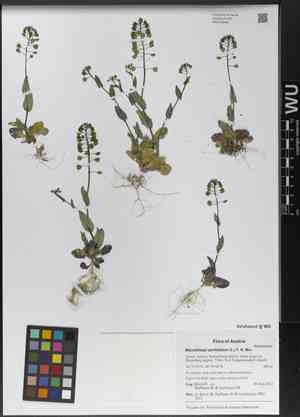
Claspleaf pennycress (Microthlaspi perfoliatum)
Also known as: Cotswold pennycress
Claspleaf pennycress, which thrives in limestone-rich soils, crumbling walls, and near agricultural fields, has been pushed to the edge of extinction due to modern farming methods. One key practice that harms this plant is fall plowing, aimed at preparing fields for the next planting season. Since claspleaf pennycress germinates in the autumn and often grows in farmland, this plowing disrupts and destroys young plants, preventing their growth and reproduction.
In This Article
Attributes of Claspleaf pennycress
Lifespan
Annual
Plant Type
Herb
Plant Height
3 cm to 40 cm
Spread
Not applicable, as it is a small herbaceous plant
Leaf Color
Green
Flower Size
5 mm
Flower Color
White
Images of Claspleaf pennycress
Quickly Identify Claspleaf pennycress
1
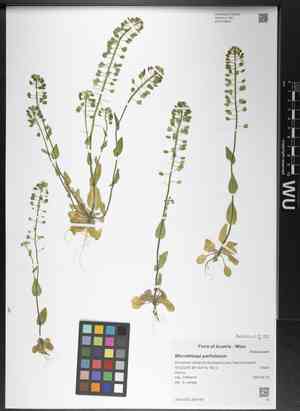
Identify Microthlaspi perfoliatum through its small white, four-petaled flowers and rounded, clasping leaves. The plant tends to grow in a rosette form close to the ground.
Scientific Classification of Claspleaf pennycress
Phylum
Vascular plants
Class
Dicotyledons
Order
Brassicales
Family
Cruciferae
Genus
Microthlaspi
Species
Claspleaf pennycress
Planting and Growing of Claspleaf pennycress
Care Difficulty
Easy
Watering Schedule
Every 4 days
Sunlight Requirements
Partial sun
Sunshine Duration
6-10 hours
Ideal Temperature
59-77℉
Soil Type
Potting Mix, Peat Mix
Soil pH
6.5-7.5
Fertilizer Type
Balanced
Pruning Season
Spring, Summer
Pruning Area
Branches, Leaves
Pruning Frequency
2 times a year
Repotting Season
Spring
Pot Type
Plastic, Ceramic
 How to Water Claspleaf pennycress?
The watering amount for Microthlaspi perfoliatum should be enough to keep the soil slightly moist but never soggy. You should aim to provide around 150 milliliters per watering. This ensures the roots receive adequate hydration without becoming waterlogged. Always allow the top inch of soil to dry before the next watering.
What are the symptoms of an underwatered Claspleaf pennycress?
›
What should I do if my Claspleaf pennycress is not getting enough water?
›
What are the symptoms of an overwatered Claspleaf pennycress?
›
How to save an overwatered Claspleaf pennycress?
›
 What Are the Sunlight Requirements for Claspleaf pennycress?
Partial sun offers Microthlaspi perfoliatum balance, reducing stressors from harsh light while promoting healthy growth cycles. Ideal lighting maximizes photosynthesis, leading to robust plants with a natural resistance to adverse conditions.
What are the ideal lighting conditions for Microthlaspi perfoliatum?
›
How can I achieve the ideal lighting conditions for this plant?
›
What benefits does ideal lighting provide for Microthlaspi perfoliatum?
›
 What Is the Ideal Temperature Range for Claspleaf pennycress?
Microthlaspi perfoliatum prefers a moderate climate with temperatures ranging from 59°F to 77°F, where it can grow optimally. The balanced warmth within this range supports healthy physiological and metabolic processes.
 What Soil is Best for Claspleaf pennycress?
Microthlaspi perfoliatum thrives in soils that are abundant in essential nutrients. This richness in nutrients supports robust growth and development, enhancing the plant's overall vitality and resilience against pests and diseases. Loamy and sandy loam soils offer excellent drainage, which is crucial for preventing root rot and other moisture-related issues. Proper drainage ensures that the plant's roots receive sufficient oxygen, promoting healthy growth. The calcareous nature of the soil provides higher calcium content, which is beneficial not only for supporting strong cellular structures but also for neutralizing soil acidity, thus offering an optimal pH range for Microthlaspi perfoliatum.
 How to Fertilize Claspleaf pennycress?
For Microthlaspi perfoliatum, applying a balanced nutrient ratio is crucial. Liquid fertilizers should be diluted to half strength to prevent nutrient burn, typically using 1/2 teaspoon per gallon of water. For slow-release fertilizers, applying 20 grams per square meter during early spring is ideal to sustain growth.
 How to Prune Claspleaf pennycress?
Begin by understanding the growth pattern of Microthlaspi perfoliatum, a perennial known for its rosette formation. It’s crucial to identify new shoots and ensure any pruning enhances natural growth without hindering the plant’s ability to regenerate. Use sharp, clean scissors or pruning shears to make precise cuts. Trim back any dead or damaged leaves first, then focus on shaping the plant by cutting at nodes or just above a set of leaves to ensure energy is directed towards new growth. After pruning, water the plant lightly to aid recovery and apply a balanced fertilizer to encourage robust new growth. Ensure the plant receives adequate sunlight and airflow, as these are vital for health during the regrowth period.
More About Pruning Techniques→
 How to Propagate Claspleaf pennycress plant?
1
Fill seed trays with sterile potting mix and lightly press down to create a smooth surface. Water gently to moisten the soil before sowing the seeds. Ensure the trays are clean to prevent any contamination.
2
Sow the Microthlaspi perfoliatum seeds thinly across the surface of the potting mix. Ensure an even distribution to allow adequate space for each seedling to grow. Cover the seeds with a thin layer of potting mix or vermiculite.
3
Place the seed trays in a warm, bright location but out of direct sunlight. Maintain humidity by covering with a propagator lid or clear plastic. Keep the soil consistently moist until germination occurs, which typically happens within a few weeks.
 How to Repot Claspleaf pennycress plant?
1
Microthlaspi perfoliatum should be repotted when you notice that its roots are starting to outgrow the current pot, or when water remains on the surface of the soil instead of draining. Another sign it's time for a new pot is if the growth seems stunted or the plant appears too top-heavy.
2
When selecting a new pot for your Microthlaspi perfoliatum, it's crucial to go for one size larger than the current. This gives the roots enough room to grow without overwhelming the plant. Ensure the pot has sufficient drainage holes to prevent water from stagnating, which can cause root rot.
3
Opt for a well-draining potting mix, ideally a blend that mimics the plant’s natural environment. This choice will prevent the roots from sitting in water, ensuring the plant receives ample air and roots dry quickly between waterings, facilitating healthy growth.



