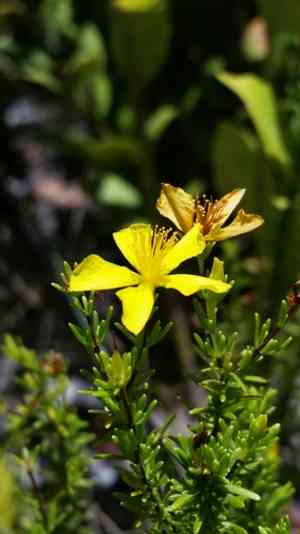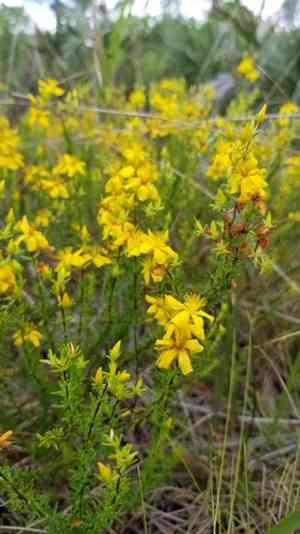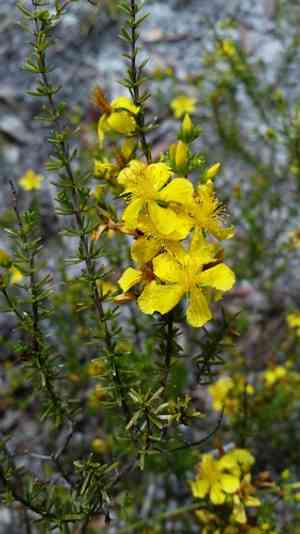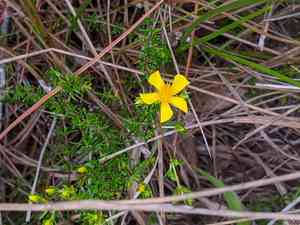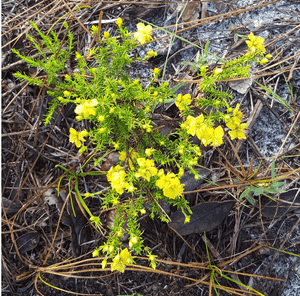
Atlantic St. John's wort(Hypericum tenuifolium)

Atlantic St. John's wort (Hypericum tenuifolium)

Also known as: Narrowleaf St. John's Wort

Atlantic St. John's Wort (Hypericum tenuifolium) is notable for its fine, linear leaves and abundant bright yellow blooms. These flowers typically herald the arrival of summer in their native habitats, thriving best with plenty of sunlight.

**Distinguishing Characteristics:**
1. **Flowers:** Vibrant yellow with five petals, blooming from late spring to summer.
2. **Leaves:** Narrow, linear, and opposite, giving the plant a delicate look.
3. **Height:** Typically grows between 1-3 feet tall.
4. **Stems:** Reddish and slender, adding to its distinctive appearance.

**Ideal Growing Conditions:**
1. **Light:** Prefers full sun to partial shade.
2. **Soil:** Does well in sandy, well-drained soils, often found in coastal plains.
3. **Water:** Drought-tolerant once established, requiring minimal watering.
4. **Hardiness:** Best suited for USDA zones 6-9.

Due to its compact growth habit, Atlantic St. John's Wort is ideal for ornamental borders and rock gardens, making it a versatile choice for challenging environments.

Attributes of Atlantic St. John's wort

Lifespan
Perennial
Plant Height
30 cm to 61 cm
Spread
30 cm to 60 cm
Leaf Color
Green
Flower Size
1-2 cm
Flower Color
Yellow

ForwardPlant - Identify plants with a snap

Identify and diagnose plants, get toxicity alerts, and explore safety guides for all types of fungi.

Try for Free

Images of Atlantic St. John's wort

Atlantic St. John's wort(Hypericum tenuifolium)

Quickly Identify Atlantic St. John's wort

1
Petite mat-forming shrub, 4–20 inches (10–50 cm) high.
2
Bright-yellow flowers with numerous stamens creating a halo effect.
3
Narrow leaves, 0.5-1 inch (1.3-2.5 cm) long, opposite arrangement.
4
Fruit capsules with 2-5 cells, varying green to brown, dry texture.
5
Distinct 2-edged stem, newer growth with 2-4 ridges transitioning to smoother rounded texture.

Scientific Classification of Atlantic St. John's wort

Phylum
Vascular plants
Class
Dicotyledons
Order
Malpighiales
Family
St. John's wort
Genus
St. John's worts
Species
Atlantic St. John's wort

Planting and Growing of Atlantic St. John's wort

Care Difficulty
Moderate
Watering Schedule
Every 4 days
Sunlight Requirements
Full sun
Sunshine Duration
4-6 hours
Ideal Temperature
60-75℉
Soil Type
Potting Mix, Peat Mix
Soil pH
6.5-7.5
Fertilizer Type
Balanced
Pruning Season
Spring, Summer
Pruning Area
Branches, Leaves
Pruning Frequency
2 times a year
Repotting Season
Spring
Pot Type
Plastic, Ceramic

water icon How to Water Atlantic St. John's wort?

For Hypericum tenuifolium, the watering amount is crucial to ensure the soil is adequately moist yet not oversaturated. The rule of thumb is to water until about 250ml per session so that moisture can reach deep roots without water pooling at the top or bottom of the pot.
What are the symptoms of an underwatered Atlantic St. John's wort?
What should I do if my Atlantic St. John's wort is not getting enough water?
What are the symptoms of an overwatered Atlantic St. John's wort?
How to save an overwatered Atlantic St. John's wort?

sunlight icon What Are the Sunlight Requirements for Atlantic St. John's wort?

Sunlight Requirements: Full sun, Partial sun
Duration of light: 6 to 8 hours daily
Hypericum tenuifolium thrives best with a mix of full sun and partial sun, particularly benefiting from about 6 to 8 hours of sunlight daily. Proper lighting boosts its blooming capacity, enhances foliage vibrancy, and supports a resilient structure.
What is the ideal light setup for Hypericum tenuifolium?
How can you achieve these lighting conditions?
What benefits does ideal lighting provide?

temperature icon What Is the Ideal Temperature Range for Atlantic St. John's wort?

Ideal Temperature: 60 ~ 75℉
Hypericum tenuifolium thrives in temperatures ranging from 60 to 75 degrees Fahrenheit. This range facilitates proper metabolic functions and encourages healthy growth and blooming. Maintaining this temperature helps the plant to efficiently photosynthesize and access the nutrients it requires for survival and development.

soil icon What Soil is Best for Atlantic St. John's wort?

Soil type: Sandy loam, Loam, Sandy soil
Soil PH: 6.5 ~ 7.5
Hypericum tenuifolium thrives in well-drained soil. Ensuring good drainage prevents root rot and allows the roots to access the necessary oxygen. It mimics the plant's natural habitat, fostering robust growth and vibrant blooms. This plant prefers soils with modest nutrient levels. Excessive nutrients can lead to lush foliage at the expense of flowers. A balanced nutrient supply supports healthy growth and abundant flowering. While Hypericum tenuifolium is drought-tolerant, it performs best in soil that retains some moisture. Consistent moisture availability is crucial for maintaining the plant's health and promoting steady growth.

fertilize icon How to Fertilize Atlantic St. John's wort?

Fertilizer type: Balanced
For Hypericum tenuifolium, provide a balanced, water-soluble fertilizer mixed at half the recommended dose to avoid nutrient burns. This ensures the plant receives adequate nutrition without overwhelming it with excessive nutrients.

prune icon How to Prune Atlantic St. John's wort?

Pruning Time: Spring, Summer
Begin by inspecting the plant, identifying any dead, diseased, or crossing branches that need removal. Look for branches that may be impeding airflow and light penetration. Trim the plant to maintain its natural shape and encourage a denser growth pattern. Make cuts at a slight angle just above a leaf node to promote new growth. To prevent the spread of disease, sanitize your pruning tools with a standard disinfectant between each cut, especially if you are cutting diseased branches. After pruning, monitor the plant for any signs of stress or disease. Water the plant thoroughly and consider applying a light layer of mulch to retain moisture. More About Pruning Techniques

propagate icon How to Propagate Atlantic St. John's wort plant?

Propagate Time: Early spring,Late spring,Early summer
1
Begin by sowing the seeds in seed trays filled with a well-draining, sandy soil mix. Lightly cover the seeds with soil and water gently. Place the trays in a warm, sunny location to encourage germination.
2
Select healthy, non-flowering stems and use sharp pruners to cut a 4-6 inch piece. Remove the leaves from the lower half and dip the cut end in rooting hormone. Plant the cutting in a pot filled with moist, well-draining soil.
3
Carefully dig up the established plant in spring. Using a sharp tool, divide the root ball into sections ensuring each has roots and shoots. Replant the divisions at the same depth as the original plant and water thoroughly.
More About Propagating Techniques

repot icon How to Repot Atlantic St. John's wort plant?

Repotting frequency: Every two years
1
Look for signals such as stunted growth, roots emerging from drainage holes, or the soil drying out very quickly. These could indicate the need for repotting. Ideally, repotting should be carried out in the early spring or late autumn when the plant is not actively flowering. This avoids stressing it further in peak growth periods.
2
Select a pot that is one to two inches larger in diameter than the current one. Make sure it has adequate drainage holes. This size allows for root expansion without overwhelming the plant with too much soil, which can lead to waterlogging. The material can be terracotta, which allows better airflow to the roots.
3
Opt for a well-draining sandy mix, offering a balance of organic matter and sand. This helps prevent waterlogging yet retains enough moisture for the roots to absorb nutrients effectively. The soil should mimic the plant's natural environment as much as possible for optimal growth.

ForwardPlant - Identify plants with a snap

Find the best spots for them to optimize their health, simply using your phone.

Try for Free

Toxicity

Ingestion

Identify toxic plants for your safety

Learn which plants are harmful to you and your pets, and make informed choices for a safer home!

Try for Free
WARNING
The judgment on toxicity and danger is for reference only. We DO NOT GUARANTEE any accuracy of such judgment. Therefore, you SHALL NOT rely on such judgment. It is IMPORTANT TO SEEK PROFESSIONAL ADVICE in advance when necessary.