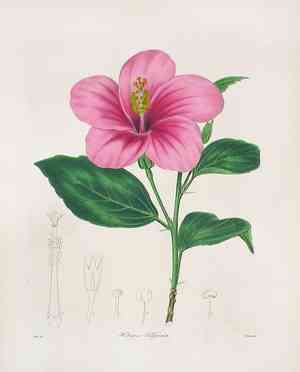
Red kauai rosemallow(Hibiscus clayi)

Red kauai rosemallow (Hibiscus clayi)

Also known as: Clay Hibiscus

The red Kauai rosemallow (Hibiscus clayi) is an eye-catching shrub native to Hawaii's forest areas. It is distinguished by its stunning red flowers with prominent yellow-tipped stamens that attract pollinators. The plant has glossy, dark green leaves that create a beautiful contrast with its blooms.

**Key Characteristics**:
1. **Appearance**: Striking red, cup-shaped flowers with yellow-tipped stamens.
2. **Foliage**: Glossy, deep green leaves.
3. **Height**: Can grow up to 3 meters (about 10 feet).

**Growing Conditions**:
1. **Climate**: Prefers a humid, tropical environment.
2. **Sunlight**: Best in partial shade but can tolerate full sun.
3. **Soil**: Requires well-drained soil.
4. **Water**: Needs regular watering but avoid waterlogging.
5. **Care**: Occasional pruning helps maintain its shape and encourages flowering.

This plant's natural beauty and ecological significance make it a valuable but endangered species in Hawaii. Conservation efforts are crucial for its survival.

Attributes of Red kauai rosemallow

Lifespan
Perennial
Plant Type
Shrub
Plant Height
3 to 6 feet (0.9 to 1.8 meters)
Spread
4 to 6 feet (1.2 to 1.8 meters)
Leaf Color
Dark Green
Flower Size
3 to 5 inches (7.6 to 12.7 cm)
Flower Color
Red

ForwardPlant - Identify plants with a snap

Identify and diagnose plants, get toxicity alerts, and explore safety guides for all types of fungi.

Try for Free

Images of Red kauai rosemallow

Red kauai rosemallow(Hibiscus clayi)

Quickly Identify Red kauai rosemallow

1
Upright growth reaching 10-15 feet (3-4.5 meters).
2
Smooth, shiny-green unlobed leaves.
3
Dark red flowers with flaring petals, 2-2.5 inches (5-6.3 cm) wide.
4
Prominent flowering from spring to fall, peaking in early summer.

Scientific Classification of Red kauai rosemallow

Phylum
Vascular plants
Class
Dicotyledons
Order
Malvales
Family
Mallow
Genus
Hibiscus
Species
Red kauai rosemallow

Planting and Growing of Red kauai rosemallow

Care Difficulty
Moderate
Watering Schedule
Every 4 days
Sunlight Requirements
Full sun
Sunshine Duration
4-8 hours
Ideal Temperature
68-77℉
Soil Type
Potting Mix, Peat Mix
Soil pH
6.5-7.5
Fertilizer Type
Balanced
Pruning Season
Spring, Summer
Pruning Area
Branches, Leaves
Pruning Frequency
2 times a year
Repotting Season
Spring
Pot Type
Plastic, Ceramic

water icon How to Water Red kauai rosemallow?

Hibiscus clayi thrives on a subtle balance of moisture. Ensure the soil remains consistently moist but not waterlogged. Water with about 500ml each time, making sure the water reaches 6-8 inches deep into the soil to feed the deeper roots without pooling on the surface.
What are the symptoms of an underwatered Red kauai rosemallow? ›
What should I do if my Red kauai rosemallow is not getting enough water? ›
What are the symptoms of an overwatered Red kauai rosemallow? ›
How to save an overwatered Red kauai rosemallow? ›

sunlight icon What Are the Sunlight Requirements for Red kauai rosemallow?

Sunlight Requirements: Full sun, Partial sun
Duration of light: 6 to 8 hours
Hibiscus clayi ideally benefits from full sun to partial sun. This range ensures maximal photosynthesis, resulting in vibrant growth, optimal blooming, and enhanced resilience against pests and diseases.
What is the ideal amount of sunlight for Hibiscus clayi? ›
How can I ensure my Hibiscus clayi gets optimal light exposure? ›
What are the benefits of providing ideal lighting to Hibiscus clayi? ›

temperature icon What Is the Ideal Temperature Range for Red kauai rosemallow?

Ideal Temperature: 68 ~ 77℉
Hibiscus clayi thrives in environments where temperatures are consistently between 68°F and 77°F. This range allows the plant's metabolic processes to function optimally, promoting healthy growth and vibrant blooms.

soil icon What Soil is Best for Red kauai rosemallow?

Soil type: Loam, Sandy loam
Soil PH: 6.5 ~ 7.5
Hibiscus clayi thrives in nutrient-rich soil, which promotes vigorous growth and vibrant blooms. Incorporate organic matter like compost to enhance soil fertility and structure, ensuring the plant receives ample nourishment. Proper drainage is critical to prevent root rot in Hibiscus clayi. Well-drained soil allows excess water to escape, keeping roots healthy and encouraging the plant to absorb necessary nutrients without waterlogging. While drainage is essential, the soil should also retain adequate moisture. This balance helps maintain consistent hydration, crucial for the plant's overall health and preventing stress during drier periods.

fertilize icon How to Fertilize Red kauai rosemallow?

Fertilizer type: Balanced
When fertilizing Hibiscus clayi, it's essential to strike a balance. For liquid fertilizers, use a 20-20-20 balanced formula at half strength per application. For solid or slow-release fertilizers, use about 20 grams per plant annually, divided across three applications. Over-fertilizing can lead to nutrient burn, so err on the side of caution.

prune icon How to Prune Red kauai rosemallow?

Pruning Time: Spring, Summer, Autumn, Winter
Start by identifying dead or diseased branches and remove them using sharp, sterilized shears. Focus on removing branches that are crossing or rubbing against each other to improve air circulation. Trim back growth to maintain desired shape, cutting just above a node to encourage new growth. Perform thinning cuts to open up the canopy of the plant. This method involves removing entire branches back to their point of origin. It helps increase light penetration and air circulation, which reduces the risk of disease and promotes even growth. Shape your Hibiscus clayi by shorting longer branches, which encourages bushier growth. Aim to create an even, rounded shape, ensuring all sides of the plant receive adequate sunlight. Shaping also enhances the plant's aesthetic appeal, making it a beautiful focal point in your garden. More About Pruning Techniques→

propagate icon How to Propagate Red kauai rosemallow plant?

Propagate Time: Spring, Early summer
1
Begin by filling seed trays with a high-quality potting mix, ensuring adequate drainage. Sow the Hibiscus clayi seeds on the surface and lightly cover them with soil. Maintain soil moisture for optimal germination rates.
2
Select a healthy, non-flowering stem and cut just below a node. Each cutting should be around 4-6 inches in length. Remove the lower leaves to minimize moisture loss and dip the cut end in rooting hormone.
3
Insert the prepared cuttings into a pot filled with a mixture of peat and perlite. Ensure that at least two nodes are buried in the soil. Water thoroughly and cover with a plastic bag to create humidity, minimizing stress on the cuttings.
More About Propagating Techniques→

repot icon How to Repot Red kauai rosemallow plant?

Repotting frequency: Every 2-3 years
1
Hibiscus clayi should be repotted when you notice roots coming out of the drainage holes or the plant appears too large for its pot. The ideal time is early in the growing season, such as during spring or summer, when the plant is actively growing and can recover more quickly.
2
Select a pot that is 1-2 inches larger in diameter than the current one. It should have adequate drainage holes to prevent waterlogging, which can lead to root rot. A slightly wider pot allows for root expansion and promotes healthy growth.
3
Use a well-draining, sandy mix for repotting Hibiscus clayi. This type of soil mimics its natural habitat conditions, ensuring proper drainage and preventing root rot. A balanced soil mix will support nutrient uptake and retain essential moisture.

ForwardPlant - Identify plants with a snap

Find the best spots for them to optimize their health, simply using your phone.

Try for Free

