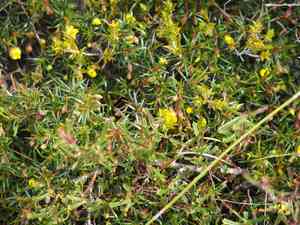
Needle leaved guinea flower (Hibbertia acerosa)
Needle leaved guinea flower is a resilient shrub adapting to sandy soils in sun-drenched environments. Its foliage is characterized by slender, needle-like leaves which minimize water loss. Vibrant yellow flowers, usually solitary, provide a sharp contrast to the greenery and attract pollinators. This hardy plant typically thrives in coastal conditions, showcasing a penchant for surviving in challenging habitats.
In This Article
Attributes of Needle leaved guinea flower
Lifespan
Perennial
Plant Type
Shrub
Plant Height
Up to 50 cm
Spread
Up to 1 meter
Leaf Color
Green
Flower Size
1-2 cm
Flower Color
Yellow
Images of Needle leaved guinea flower
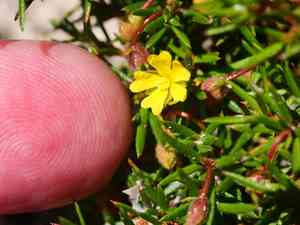
Quickly Identify Needle leaved guinea flower
1
Look for a small shrub with narrow, needle-like leaves and vibrant yellow flowers. The plant often forms a compact, low-lying structure.
Scientific Classification of Needle leaved guinea flower
Phylum
Vascular plants
Class
Dicotyledons
Order
Dilleniales
Family
Dillenia
Genus
Guinea flowers
Species
Needle leaved guinea flower
Planting and Growing of Needle leaved guinea flower
Care Difficulty
Moderate
Watering Schedule
Every 2 days
Sunlight Requirements
Full sun
Sunshine Duration
4-8 hours
Ideal Temperature
65-75℉
Soil Type
Potting Mix, Peat Mix
Soil pH
6-7.5
Fertilizer Type
Balanced
Pruning Season
Spring, Summer
Pruning Area
Branches, Leaves
Pruning Frequency
2 times a year
Repotting Season
Spring
Pot Type
Plastic, Ceramic
 How to Water Needle leaved guinea flower?
The watering amount for Hibbertia acerosa should be just enough to moisten the soil without oversaturating it. Aim for around 200 milliliters per session. This amount ensures the soil is sufficiently hydrated without causing waterlogging, as the plant prefers well-drained conditions.
What are the symptoms of an underwatered Needle leaved guinea flower?
›
What should I do if my Needle leaved guinea flower is not getting enough water?
›
What are the symptoms of an overwatered Needle leaved guinea flower?
›
How to save an overwatered Needle leaved guinea flower?
›
 What Are the Sunlight Requirements for Needle leaved guinea flower?
Hibbertia acerosa ideally receives full sun to partial sun exposure. The optimal lighting promotes healthy growth, vibrant flowering, and robust foliage development, ensuring plant wellness.
How much sunlight does Hibbertia acerosa need?
›
What happens if Hibbertia acerosa gets too much direct sun?
›
Is it possible to grow Hibbertia acerosa indoors?
›
 What Is the Ideal Temperature Range for Needle leaved guinea flower?
The ideal temperature range for Hibbertia acerosa to thrive is between 65°F and 75°F. In this range, the plant can perform optimal photosynthesis and grow healthily. This range ensures that the plant’s enzymatic and metabolic processes function at their best, leading to strong growth and vibrant blooms.
 What Soil is Best for Needle leaved guinea flower?
Hibbertia acerosa prefers soils with excellent drainage to prevent root rot. Well-drained soils allow excess water to escape, providing the roots with necessary oxygen. While not strictly necessary, a moderately fertile soil can enhance the growth of Hibbertia acerosa. The presence of essential nutrients supports vibrant foliage and robust plant health. An aerated soil structure is crucial for this plant as it promotes root growth and development. Soil with good aeration delivers oxygen to the root zone, enhancing overall plant vitality.
 How to Fertilize Needle leaved guinea flower?
For Hibbertia acerosa, the fertilization amount should be moderate. Use a balanced liquid fertilizer diluted to half the recommended strength. Typically, apply about 500 ml per plant when using a liquid fertilizer. For slow-release granules, sprinkle lightly around the base, ensuring it covers the root zone without overburdening the soil.
 How to Prune Needle leaved guinea flower?
Before you start pruning Hibbertia acerosa, take a few moments to assess the overall shape and structure of the plant. Identify any overcrowded areas and branches that may need removal or shortening to ensure balanced growth. Using a pair of clean, sharp pruning shears, begin by trimming back any dead, damaged, or diseased branches. Then, proceed to prune the branches that disrupt the desired shape or promote overcrowding. Aim to create an open and well-ventilated structure. After pruning, ensure the plant is well-watered and receives adequate sunlight. Apply a balanced fertilizer to promote recovery and bolster new growth. Monitor the plant for signs of distress and water as needed.
More About Pruning Techniques→
 How to Propagate Needle leaved guinea flower plant?
1
Collect seeds from a mature Hibbertia acerosa plant during late spring when the seed capsules dry up. Ensure the seeds are cleaned and free from any plant debris before sowing.
2
Using sterilized pruning shears, take semi-hardwood cuttings, approximately 10 cm long. Remove the lower leaves and dip the cut end in rooting hormone for better root development.
3
Sow seeds on the surface of a seed tray filled with well-draining potting mix, lightly covering them with soil. For cuttings, insert them into a potting mix, ensuring they are upright and firm in the soil.
 How to Repot Needle leaved guinea flower plant?
1
Repot your Hibbertia acerosa when you notice it's becoming root-bound, which means roots are growing out of the drainage holes. Another sign is stunted growth, where the plant stops thriving despite proper care. Early spring or summer is typically ideal, as the plant will have ample growing season to adjust to its new setting.
2
Choose a pot that's only slightly larger than the current one, usually 1-2 inches larger in diameter. A pot too large can retain excess water, risking root rot. Ensure it has ample drainage holes to facilitate water flow, mimicking the plant's natural sandy habitat and preventing overwatering issues.
3
Opt for a well-draining sandy soil mix, similar to what you'd find in its native environment. This ensures that the roots get adequate oxygen and don't sit in moisture, which can lead to rot. A sandy soil mix facilitates optimal growth by maintaining the perfect balance of moisture and air.
Learn More About Needle leaved guinea flower Diseases
Anthracnose
Bacterial Leaf Spot
Bacterial Wilt
Black Spot
Chemical Injury
Crown Gall
Cyst Nematode
Damping-off
Downy Mildew
Drought Stress
Fusarium Wilt
Gray Mold
Leaf Curl
Leaf Spot
Mosaic
Nutrient Deficiency
Nutrient Toxicity
Powdery Mildew
Root Rot
Root-knot Nematode
Rusts
Sooty Mold
Spider Mites
Temperature Stress
Thrips Damage
White Mold



