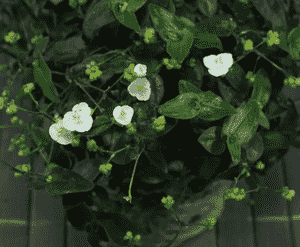
Tahitian bridal veil(Gibasis geniculata)

Tahitian bridal veil (Gibasis geniculata)

Also known as: Tahitia spiderwort, Bridal veil

The Tahitian bridal veil plant (Gibasis geniculata) is a favored ornamental plant, commonly seen in hanging baskets due to its graceful, trailing stems and dainty appearance.

**Key Characteristics:**
- **Flowers**: Small, white, three-petaled blooms that appear from late spring through fall.
- **Foliage**: Dark green, lance-shaped leaves that are small and delicate.
- **Growth Pattern**: Trailing habit, perfect for cascading over the edges of containers.

**Optimal Growing Conditions:**
- **Light**: Prefers bright but indirect sunlight.
- **Temperature**: Ideal range is 60-75°F (15-24°C).
- **Water**: Soil should be kept consistently moist but not overly saturated.
- **Humidity**: Benefits from moderate to high humidity levels.
- **Soil**: Requires a well-draining, light potting mix.

Regular trimming encourages a bushier appearance and promotes healthier growth.

Attributes of Tahitian bridal veil

Lifespan
Perennial
Plant Type
Herb
Plant Height
1 m
Spread
1 m
Leaf Color
Green
Flower Size
Less than 1 cm
Flower Color
White

ForwardPlant - Identify plants with a snap

Identify and diagnose plants, get toxicity alerts, and explore safety guides for all types of fungi.

Try for Free

Images of Tahitian bridal veil

Tahitian bridal veil(Gibasis geniculata)

Quickly Identify Tahitian bridal veil

1
Gibasis geniculata can be identified by its slender, green stems that produce small, white, three-petaled flowers. The leaves are small, ovate, and arranged alternately along the stems. The plant tends to have a trailing habit, making it popular in hanging baskets.

Scientific Classification of Tahitian bridal veil

Phylum
Vascular plants
Class
Monocotyledons
Order
Commelinales
Family
Spiderwort
Genus
Bridalveil
Species
Tahitian bridal veil

Planting and Growing of Tahitian bridal veil

Care Difficulty
Easy
Watering Schedule
Every 3 days
Sunlight Requirements
Partial sun
Sunshine Duration
6-10 hours
Ideal Temperature
65-75℉
Soil Type
Potting Mix, Peat Mix
Soil pH
6.5-7.5
Fertilizer Type
Balanced
Pruning Season
Spring, Summer
Pruning Area
Branches, Leaves
Pruning Frequency
2 times a year
Repotting Season
Spring
Pot Type
Plastic, Terracotta

water icon How to Water Tahitian bridal veil?

Gibasis geniculata prefers its soil to be kept consistently moist but never waterlogged. When watering, ensure the water drains through the pot's drainage holes to prevent standing water, which can lead to root rot.
What are the symptoms of an underwatered Tahitian bridal veil?
What should I do if my Tahitian bridal veil is not getting enough water?
What are the symptoms of an overwatered Tahitian bridal veil?
How to save an overwatered Tahitian bridal veil?

sunlight icon What Are the Sunlight Requirements for Tahitian bridal veil?

Sunlight Requirements: Partial sun, Full shade
Duration of light: 3-6 hours sunlight
Partial sun or full shade is ideal, providing filtered light simulates its natural environment. It ensures lush growth, prevents leaf burning, and maintains vibrant leaf coloration.
What is the ideal lighting condition?
How to achieve ideal lighting?
What benefits does ideal lighting provide?

temperature icon What Is the Ideal Temperature Range for Tahitian bridal veil?

Ideal Temperature: 65 ~ 75℉
Gibasis geniculata thrives best between temperatures of 65°F and 75°F. This range ensures optimal growth and vitality, as the plant can efficiently perform crucial processes like photosynthesis and respiration. Maintaining this temperature range helps to replicate its natural tropical habitat.

soil icon What Soil is Best for Tahitian bridal veil?

Soil type: Loam, Sandy loam
Soil PH: 6.5 ~ 7.5
Gibasis geniculata thrives best in well-drained soils as this prevents root rot and waterlogging. Loam or sandy loam is particularly beneficial, promoting proper aeration and nutrient availability which enhances its growth and vibrant foliage. Rich, nutrient-laden soil is advantageous for Gibasis geniculata as it supports robust growth and lush leaf development. Organic matter such as compost can be mixed with soil to meet its nutrient needs without overwhelming the plant’s roots. The plant requires soil that retains moisture but also allows for adequate drainage. This balance ensures Gibasis geniculata receives the water it needs without the risk of standing water, which can lead to root diseases.

fertilize icon How to Fertilize Tahitian bridal veil?

Fertilizer type: Balanced
For Gibasis geniculata, a balanced fertilizer with an N-P-K ratio of 10-10-10 is ideal. Use about 1/4 teaspoon per gallon of water for liquid fertilizers. This ensures nutrients are available without overwhelming the plant.

prune icon How to Prune Tahitian bridal veil?

Pruning Time: Spring, Summer, Autumn
Carefully examine the plant to locate leggy or overgrown stems. Gibasis geniculata often produces long, thin stems that can be trimmed back to a healthier length. Pruning should occur just above a leaf node, where new growth is most likely to emerge. This encourages bushier growth and prevents the plant from becoming too sparse. Check for any leaves that are yellow, brown, or show disease signs. Remove these leaves to allow the plant to focus its energy on healthy growth. After handling problematic areas, shape the remaining foliage to create an aesthetically pleasing form. This keeps the Gibasis geniculata tidy and promotes a uniform appearance.

propagate icon How to Propagate Tahitian bridal veil plant?

Propagate Time: Spring, Early summer
1
Choose healthy, disease-free stems for cuttings, ideally with several nodes. Using sharp pruning shears, cut just below a node. Aim for cuttings about 4-6 inches long.
2
Remove any lower leaves from the cutting, leaving a few at the top. Dip the cut end in rooting hormone to facilitate quicker root development.
3
Prepare a pot with a well-draining potting mix and insert the cutting at least an inch deep. Ensure the potting mix is moist but not waterlogged.

repot icon How to Repot Tahitian bridal veil plant?

Repotting frequency: Every 2-3 years
1
Keep an eye on your Gibasis geniculata for signals that it needs repotting. When roots begin to grow through the bottom drainage holes or you observe slowed growth despite optimal care, it’s a sign that the plant's current pot is too crowded, signalling a need for repotting.
2
Select a pot that is one size larger than the current pot. Ensure the new pot has ample drainage holes to prevent root rot. The right-sized pot will give your Gibasis geniculata enough room to grow and flourish, reducing the need for frequent repotting and preventing water from accumulating around the roots.
3
Opt for a well-draining loamy soil mix that retains some moisture but doesn't stay soggy. This type of soil helps maintain the perfect balance between moisture retention and aeration, preventing root rot and ensuring your Gibasis geniculata thrives.

ForwardPlant - Identify plants with a snap

Find the best spots for them to optimize their health, simply using your phone.

Try for Free

Toxicity

Ingestion

Identify toxic plants for your safety

Learn which plants are harmful to you and your pets, and make informed choices for a safer home!

Try for Free
WARNING
The judgment on toxicity and danger is for reference only. We DO NOT GUARANTEE any accuracy of such judgment. Therefore, you SHALL NOT rely on such judgment. It is IMPORTANT TO SEEK PROFESSIONAL ADVICE in advance when necessary.

