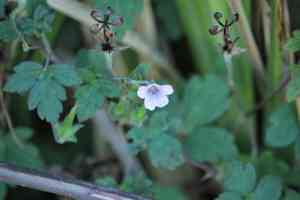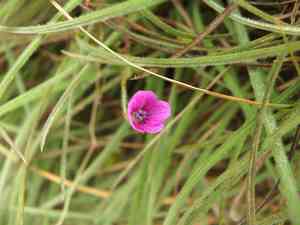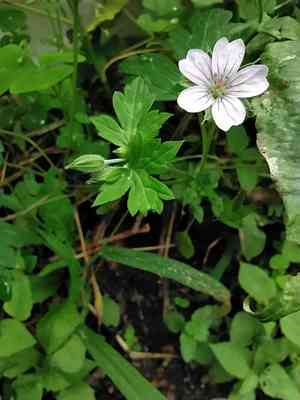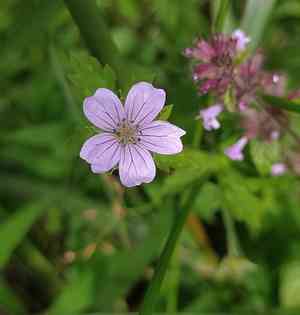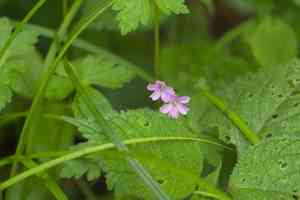
Nepalese cranes bill(Geranium nepalense)

Nepalese cranes bill (Geranium nepalense)

Also known as: Nepal cranesbill

The Nepalese cranesbill (Geranium nepalense) is a charming wildflower known for its pink or purple flowers with dark veins, each having five petals. It thrives in forests and scrubby slopes near the Himalayas and is primarily pollinated by insects.

**Characteristics:**
- Displays deeply lobed, serrated green leaves.
- Adaptable to various soil types and requires minimal maintenance.
- Prefers sunny to partially shaded conditions.
- Blooms from late spring to early autumn.

**Uses:**
- Widely used as an ornamental plant in gardens and landscapes.
- Acts as a ground cover, helping to prevent soil erosion.
- Attracts beneficial pollinators like bees and butterflies.
- Roots are rich in tannins and occasionally used to produce red dyes.

Its aesthetic appeal and versatility make it a favored choice for gardeners and landscapers.

Attributes of Nepalese cranes bill

Lifespan
Perennial
Plant Type
Herb
Plant Height
50 cm
Spread
60 cm
Leaf Color
Green
Flower Size
8 mm to 1.5 cm
Flower Color
White Purple Pink

ForwardPlant - Identify plants with a snap

Identify and diagnose plants, get toxicity alerts, and explore safety guides for all types of fungi.

Try for Free

Images of Nepalese cranes bill

Nepalese cranes bill(Geranium nepalense)

Quickly Identify Nepalese cranes bill

1
To identify Geranium nepalense, look for its deeply lobed leaves and pink to pale purple five-petaled flowers. The stems are hairy, and the plant typically forms a low, sprawling habit.

Scientific Classification of Nepalese cranes bill

Phylum
Vascular plants
Class
Dicotyledons
Order
Geraniales
Family
Geranium
Genus
Geraniums
Species
Nepalese cranes bill

Planting and Growing of Nepalese cranes bill

Care Difficulty
Easy
Watering Schedule
Every 3 days
Sunlight Requirements
Partial sun
Sunshine Duration
4-6 hours
Ideal Temperature
60-75℉
Soil Type
Potting Mix, Peat Mix
Soil pH
6-7.5
Fertilizer Type
Balanced
Pruning Season
Spring, Summer
Pruning Area
Branches, Leaves
Pruning Frequency
2 times a year
Repotting Season
Spring
Pot Type
Plastic, Terracotta

water icon How to Water Nepalese cranes bill?

Geranium nepalense thrives in soil that is kept consistently moist, yet should never be drenched. Water the plant with around 250ml of water, ensuring the soil is moistened evenly but does not become waterlogged, which can harm the roots.
What are the symptoms of an underwatered Nepalese cranes bill?
What should I do if my Nepalese cranes bill is not getting enough water?
What are the symptoms of an overwatered Nepalese cranes bill?
How to save an overwatered Nepalese cranes bill?

sunlight icon What Are the Sunlight Requirements for Nepalese cranes bill?

Sunlight Requirements: Partial sun, Full sun
Duration of light: 5 to 7 hours
Partial to full sun provides Geranium nepalense with sufficient energy for photosynthesis, enhancing growth and bloom. Ideal lighting prevents stress from extremes, promoting a healthy, robust appearance.
How much sunlight does Geranium nepalense need daily?
What are the strategies to ensure adequate sunlight?
Benefits of achieving optimal lighting for Geranium nepalense?

temperature icon What Is the Ideal Temperature Range for Nepalese cranes bill?

Ideal Temperature: 60 ~ 75℉
Geranium nepalense grows optimally in a temperature range between 60°F and 75°F. This range provides the plant with the warmth needed for active growth while avoiding heat stress. Maintaining these temperatures helps facilitate photosynthesis and nutrient uptake efficiently, supporting healthy foliage and blossoms.

soil icon What Soil is Best for Nepalese cranes bill?

Soil type: Loam, Sandy loam
Soil PH: 6 ~ 7.5
Geranium nepalense thrives in well-drained soil to prevent root rot. Ensuring proper drainage keeps the roots healthy and supports vigorous plant growth. This plant prefers soil with consistent, moderate moisture. Keeping the soil evenly moist will help in promoting continuous blooming and healthy foliage. A nutrient-rich soil is beneficial for Geranium nepalense, as it supports lush growth and vibrant flowers. Periodic addition of organic matter like compost can enrich the soil.

fertilize icon How to Fertilize Nepalese cranes bill?

Fertilizer type: Balanced
When fertilizing Geranium nepalense, it's crucial to get the balance right. Use a low-strength liquid fertilizer diluted to half its recommended strength for house plants. This should amount to approximately 1-2 teaspoons per gallon of water, ensuring that you don't overwhelm the plant with nutrients.

prune icon How to Prune Nepalese cranes bill?

Pruning Time: Spring, Summer, Autumn
Before you start pruning, take a moment to assess the overall structure of the plant. Identify the parts that need attention—whether they are loose stems, dead blooms, or excess growth. Begin by trimming back any overgrown or straggly stems. Cut just above a node to encourage new branching and bushier growth. This helps in maintaining a compact and aesthetically pleasing shape. Regularly deadhead faded flowers to prolong the blooming period. Gently pinch or cut off the spent blooms where they meet the stem to redirect energy towards new flower production. Clear away any dead or damaged leaves from the plant. This not only improves the plant’s appearance but also helps direct the plant's energy towards healthy growth and minimizes disease risk. During different seasons, adjust your pruning according to the plant's growth pattern. More vigorous cuts may be needed in spring to control fresh growth, while less pruning might be necessary in autumn as growth slows down. More About Pruning Techniques

propagate icon How to Propagate Nepalese cranes bill plant?

Propagate Time: Spring, Early summer, Late autumn
1
Collect seeds from mature plants once they have dried. Sow them in a seed-starting tray with a quality seed starting mix. Keep the tray in a warm location with indirect light, and maintain consistent moisture to aid germination.
2
Choose healthy stems with several leaf nodes to take cuttings. Cut below a node at a 45-degree angle. Remove lower leaves and plant the cutting in a pot filled with a moistened potting mix, keeping it warm and humid to encourage root growth.
3
Gently dig around the plant base and lift it out of the ground. Use a sharp, clean tool to divide the root mass into sections, ensuring each section has a healthy root system. Plant each section at the same depth it was growing previously.

repot icon How to Repot Nepalese cranes bill plant?

Repotting frequency: Every 2-3 years
1
You should consider repotting Geranium nepalense when you notice the roots beginning to circle around the bottom of the pot or protruding from the drainage holes. Another signal might be slowed growth despite optimal care, indicating that the plant might be root-bound or nutrient-depleted.
2
Select a pot that is one size larger than the current one, with ample drainage holes to prevent waterlogging. The benefit of an appropriately sized pot is that it provides enough room for growth without overwhelming the plant with excess soil, which can retain too much moisture.
3
Use a well-draining potting mix that allows for sufficient airflow, like one containing perlite or coarse sand. This balances moisture retention and drainage, crucial for preventing root rot and supporting healthy plant growth.

ForwardPlant - Identify plants with a snap

Find the best spots for them to optimize their health, simply using your phone.

Try for Free