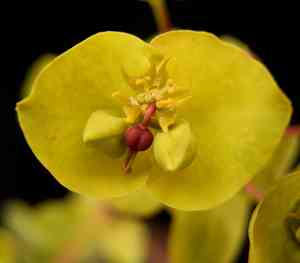
Euphorbia decaryi (Euphorbia decaryi)
Also known as: Madagascar Jewel, Decary's Spurge
Euphorbia decaryi, a spreading evergreen, is indigenous to Madagascar, where it faces growing threats from habitat destruction. This plant, exclusive to Madagascar, typically thrives in dry scrublands or rocky terrains. In late spring, it blooms with small, three-petaled flowers that can be chartreuse, yellow, or red.
In This Article
Attributes of Euphorbia decaryi
Lifespan
Perennial
Plant Type
Succulent
Plant Height
30 cm
Spread
50 cm
Leaf Color
Green with reddish edges
Flower Size
0.2 to 0.4 inches (0.5 to 1 cm)
Flower Color
Pink, Red
Images of Euphorbia decaryi
Quickly Identify Euphorbia decaryi
1
The plant can be identified by its characteristic wavy stems that often form a ground-hugging mat. It has small, leathery leaves that are usually green with a reddish tint around the edges. The small flowers are typically pink or red and grow in clusters.
Scientific Classification of Euphorbia decaryi
Phylum
Vascular plants
Class
Dicotyledons
Order
Malpighiales
Family
Spurge
Genus
Spurges
Species
Euphorbia decaryi
Planting and Growing of Euphorbia decaryi
Care Difficulty
Easy
Watering Schedule
Every 3 days
Sunlight Requirements
Partial sun
Sunshine Duration
10-12 hours
Ideal Temperature
70-80℉
Soil Type
Potting Mix, Peat Mix
Soil pH
6.5-7.5
Fertilizer Type
Balanced
Pruning Season
Spring, Summer
Pruning Area
Branches, Leaves
Pruning Frequency
2 times a year
Repotting Season
Spring
Pot Type
Plastic, Ceramic
 How to Water Euphorbia decaryi?
When watering Euphorbia decaryi, ensure the soil is thoroughly moistened without becoming waterlogged. The ideal is to give about 200 ml of water, enough to soak the root ball but quickly drain through the soil. This reflects its native arid climate, where brief but intense watering occurs.
What are the symptoms of an underwatered Euphorbia decaryi?
›
What should I do if my Euphorbia decaryi is not getting enough water?
›
What are the symptoms of an overwatered Euphorbia decaryi?
›
How to save an overwatered Euphorbia decaryi?
›
 What Are the Sunlight Requirements for Euphorbia decaryi?
Euphorbia decaryi thrives in partial sun conditions. This involves 3 to 5 hours of moderately bright, indirect sunlight daily, which supports healthy growth, prevents overheating, and aids in optimal photosynthesis without potential damage from harsh rays.
What is the best lighting condition for Euphorbia decaryi?
›
How can we achieve this ideal lighting for Euphorbia decaryi?
›
What benefits does ideal lighting provide to Euphorbia decaryi?
›
 What Is the Ideal Temperature Range for Euphorbia decaryi?
The ideal temperature range for Euphorbia decaryi is between 70°F and 80°F. This range supports optimal metabolic functioning and health. It helps maintain the plant's growth rate and ensures that it retains its striking appearance. Keeping the temperature within this range aids in preventing stress from heat or cold, which could lead to adverse effects.
 What Soil is Best for Euphorbia decaryi?
Euphorbia decaryi thrives in well-drained soils that prevent waterlogging, which can lead to root rot. This soil requirement is crucial as Euphorbia decaryi, like many succulents, is susceptible to overwatering. A well-drained soil allows excess moisture to escape, providing a healthier root environment and ensuring the plant's longevity. This plant benefits from a soil medium that is rich in nutrients to support its growth and sustain its unique foliage. An enriched substrate provides the necessary elements for photosynthesis and cellular functions, boosting the plant's growth and resilience against pests and diseases. Euphorbia decaryi prefers a slightly acidic to neutral pH range between 6.5 and 7.5. This pH range optimizes nutrient availability in the soil, ensuring that the plant can absorb essential nutrients efficiently. Proper pH balance aids in healthy growth and prevents nutrient deficiencies.
 How to Fertilize Euphorbia decaryi?
Euphorbia decaryi is a succulent known for its low nutrient requirements. For liquid fertilizers, aim for a diluted mixture at half the recommended strength, applying around one tablespoon of liquid fertilizer per liter of water. For solid fertilizers, a small amount, roughly a teaspoon, of slow-release granular fertilizer is sufficient. Ensure that the fertilizer is suitable for succulents and cacti.
 How to Prune Euphorbia decaryi?
Before starting, identify which parts of the Euphorbia decaryi need attention. Look for any dead, discolored, or damaged branches or leaves. These should be the primary targets for your pruning efforts. When pruning, aim to make precise cuts just above a healthy node or pair of leaves. This encourages new growth in the right direction and maintains the plant’s natural shape. Avoid hacking indiscriminately, as the plant can be sensitive to overly aggressive cutting.
More About Pruning Techniques→
 How to Propagate Euphorbia decaryi plant?
1
Choose a healthy parent plant. Water it a day before you plan to take cuttings or divisions, ensuring the plant is hydrated, which aids in forming roots faster.
2
Use a sharp knife or pruners to take 3–4 inch cuttings or divide a section of the plant with roots. Ensure each section taken has some roots attached for division propagation.
3
Let the cut ends dry for a day to prevent rot, then plant them in well-draining soil. Keep them at a warm temperature to facilitate quicker root development.
 How to Repot Euphorbia decaryi plant?
1
Euphorbia decaryi should be repotted when you notice the roots starting to grow out of the drainage holes, or if the plant seems top-heavy and unstable. Another signal is if water is not draining properly due to compacted soil. It's best to repot during the plant's active growth phase in spring or early summer to minimize stress.
2
Select a pot that is one size larger than the current one. Ensure it has drainage holes to prevent waterlogging, which can lead to root rot. A slightly shallower pot is ideal as it mimics the natural growing conditions of the Euphorbia decaryi and provides proper aeration which is crucial for healthy root development.
3
Use a well-draining cactus or succulent soil mix that provides adequate aeration. This type of soil prevents water retention, reducing the risk of root rot. Adding some mineral grit or perlite can enhance drainage, ensuring your Euphorbia decaryi thrives in its new home.
Toxicity
Ingestion, Skin Contact
WARNING
The judgment on toxicity and danger is for reference only. We DO NOT GUARANTEE any accuracy of such judgment. Therefore, you SHALL NOT rely on such judgment. It is IMPORTANT TO SEEK PROFESSIONAL ADVICE in advance when necessary.
Learn More About Euphorbia decaryi Diseases
Anthracnose
Bacterial Leaf Spot
Bacterial Soft Rot
Chemical Injury
Crown Gall
Cyst Nematode
Damping-off
Drought Stress
Fusarium Wilt
Gray Mold
Leaf Curl
Leaf Spot
Mosaic
Nutrient Deficiency
Nutrient Toxicity
Powdery Mildew
Root Rot
Root-knot Nematode
Sooty Mold
Spider Mites
Temperature Stress
Thrips Damage
White Mold



