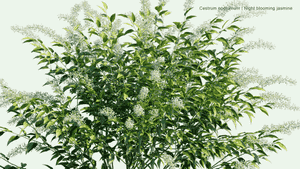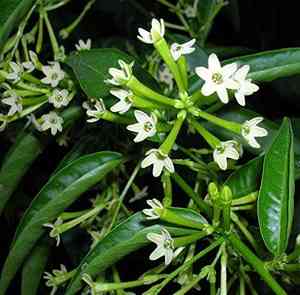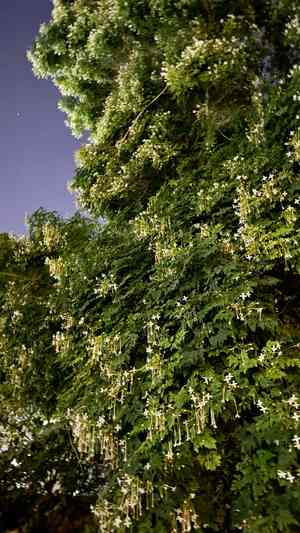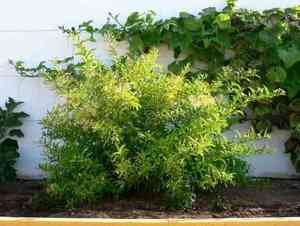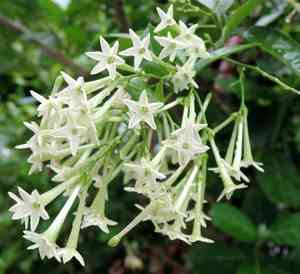
Night-blooming jasmine(Cestrum nocturnum)

Night-blooming jasmine (Cestrum nocturnum)

Also known as: Lady of the night, Night-blooming cestrum, Night-scented jessamine

Night-blooming jasmine typically blooms from summer to fall, producing tubular white flowers that emit a strong, distinctive fragrance. True to its name, the flowers open in the evening and stay open through the night, closing during the day. When in bloom, their scent can spread over a considerable distance, often between 91 to 152 meters.

Attributes of Night-blooming jasmine

Lifespan
Perennial
Plant Type
Shrub
Plant Height
2 m to 3 m
Spread
1.2 m to 1.8 m
Leaf Color
Green
Flower Size
1 cm to 1.3 cm
Flower Color
Green White Yellow

ForwardPlant - Identify plants with a snap

Identify and diagnose plants, get toxicity alerts, and explore safety guides for all types of fungi.

Try for Free

Images of Night-blooming jasmine

Night-blooming jasmine(Cestrum nocturnum)

Quickly Identify Night-blooming jasmine

1
To identify Cestrum nocturnum, look for its tubular flowers that emit a strong, sweet fragrance at night. The plant has glossy, lance-shaped leaves and can grow as a shrub or vine.

Scientific Classification of Night-blooming jasmine

Phylum
Vascular plants
Class
Dicotyledons
Order
Nightshades, bindweeds, gooseweeds, and allies
Family
Nightshade
Genus
Cestrums
Species
Night-blooming jasmine

Planting and Growing of Night-blooming jasmine

Care Difficulty
Easy
Watering Schedule
Every 2 days
Sunlight Requirements
Partial sun
Sunshine Duration
6-8 hours
Ideal Temperature
65-85℉
Soil Type
Potting Mix, Peat Mix
Soil pH
6.5-7.5
Fertilizer Type
Balanced
Pruning Season
Spring, Summer
Pruning Area
Branches, Leaves
Pruning Frequency
2 times a year
Repotting Season
Spring
Pot Type
Plastic, Ceramic

water icon How to Water Night-blooming jasmine?

For Cestrum nocturnum, the watering amount should be just enough to ensure the soil remains evenly moist. Use approximately 250 milliliters of water, ensuring it saturates the soil without causing waterlogging. The key principle is to allow the top inch of soil to dry before watering again.
What are the symptoms of an underwatered Night-blooming jasmine?
What should I do if my Night-blooming jasmine is not getting enough water?
What are the symptoms of an overwatered Night-blooming jasmine?
How to save an overwatered Night-blooming jasmine?
More About Watering Techniques

sunlight icon What Are the Sunlight Requirements for Night-blooming jasmine?

Sunlight Requirements: Partial sun, Full sun
Duration of light: 4 to 6 hours
Cestrum nocturnum thrives in partial to full sun. It prefers morning sun and afternoon shade, promoting vibrant blooms and healthy growth cycles.
How to provide optimal light?
What solutions offer the best results?
Why balance light exposure?
More About Sunlight Requirements Techniques

temperature icon What Is the Ideal Temperature Range for Night-blooming jasmine?

Ideal Temperature: 65 ~ 85℉
The ideal temperature range for Cestrum nocturnum, commonly known as night-blooming jasmine, is between 65°F to 85°F. This range allows the plant to thrive and produce its aromatic blossoms efficiently. Maintaining this temperature ensures optimal metabolic processes, leading to better growth, health, and flowering potential. During these temperatures, the plant's biological processes such as photosynthesis and respiration are most effective, enabling robust foliage development and increased flower production.

soil icon What Soil is Best for Night-blooming jasmine?

Soil type: Loam, Acidic soil
Soil PH: 6.5 ~ 7.5
Cestrum nocturnum thrives in well-drained soil to prevent root rot. Ensuring efficient drainage allows air to reach the roots, providing essential oxygen, and can help the plant maintain its vigorous growth and lush foliage. Providing nutrient-rich soil can significantly boost the growth and flowering of Cestrum nocturnum. Incorporating organic matter, like compost, enhances both the nutrient content and texture of the soil, aiding in robust plant health and abundant blooms. Although Cestrum nocturnum can endure short periods of drought, consistent moderate moisture is vital for optimal growth. This balance helps sustain its lush leaves and supports the night-blooming fragrance it is famous for. More About Soil

fertilize icon How to Fertilize Night-blooming jasmine?

Fertilizer type: Balanced
Cestrum nocturnum, commonly known as night-blooming jasmine, benefits from moderate fertilization. A balanced 10-10-10 liquid fertilizer should be applied at half the recommended strength. Use approximately 1 tablespoon per gallon of water to avoid over-fertilization, ensuring that the nutrients are sufficient without overwhelming the plant. More About Fertilizing Techniques

prune icon How to Prune Night-blooming jasmine?

Pruning Time: Spring, Summer, Autumn, Winter
Examine the plant for any branches that appear dead, diseased, or damaged. Such branches often have a different texture or color compared to healthy wood. Carefully remove these branches at their base to prevent the spread of any issues throughout the plant. Cestrum nocturnum benefits from being shaped as it encourages more blooms. Trim back excessive growth to maintain an even, bushy shape. Clip just above leaf nodes to encourage branching and more vigorous flowering. After completing your pruning session, water the plant deeply to reduce stress and promote recovery. Consider applying a balanced fertilizer to support new growth, especially if your pruning session was intensive. More About Pruning Techniques

propagate icon How to Propagate Night-blooming jasmine plant?

Propagate Time: Spring, Early summer
1
Select healthy stems and make cuts at a 45-degree angle. Ensure that each cutting is 4-6 inches long and has at least two leaf nodes for successful rooting.
2
Use a well-draining potting mix, ideally composed of peat and perlite, to ensure adequate moisture retention and aeration for root development.
3
Insert the cuttings into the soil, ensuring that the leaf nodes are slightly covered. Space them evenly to prevent overcrowding and enhance root expansion.
More About Propagating Techniques

repot icon How to Repot Night-blooming jasmine plant?

Repotting frequency: Once every 2 years
1
Cestrum nocturnum should be repotted when you notice the roots coming out of the drainage holes, or if the plant appears root-bound with stunted growth. Repotting in early spring or summer helps minimize stress.
2
Select a pot that is one to two sizes larger than the current one. It should provide enough room for growth while preventing excessive soil moisture retention. Ensure it has adequate drainage holes to prevent waterlogging and root rot.
3
Opt for a well-draining potting mix enriched with organic matter to promote healthy root growth. A balanced mix of peat moss, perlite, and pine bark chips can provide the perfect environment for your Night Blooming Jasmine.
More About Repotting Techniques

ForwardPlant - Identify plants with a snap

Find the best spots for them to optimize their health, simply using your phone.

Try for Free

Toxicity of Night-blooming jasmine

Is Night-blooming jasmine toxic to humans?

Night-blooming jasmine is a poisonous plant that poses risks to humans when consumed. The symptoms can vary from mild to moderate severity. Every part of the night-blooming jasmine is toxic, and even the fragrance emitted by the plant can trigger adverse reactions. Ingesting the plant can lead to gastritis, elevated body temperature, increased heart rate, and excessive saliva production; on the other hand, inhaling the plant's scent may cause nausea, dizziness, respiratory difficulties, and headaches. Due to its rapid spread, this plant often thrives near densely populated areas, making it readily accessible to individuals who may inadvertently consume its toxic parts.

Is Night-blooming jasmine toxic to cat?

The night-blooming jasmine presents a moderate toxic threat to felines. This risk arises when cats consume any part of the plant, as all its components are toxic. After ingestion, cats may display a range of symptoms indicating physical distress due to poisoning. Should this occur, it is imperative to obtain prompt veterinary assistance to alleviate the effects and safeguard the well-being of the affected cat.

Is Night-blooming jasmine toxic to dog?

Night-blooming jasmine presents a moderate threat of toxicity to dogs. Any part of this plant is toxic and can lead to poisoning if ingested by canines. Symptoms of poisoning may include gastrointestinal distress, vomiting, diarrhea, lethargy, and in severe instances, seizures or respiratory complications. It is essential for dog owners to keep a vigilant eye on their pets and restrict their access to night-blooming jasmine. If a dog consumes any portion of this plant, seeking immediate veterinary attention is vital for effective management of the poisoning.

Identify toxic plants for your safety

Learn which plants are harmful to you and your pets, and make informed choices for a safer home!

Try for Free
WARNING
The judgment on toxicity and danger is for reference only. We DO NOT GUARANTEE any accuracy of such judgment. Therefore, you SHALL NOT rely on such judgment. It is IMPORTANT TO SEEK PROFESSIONAL ADVICE in advance when necessary.
More About Toxic Techniques