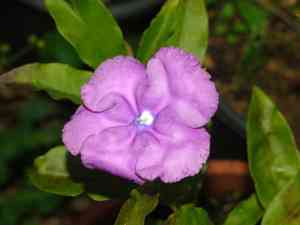
Royal purple brunfelsia (Brunfelsia grandiflora)
Also known as: Yesterday today and tomorrow, Bigflower raintree, Manaka root
This shrub can reach a height of up to 3 meters and spread out to about 2.5 meters in width. It features dense foliage with alternately arranged leaves that can grow up to 30 cm in length. The flowers are fragrant and typically come in white or various shades of purple. Remarkably, these blossoms appear almost throughout the year.
In This Article
Attributes of Royal purple brunfelsia
Lifespan
Perennial
Plant Type
Tree, Shrub
Plant Height
4 m
Spread
3 m
Leaf Color
Green Red
Flower Size
2.5 cm
Flower Color
White Purple Blue Lavender Violet
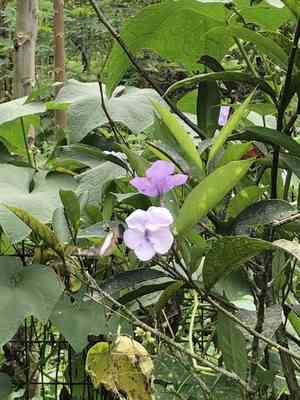
Images of Royal purple brunfelsia
Quickly Identify Royal purple brunfelsia
1
To identify Brunfelsia grandiflora, look for its vibrant flowers that change color from purple to lavender to white within three days. The lance-shaped leaves are glossy and dark green. The flowers have a sweet fragrance, especially in the evening.
Scientific Classification of Royal purple brunfelsia
Phylum
Vascular plants
Class
Dicotyledons
Order
Solanales
Family
Nightshade
Genus
Lady of the night
Species
Royal purple brunfelsia
Planting and Growing of Royal purple brunfelsia
Care Difficulty
Easy
Watering Schedule
Every 4 days
Sunlight Requirements
Partial sun
Sunshine Duration
4-8 hours
Ideal Temperature
65-75℉
Soil Type
Potting Mix, Peat Mix
Soil pH
6.5-7.5
Fertilizer Type
Balanced
Pruning Season
Spring, Summer
Pruning Area
Branches, Leaves
Pruning Frequency
2 times a year
Repotting Season
Spring
Pot Type
Plastic, Ceramic
 How to Water Royal purple brunfelsia?
When watering Brunfelsia grandiflora, ensure the soil is evenly moist, but not waterlogged. Pour approximately 300 milliliters of water, enough to moisten the entire root zone without leaving standing water. Ensure excess water drains out to prevent root rot, aiming for the soil surface to dry slightly between waterings.
What are the symptoms of an underwatered Royal purple brunfelsia?
›
What should I do if my Royal purple brunfelsia is not getting enough water?
›
What are the symptoms of an overwatered Royal purple brunfelsia?
›
How to save an overwatered Royal purple brunfelsia?
›
 What Are the Sunlight Requirements for Royal purple brunfelsia?
Brunfelsia grandiflora flourishes in partial to full sun settings, receiving dappled light throughout the day. Ideal light boosts flowering and maintains vibrant foliage.
More About Sunlight Requirements Techniques→
What is the ideal light for Brunfelsia grandiflora?
›
How can I ensure my plant receives appropriate light?
›
Why is specific light important for this plant?
›
 What Is the Ideal Temperature Range for Royal purple brunfelsia?
The ideal temperature range for Brunfelsia grandiflora plants is between 65°F and 75°F. These temperatures support optimal growth and flowering by mimicking the plant's native tropical conditions.
 What Soil is Best for Royal purple brunfelsia?
Brunfelsia grandiflora prefers well-drained soils to prevent root rot. Good drainage ensures healthy root development and prevents the accumulation of excess water, allowing the plant to access necessary nutrients efficiently. The plant thrives in soil enriched with organic matter, which provides essential nutrients for vigorous growth. Organic materials like compost improve soil structure and fertility, promoting healthier blooms and lush foliage. Maintaining moderate moisture levels is crucial for the plant. It ensures that the plant receives enough water to sustain growth without causing waterlogged conditions that might lead to root decay.
 How to Fertilize Royal purple brunfelsia?
For Brunfelsia grandiflora, use a balanced fertilizer at half the recommended strength. When applying liquid fertilizers, about 1 tablespoon diluted in a gallon of water is often sufficient for each application. Be mindful to not over-fertilize, especially in containers.
 How to Prune Royal purple brunfelsia?
Begin by examining the Brunfelsia grandiflora for any dead, diseased, or damaged branches. These should be removed first to prevent the spread of disease and encourage healthy growth. Trim back long or wayward stems to shape the plant as desired. Aim for a balanced look by cutting just above a node or outward-facing bud. This encourages new growth and helps develop a fuller plant. Pinch back the tips of new branches to encourage bushier growth. This involves removing the tip of a stem just above a node to stimulate the plant to produce more lateral branches.
More About Pruning Techniques→
 How to Propagate Royal purple brunfelsia plant?
1
Collect seeds from mature Brunfelsia grandiflora plants. Clean the seeds by removing any pulp or outer coverings. Prepare seed trays with a well-draining seed-starting mix and sow the seeds at a shallow depth. Keep the soil moist but not waterlogged.
2
Select healthy, non-flowering stems about 4-6 inches in length for cuttings. Make a clean cut below a node using sanitized pruning shears. Remove the lower leaves and dip the cut end in rooting hormone before placing it in a pot filled with a well-draining soil mixture.
3
Choose a healthy low branch of the Brunfelsia grandiflora plant. Bend it down to the ground and cover a mid-section with soil, leaving the tip exposed. Secure it with a pin or small rock. Water regularly and wait for roots to develop before severing it from the parent plant.
 How to Repot Royal purple brunfelsia plant?
1
Brunfelsia grandiflora typically needs repotting when you notice its roots beginning to circle the pot or protrude from drainage holes. Additionally, if the plant's growth seems stunted or the soil is compacted and drains poorly, it's time to consider repotting.
2
Select a pot only a few inches larger in diameter than the current one, with adequate drainage holes. A slightly larger pot provides room for root growth without overwhelming the plant, ensuring it can still draw moisture properly without risk of root rot.
3
Opt for a rich, well-draining potting mix containing organic matter like peat moss or coco coir, and perlite. This soil composition aids in retaining enough moisture without becoming waterlogged, providing the plant with essential nutrients for vibrant growth.
Toxicity
ingestion
WARNING
The judgment on toxicity and danger is for reference only. We DO NOT GUARANTEE any accuracy of such judgment. Therefore, you SHALL NOT rely on such judgment. It is IMPORTANT TO SEEK PROFESSIONAL ADVICE in advance when necessary.
Learn More About Royal purple brunfelsia Diseases
Anthracnose
Bacterial Leaf Spot
Bacterial Soft Rot
Bacterial Wilt
Black Spot
Chemical Injury
Crown Gall
Cyst Nematode
Damping-off
Drought Stress
Fusarium Wilt
Gray Mold
Leaf Curl
Leaf Spot
Mosaic
Nutrient Deficiency
Nutrient Toxicity
Powdery Mildew
Root Rot
Root-knot Nematode
Rusts
Sooty Mold
Spider Mites
Temperature Stress
Thrips Damage
White Mold



