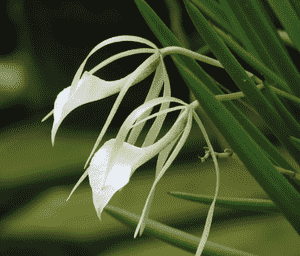
Lady of the night orchid(Brassavola nodosa)

Lady of the night orchid (Brassavola nodosa)

Also known as: Lady of the Night, Dama de Noche

The plant features stems and pseudobulbs. The pseudobulb is elongated and cylindrical, measuring between 3 and 15 cm in length. It supports a single leaf at its tip, which is needle-like and linear, ranging from 15 to 30 cm long but only 2 to 3 cm wide. The leaf is thick, hard, and has a grooved surface. Flowering occurs in the fall, with 1 to 6 flowers emerging from a flower stem approximately 20 cm from the pseudobulb's tip. Each flower is about 8 cm across. The sepals and petals are linear, tapering, gently curved, and yellowish-green. The lip is white, wraps around the column, expands into a heart shape, and has a slightly pointed tip. The flowers emit a fragrance, particularly noticeable at night.

Attributes of Lady of the night orchid

Lifespan
Perennial
Plant Type
Herb
Plant Height
50 cm
Spread
50 cm
Leaf Color
Green
Flower Size
10 cm to 13 cm
Flower Color
White Green Cream

ForwardPlant - Identify plants with a snap

Identify and diagnose plants, get toxicity alerts, and explore safety guides for all types of fungi.

Try for Free

Images of Lady of the night orchid

Lady of the night orchid(Brassavola nodosa)

Quickly Identify Lady of the night orchid

1
Brassavola nodosa can be identified by its narrow, cylindrical leaves and white, star-shaped flowers with a distinctively large lip that often has a hint of green or yellow. The fragrance is most potent at night.

Scientific Classification of Lady of the night orchid

Phylum
Vascular plants
Class
Monocotyledons
Order
Asparagales
Family
Orchid
Genus
Brassavola
Species
Lady of the night orchid

Planting and Growing of Lady of the night orchid

Care Difficulty
Easy
Watering Schedule
Every 2 days
Sunlight Requirements
Partial sun
Sunshine Duration
6-10 hours
Ideal Temperature
65-75℉
Soil Type
Potting Mix, Peat Mix
Soil pH
6.5-7.5
Fertilizer Type
Balanced
Pruning Season
Spring, Summer
Pruning Area
Branches, Leaves
Pruning Frequency
2 times a year
Repotting Season
Spring
Pot Type
Plastic, Ceramic

water icon How to Water Lady of the night orchid?

For Brassavola nodosa, ensure thorough watering until water drains from the bottom of the pot. This indicates that the roots have adequate moisture without becoming waterlogged, following the principle of deep soaking to promote healthy root growth.
What are the symptoms of an underwatered Lady of the night orchid?
What should I do if my Lady of the night orchid is not getting enough water?
What are the symptoms of an overwatered Lady of the night orchid?
How to save an overwatered Lady of the night orchid?

sunlight icon What Are the Sunlight Requirements for Lady of the night orchid?

Sunlight Requirements: Partial sun
Duration of light: 4-6 hours of sunlight
Partial sun is best, ideally about 4-6 hours of bright, filtered sunlight daily. Proper lighting supports bountiful blooming and overall energetic growth, reflecting the plant's natural preference for a balanced light environment.
What is the ideal light setting for Brassavola nodosa?
How can one adapt the environment to provide ideal lighting?
What are the benefits of providing ideal light conditions?
More About Sunlight Requirements Techniques

temperature icon What Is the Ideal Temperature Range for Lady of the night orchid?

Ideal Temperature: 65 ~ 75℉
The ideal temperature range for Brassavola nodosa is between 65°F to 75°F. This range provides optimal conditions for growth and flowering. Maintaining this range helps in preventing stress and ensuring that the plant receives an environment akin to its natural habitat.

soil icon What Soil is Best for Lady of the night orchid?

Soil type: Sandy soil, Loam, Sandy loam
Soil PH: 6.5 ~ 7.5
Brassavola nodosa thrives in well-draining soil. This ensures that excess water is efficiently drained, reducing the risk of root rot and promoting healthy root growth. The plant prefers a nutrient-rich medium to support its growth and flowering. Adequate nutrients in the soil enhance its vigor and bloom abundance, benefiting the overall health of the orchid. Aerated soil allows for proper gas exchange needed by the roots of Brassavola nodosa. This prevents soil compaction and ensures roots receive adequate oxygen, which is vital for orchid health.

fertilize icon How to Fertilize Lady of the night orchid?

Fertilizer type: Balanced
For Brassavola nodosa, the amount of fertilizer should be moderate. During the growing season, apply a weak solution, typically a quarter to a half of the recommended strength on the fertilizer packaging. This ensures the plant receives nutrients without the risk of over-fertilization.

prune icon How to Prune Lady of the night orchid?

Pruning Time: Spring, Summer
Start by identifying any dead or damaged parts of the plant. Look for yellowing leaves or blackened pseudobulbs, which should be removed during pruning to promote healthier growth. For optimal results, make cuts at the base of the plant where the dead growth meets healthy tissue. Use a clean, sharp tool to ensure a clean cut that will heal quickly, minimizing the risk of infection. After pruning, keep an eye on the plant for new growth. This helps ensure that the plant is recovering well, and allows adjustments to care routines if needed to support its health. More About Pruning Techniques

propagate icon How to Propagate Lady of the night orchid plant?

Propagate Time: Spring, Early summer
1
Carefully remove the Brassavola nodosa from its pot and gently separate the pseudobulbs with roots attached. Ensure each section has a healthy root system before planting them into pots with suitable orchid medium.
2
Obtain an explant from a healthy Brassavola nodosa and sterilize it. Place the sterilized explant onto a nutrient-rich agar medium under sterile conditions. Monitor it for contamination and initial growth.
3
Prepare the new pots with orchid bark substrate. Gently place the divided sections in the pots, ensuring the roots have good contact with the substrate. Water lightly and provide adequate humidity.
More About Propagating Techniques

repot icon How to Repot Lady of the night orchid plant?

Repotting frequency: Every two to three years
1
Repot Brassavola nodosa when you notice roots growing out of the pot's drainage holes or when the potting medium starts to break down. Additionally, if you observe reduced growth or yellowing of leaves, it's time to consider repotting. The best time to repot is during active growth phases like spring and summer, ensuring minimal disturbance to the plant.
2
Select a pot that is just slightly larger than the current one, allowing room for the roots to grow. Ensure it has good drainage holes to prevent waterlogging, which can lead to root rot. A transparent pot can help monitor root health and moisture levels, providing a healthier environment for your Brassavola nodosa.
3
Opt for an orchid bark mix, which provides excellent aeration and drainage essential for epiphytic orchids like Brassavola nodosa. This medium mimics their natural habitat by allowing roots to breathe and preventing water retention, which can cause root rot and other issues.

ForwardPlant - Identify plants with a snap

Find the best spots for them to optimize their health, simply using your phone.

Try for Free

