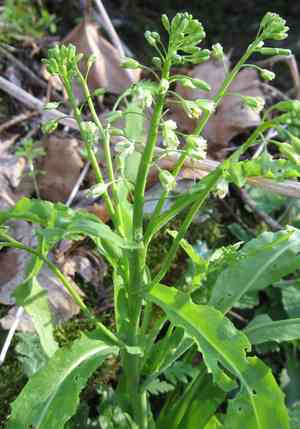
Smooth rockcress (Boechera laevigata)
Also known as: Smooth Rockcress
Smooth rockcress (Boechera laevigata), belonging to the mustard family, grows predominantly in the eastern United States. It favors habitats such as rocky woodlands, cliffs, and ledges. Bees and flies are attracted to its nectar and pollen, and various insects feed on its leaves. Notably, it serves as a host plant for the rare Olympia Marble butterfly.
In This Article
Attributes of Smooth rockcress
Lifespan
Biennial
Plant Type
Herb
Plant Height
30 cm to 91 cm
Spread
15 cm
Leaf Color
Green
Flower Size
4 mm
Flower Color
White Green
Images of Smooth rockcress
Quickly Identify Smooth rockcress
1
To identify Boechera laevigata, look for its smooth, slender stems and the basal rosette of leaves. The leaves are lanceolate to oblanceolate and have a smooth margin. Its small, white to lavender flowers bloom in clusters at the stem tips.
Scientific Classification of Smooth rockcress
Phylum
Vascular plants
Class
Dicotyledons
Order
Brassicales
Family
Cruciferae
Genus
rockcress
Species
Smooth rockcress
Planting and Growing of Smooth rockcress
Care Difficulty
Easy
Watering Schedule
Every 3 days
Sunlight Requirements
Partial sun
Sunshine Duration
4-8 hours
Ideal Temperature
60-75℉
Soil Type
Potting Mix, Peat Mix
Soil pH
6.5-7.5
Fertilizer Type
Balanced
Pruning Season
Spring, Summer
Pruning Area
Branches, Leaves
Pruning Frequency
2 times a year
Repotting Season
Spring
Pot Type
Plastic, Ceramic
 How to Water Smooth rockcress?
Boechera laevigata requires careful watering where the soil should be saturated but not waterlogged. It's essential to let the top 1-2 inches of soil dry out between waterings to prevent root rot. As a rule of thumb, about 250 ml per watering should suffice, ensuring the container's drainage is effective.
What are the symptoms of an underwatered Smooth rockcress?
›
What should I do if my Smooth rockcress is not getting enough water?
›
What are the symptoms of an overwatered Smooth rockcress?
›
How to save an overwatered Smooth rockcress?
›
 What Are the Sunlight Requirements for Smooth rockcress?
Partial sun. Allowing Boechera laevigata to receive this light range helps in maintaining its health, supports steady flowering, and ensures a robust vegetative state.
More About Sunlight Requirements Techniques→
Question: How much sunlight does Boechera laevigata need daily?
›
Question: Can Boechera laevigata tolerate full sun exposure?
›
Question: Why is partial shade crucial for Boechera laevigata?
›
 What Is the Ideal Temperature Range for Smooth rockcress?
Boechera laevigata thrives best in a temperature range of 60°F to 75°F. This range provides optimal conditions for growth and development, ensuring the plant can photosynthesize efficiently and maintain respiratory processes. Temperatures within this range also support healthy flowering and seed production.
 What Soil is Best for Smooth rockcress?
Boechera laevigata thrives in well-drained soil that prevents water accumulation around the roots, which can cause root rot. This condition is particularly beneficial because it helps maintain the plant's health and encourages robust growth. The plant prefers soil with moderate nutrient levels. Excess nutrients can lead to overgrowth, reducing the plant's strength. Ensuring balanced soil nutrients supports its flowering and resilience against environmental stress. Keeping the soil pH between 6.5 and 7.5 is crucial for optimal nutrient uptake. This pH range maximizes nutrient availability, contributing to healthy foliage and flowering, which makes the plant more vibrant and vigorous.
 How to Fertilize Smooth rockcress?
Boechera laevigata usually requires a balanced nutrient supply. Use a liquid fertilizer with a ratio of 10-10-10; apply about 1 tablespoon per gallon of water during the growing season for optimal results.
 How to Prune Smooth rockcress?
Look for older, woodier stems that no longer produce fresh leaves or flowers. Use clean, sharp pruning shears to cut them back to the base of the plant. This helps redirect the plant's energy towards newer, more productive growth. Trim back branches that disrupt the natural shape of Boechera laevigata. By maintaining a pleasing and balanced form, you allow sunlight to reach all parts of the plant evenly, promoting healthier growth.
More About Pruning Techniques→
 How to Propagate Smooth rockcress plant?
1
Fill the seed trays with sterile potting mix, leaving about a quarter-inch from the top. Lightly water the soil to ensure it's evenly moist, which is crucial for germination.
2
Scatter the Boechera laevigata seeds evenly on the surface of the moistened potting mix. Cover the seeds with a thin layer of soil, approximately twice the size of the seed, to protect them.
3
Place the seed trays in a location that receives indirect sunlight. Maintain a temperature range between 65-75°F (18-24°C) to facilitate successful germination.
 How to Repot Smooth rockcress plant?
1
Observe for roots growing out of the drainage holes or a noticeable decline in plant health. These signs indicate that Boechera laevigata needs more space for root expansion and better nutrient availability.
2
Opt for a pot 1-2 inches larger in diameter than the current one with ample drainage holes. This size ensures the plant has room to grow without overwhelming it with excessive soil, which could lead to water retention and root rot.
3
Choose a sandy loam mix that drains well yet retains enough moisture to support healthy root function. This type of soil provides a balance of nutrients and water retention, promoting strong and vigorous plant growth.
Learn More About Smooth rockcress Diseases
Anthracnose
Bacterial Leaf Spot
Bacterial Soft Rot
Clubroot
Crown Gall
Cyst Nematode
Damping-off
Downy Mildew
Fusarium Wilt
Gray Mold
Leaf Spot
Mosaic
Nutrient Deficiency
Nutrient Toxicity
Powdery Mildew
Root Rot
Root-knot Nematode
Rusts
Sooty Mold
White Mold
Chemical Injury
Drought Stress
Spider Mites
Temperature Stress
Thrips Damage



