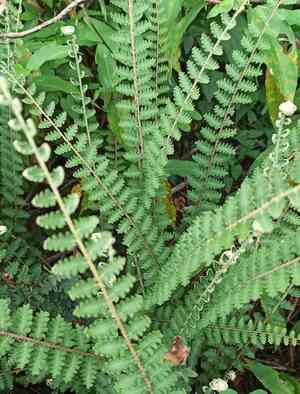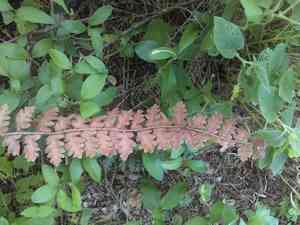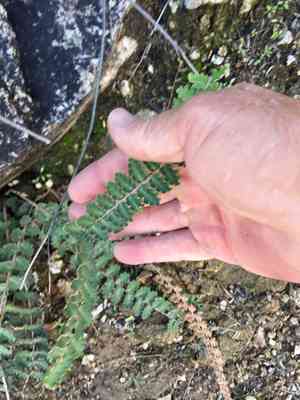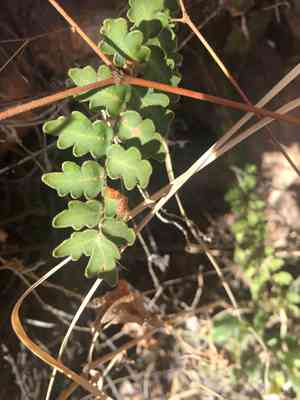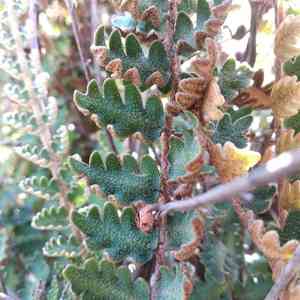
Wavy scaly cloakfern(Astrolepis sinuata)

Wavy scaly cloakfern (Astrolepis sinuata)

Also known as: Wavy scale cloakfern, Prairiesumac

The wavy scaly cloakfern (Astrolepis sinuata) is well-suited to arid desert environments, often taking root beneath the branches of evergreen shrubs and in rocky crevices. It thrives in well-drained soils and requires good airflow to prevent prolonged moisture exposure.

Key adaptations include:
1. **Scaly, fuzzy leaf undersides**: These scales help minimize water loss and can change color from white to cinnamon throughout the season, reflecting sunlight and reducing transpiration.
2. **Well-drained habitat preference**: The fern avoids prolonged soaking by growing in rocky areas that facilitate quick drainage.
3. **Sheltered growth sites**: By growing under shrub branches, the fern benefits from shade and reduced water loss due to lower wind exposure.

These adaptations ensure the wavy scaly cloakfern can survive and thrive in the challenging conditions of desert landscapes.

Attributes of Wavy scaly cloakfern

Lifespan
Perennial
Plant Type
Herb
Plant Height
60 cm
Spread
45 cm
Leaf Color
Green Gray
Flower Size
N/A (ferns do not produce flowers)
Flower Color
N/A (ferns do not produce flowers)

ForwardPlant - Identify plants with a snap

Identify and diagnose plants, get toxicity alerts, and explore safety guides for all types of fungi.

Try for Free

Images of Wavy scaly cloakfern

Wavy scaly cloakfern(Astrolepis sinuata)

Quickly Identify Wavy scaly cloakfern

1
To identify Astrolepis sinuata, look for its characteristic wavy, lance-shaped fronds that are covered with small scales, giving them a somewhat textured appearance. The edges of the fronds are typically undulating.

Scientific Classification of Wavy scaly cloakfern

Phylum
Vascular plants
Class
Ferns
Order
Polypodiales
Family
Brake
Genus
Star-scaled cloak fern
Species
Wavy scaly cloakfern

Planting and Growing of Wavy scaly cloakfern

Care Difficulty
Easy
Watering Schedule
Every 2 days
Sunlight Requirements
Full sun
Sunshine Duration
6-10 hours
Ideal Temperature
65-80℉
Soil Type
Potting Mix, Peat Mix
Soil pH
6.5-7.5
Fertilizer Type
Balanced
Pruning Season
Spring, Summer
Pruning Area
Branches, Leaves
Pruning Frequency
2 times a year
Repotting Season
Spring
Pot Type
Plastic, Ceramic

water icon How to Water Wavy scaly cloakfern?

Astrolepis sinuata prefers its soil to be evenly moist but never waterlogged. Typically, around 120 milliliters per watering should suffice. The key principle is to water deeply, allowing the soil to be moistened to the depth of the root system, without saturating the soil completely. This helps ensure that the water reaches the roots without causing rot.
What are the symptoms of an underwatered Wavy scaly cloakfern?
What should I do if my Wavy scaly cloakfern is not getting enough water?
What are the symptoms of an overwatered Wavy scaly cloakfern?
How to save an overwatered Wavy scaly cloakfern?

sunlight icon What Are the Sunlight Requirements for Wavy scaly cloakfern?

Sunlight Requirements: Full sun, Partial sun
Duration of light: 4 to 6 hours
Astrolepis sinuata thrives best in partial to full sun. It benefits from balanced light exposure, maintaining its vibrant appearance and enhancing its drought and heat resistance.
How much sunlight does Astrolepis sinuata need?
What are the solutions to ensure Astrolepis sinuata gets ideal lighting?
Why is ideal lighting beneficial for Astrolepis sinuata?
More About Sunlight Requirements Techniques

temperature icon What Is the Ideal Temperature Range for Wavy scaly cloakfern?

Ideal Temperature: 65 ~ 80℉
Astrolepis sinuata thrives best in temperatures ranging from 65 to 80°F. This range ensures the plant can carry out its physiological processes efficiently, leading to robust growth and development.

soil icon What Soil is Best for Wavy scaly cloakfern?

Soil type: Loam, Sandy loam, Calcareous soil
Soil PH: 6.5 ~ 7.5
Astrolepis sinuata thrives best in well-drained soils. Proper drainage prevents water from pooling around the roots, thus reducing the risk of root rot and promoting healthy growth. While Astrolepis sinuata is not particularly demanding, a moderately nutrient-rich soil can provide essential minerals that support robust plant growth and vigor. Soil with adequate aeration is ideal, as it allows roots to breathe and facilitates nutrient uptake, ensuring the plant's metabolic processes function efficiently.

fertilize icon How to Fertilize Wavy scaly cloakfern?

Fertilizer type: Balanced
Astrolepis sinuata enjoys a balanced approach when it comes to fertilization. Use a liquid fertilizer with an NPK ratio of 10-10-10, diluted to half strength, ensuring the plant receives approximately 50 ml of the solution per application. This allows the plant to get its essential nutrients without risk of over-fertilization.

prune icon How to Prune Wavy scaly cloakfern?

Pruning Time: Spring, Autumn
Begin by observing the plant for dead or damaged fronds. These should be removed first to maintain overall plant health. Use clean, sharp scissors or pruning shears to make clean cuts close to the base. Avoid cutting healthy fronds as they aid in photosynthesis and overall vigor. Next, inspect the base of the plant and trim away any brown or withered edges to encourage fresh growth. Finally, step back and trim for shape, keeping the plant as symmetrical as possible. This fosters an attractive, balanced appearance. More About Pruning Techniques

propagate icon How to Propagate Wavy scaly cloakfern plant?

Propagate Time: Spring, Early spring
1
First, choose a healthy and mature Astrolepis sinuata for division, as it will have a robust root system. Ensure the plant shows no signs of disease, which could affect the division's success.
2
Gently dig around the plant, loosening the soil to expose the roots. Avoid breaking or tearing the roots, as clean division is important for the plant’s recovery and health post-propagation.
3
With your sharp spade, slice through the root clump into smaller sections, each containing a share of the root system and foliage. This process should be done with care to minimize trauma to the plant.
More About Propagating Techniques

repot icon How to Repot Wavy scaly cloakfern plant?

Repotting frequency: Every 2-3 years
1
Look for signs like roots circling the pot, stunted growth, or poor soil drainage. These are clear indications that it’s time to repot Astrolepis sinuata. Repotting during Spring or Summer ensures that the plant can recover during its active growth phase, making the transition smoother.
2
Select a pot that is about an inch larger in diameter than the current one to allow space for growth without overwhelming the plant. A pot with good drainage holes is crucial to prevent waterlogging, which can lead to root rot, especially given Astrolepis sinuata's preference for well-drained conditions.
3
Opt for a well-drained, sandy soil mix. This type of soil mimics the plant's native environment, facilitating optimal root aeration and preventing moisture retention, which could otherwise lead to root diseases and impair the plant’s health.

ForwardPlant - Identify plants with a snap

Find the best spots for them to optimize their health, simply using your phone.

Try for Free