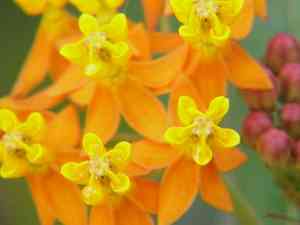
Whitestem milkweed (Asclepias albicans)
Also known as: White-stemmed milkweed
Whitestem milkweed stands out in the arid landscapes where it thrives with its striking waxy-white foliage. This desert perennial, with its stout, branched form, can reach up to two meters in height. It's adorned with small, clustered cream or pale pink flowers throughout the blossoming season, which attract a variety of pollinators. Adapted to hot, dry environments, whitestem milkweed's thick leaves minimize water loss, vital for survival in its native habitat.
In This Article
Attributes of Whitestem milkweed
Lifespan
Perennial
Plant Type
Shrub, Succulent
Plant Height
3 to 6 feet (0.9 to 1.8 meters)
Spread
1 to 2 feet (0.3 to 0.6 meters)
Leaf Color
Gray-green (leaves are often tiny or absent)
Flower Size
About 0.2 to 0.3 inches (5 to 8 mm)
Flower Color
Yellowish to green
Images of Whitestem milkweed

Quickly Identify Whitestem milkweed
1
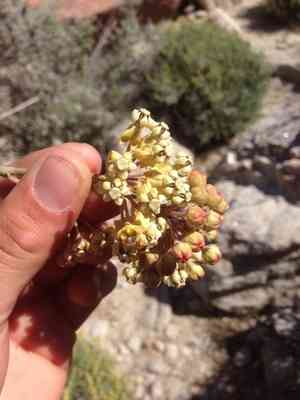
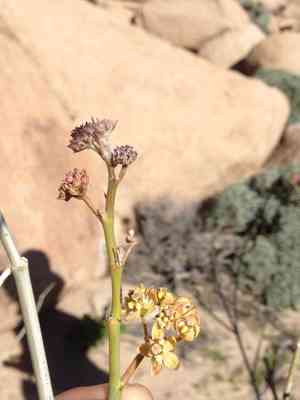
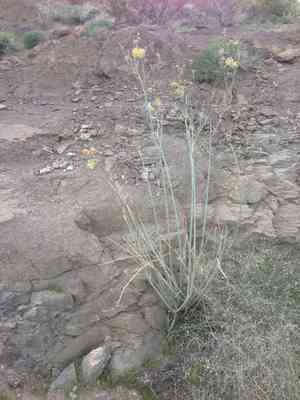
Identification can be done by observing the tall, white, wand-like stems that are often leafless; the plant also produces small yellowish to green flowers in clusters.
Scientific Classification of Whitestem milkweed
Phylum
Vascular plants
Class
Dicotyledons
Order
Gentianales
Family
Dogbane
Genus
Milkweeds
Species
Whitestem milkweed
Planting and Growing of Whitestem milkweed
Care Difficulty
Moderate
Watering Schedule
Every day
Sunlight Requirements
Full sun
Sunshine Duration
4-8 hours
Ideal Temperature
65-85℉
Soil Type
Potting Mix, Peat Mix
Soil pH
6.5-7.5
Fertilizer Type
Balanced
Pruning Season
Spring, Summer
Pruning Area
Branches, Leaves
Pruning Frequency
2 times a year
Repotting Season
Spring
Pot Type
Ceramic, Plastic
 How to Water Whitestem milkweed?
Asclepias albicans, known as the white-stemmed milkweed, requires moderate watering conditions akin to its desert habitat. Water this plant with approximately 250 ml, ensuring that the soil is moist but not saturated, simulating its natural semi-arid settings.
What are the symptoms of an underwatered Whitestem milkweed?
›
What should I do if my Whitestem milkweed is not getting enough water?
›
What are the symptoms of an overwatered Whitestem milkweed?
›
How to save an overwatered Whitestem milkweed?
›
 What Are the Sunlight Requirements for Whitestem milkweed?
Asclepias albicans prefers full sun, ideally 6 to 8 hours daily. Ample sunlight fosters healthy growth, maximizes flowering potential, and strengthens physiological processes, making the plant more resilient.
Optimal Sunlight Hours
›
Seasonal Sunlight Adjustments
›
Sunlight Orientation
›
 What Is the Ideal Temperature Range for Whitestem milkweed?
The ideal temperature range for Asclepias albicans is between 65°F and 85°F. This range facilitates the optimal growth and physiological functions of the plant. At these temperatures, the metabolic processes of Asclepias albicans are most efficient, promoting healthy development and robust flowering. Consequently, keeping the environment within this temperature bracket is critical for maximizing the plant's aesthetic and ecological value.
 What Soil is Best for Whitestem milkweed?
Asclepias albicans thrives in well-drained soils that prevent waterlogging. This drainage capability is crucial, allowing oxygen to permeate the soil, promoting healthy root systems and preventing root rot. This plant can flourish in nutrient-poor soils, making it ideal for areas with less fertile ground. Its ability to withstand low-nutrient conditions allows it to occupy niches where more demanding plants might not survive, ensuring ecological stability. While preferring dry conditions, moderate moisture retention ensures that Asclepias albicans can access necessary hydration sporadically. This tolerance allows it to adapt to varying weather conditions, enhancing its resilience.
 How to Fertilize Whitestem milkweed?
For Asclepias albicans, use a balanced, water-soluble fertilizer with an N-P-K ratio of approximately 10-10-10. When applying liquid fertilizer, dilute it to half-strength to prevent leaf burn. For slow-release granules, use about half a tablespoon per plant, ensuring even distribution around the soil surface.
 How to Prune Whitestem milkweed?
To prune Asclepias albicans effectively, use sharp, clean pruning shears. This ensures quick, clean cuts that minimize plant damage and reduce the risk of disease transmission. Begin by assessing the plant and identify stems that are dead, diseased, or damaged. Use pruning shears to cut these stems back to the base. Aim to shape the plant by cutting selectively for form balance, avoiding excessive foliage removal. After pruning Asclepias albicans, apply a balanced fertilizer to support new growth and monitor soil moisture, ensuring it remains consistently moist but not waterlogged.
More About Pruning Techniques→
 How to Propagate Whitestem milkweed plant?
1
Collect seeds from the pods once they have dried and started to split naturally. Remove fluff around seeds to prepare for sowing. This reduces competition and ensures better contact with soil.
2
Dispense seeds evenly on the surface of a pre-moistened seed mix. Cover lightly with additional soil and lightly water to avoid displacing them, ensuring proper seed-soil contact.
3
Select healthy, non-flowering stems and cut them at an angle. Remove lower leaves before dipping cut ends in rooting hormone to encourage root growth when potted.
 How to Repot Whitestem milkweed plant?
1
Asclepias albicans, commonly known as the milkweed, indicates it's time for repotting when the roots begin circling the pot's edge or growing through drainage holes. If growth seems stunted or the plant is top-heavy, these are telltale signs. Repotting should be done preferably at the start of its active growing season for minimal stress and optimal adaptation.
2
Select a pot that is 1-2 inches larger in diameter than the current one. Ensure it has ample drainage to prevent waterlogging, which is fatal to Asclepias albicans. A terracotta pot is ideal, as it allows the soil to dry out between waterings, preventing root rot and promoting healthy root respiration.
3
Opt for well-draining cactus soil mixed with perlite or sand to enhance drainage for Asclepias albicans. This soil composition mimics its natural habitat, allowing it to thrive by preventing water accumulation around the roots and ensuring the plant receives adequate aeration.
Toxicity
Ingestion, Contact with plant latex
WARNING
The judgment on toxicity and danger is for reference only. We DO NOT GUARANTEE any accuracy of such judgment. Therefore, you SHALL NOT rely on such judgment. It is IMPORTANT TO SEEK PROFESSIONAL ADVICE in advance when necessary.
Learn More About Whitestem milkweed Diseases
Anthracnose
Bacterial Leaf Spot
Bacterial Soft Rot
Bacterial Wilt
Black Spot
Chemical Injury
Crown Gall
Damping-off
Downy Mildew
Drought Stress
Fusarium Wilt
Gray Mold
Leaf Curl
Leaf Spot
Mosaic
Nutrient Deficiency
Nutrient Toxicity
Powdery Mildew
Root Rot
Root-knot Nematode
Rusts
Sooty Mold
Spider Mites
Temperature Stress
Thrips Damage
White Mold



