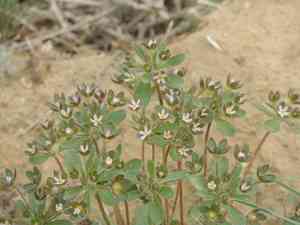
Large rock jasmine (Androsace maxima)
Also known as: Annual androsace
The small-flowered sand-verbena (Tripterocalyx micranthus) is a low-growing plant known for its five-petaled green flowers. Spotting this plant in the wild is a rare event, as it is listed as critically endangered by the International Union for Conservation of Nature (IUCN).
In This Article
Attributes of Large rock jasmine
Lifespan
Annual
Plant Type
Herb
Plant Height
15 cm
Spread
Varies, generally forms a small rosette
Leaf Color
Green
Flower Size
5 mm
Flower Color
White Pink
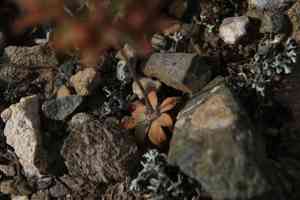
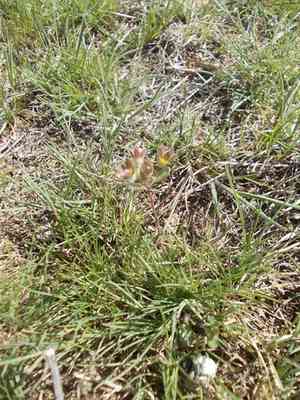
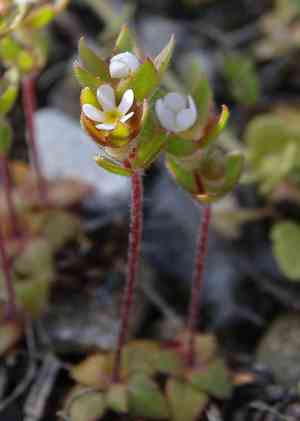
Images of Large rock jasmine
Quickly Identify Large rock jasmine
1
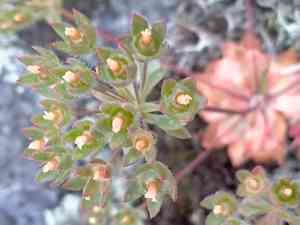
Look for a rosette of rounded, slightly hairy basal leaves. The plant produces a central stalk with clusters of small, white to pinkish flowers. The petals are often notched at the tips.
Scientific Classification of Large rock jasmine
Phylum
Vascular plants
Class
Dicotyledons
Order
Ericales
Family
Primrose
Genus
Rock jasmines
Species
Large rock jasmine
Planting and Growing of Large rock jasmine
Care Difficulty
Hard
Watering Schedule
Every 2 days
Sunlight Requirements
Partial sun
Sunshine Duration
4-8 hours
Ideal Temperature
59-68℉
Soil Type
Potting Mix, Peat Mix
Soil pH
6-7.5
Fertilizer Type
Balanced
Pruning Season
Spring, Summer
Pruning Area
Branches, Leaves
Pruning Frequency
2 times a year
Repotting Season
Spring
Pot Type
Plastic, Ceramic
 How to Water Large rock jasmine?
Androsace maxima requires moderate watering. The soil should be kept slightly moist but not waterlogged. Watering is best done until the soil is uniformly moist. Avoid overwatering by ensuring excess water can drain away.
What are the symptoms of an underwatered Large rock jasmine?
›
What should I do if my Large rock jasmine is not getting enough water?
›
What are the symptoms of an overwatered Large rock jasmine?
›
How to save an overwatered Large rock jasmine?
›
 What Are the Sunlight Requirements for Large rock jasmine?
Partial sun; ensures that Androsace maxima captures sufficient energy for growth and blooming while avoiding the detrimental effects of harsh, direct sun.
What is the ideal light condition for Androsace maxima?
›
How can you achieve the ideal light for Androsace maxima?
›
Benefits of providing ideal light for Androsace maxima
›
 What Is the Ideal Temperature Range for Large rock jasmine?
Androsace maxima thrives best in a temperature range of 59°F to 68°F. This range ensures optimal growth and reproduction by maintaining a consistent environment that neither stresses the plant nor triggers dormancy. Aim to keep your indoor settings or greenhouse within this range to support the plant's natural metabolic processes.
 What Soil is Best for Large rock jasmine?
Androsace maxima thrives in well-draining soils which prevent water from stagnating around the roots, thus avoiding root rot and promoting healthy growth. This plant prefers moderately fertile soils, as too much fertility can cause excessive foliage at the expense of blossom production. Androsace maxima requires soil with low salinity levels to ensure that nutrient absorption is effective, as high salinity can prevent the intake of essential elements.
 How to Fertilize Large rock jasmine?
For Androsace maxima, it's critical to apply a balanced fertilizer at the right intensity. Use about half the recommended dose for general houseplants, as over-fertilization can easily occur. Typically, for liquid fertilizers, this means about 1/4 teaspoon per gallon of water, depending on the product's concentration.
 How to Prune Large rock jasmine?
Begin by examining your Androsace maxima for any dead or diseased foliage. Remove these first to prevent any spread of disease and to maintain plant health. Locate the growth nodes along the stems, which are crucial as cutting just above these nodes will stimulate new shoots and leaves, promoting a fuller plant. Using pruning shears, cut just above a node at a slight angle. This allows water to run off the cut, reducing the chance of rot and promoting optimal healing. After pruning, monitor your plant for any signs of stress or disease. Provide adequate water and sunlight to help it recover quickly and flourish.
More About Pruning Techniques→
 How to Propagate Large rock jasmine plant?
1
Fill the seed trays with potting soil up to the brim, lightly compacting the surface. Water the soil thoroughly before sowing seeds to ensure it is evenly moist. This step is crucial as it provides a suitable environment for seeds to germinate.
2
Scatter the Androsace maxima seeds thinly over the surface of the moist soil. Cover them lightly with a thin layer of soil or sand. Light coverage ensures seeds receive enough light to stimulate germination while maintaining moisture.
3
Place the seed trays in a warm, sheltered spot with indirect light. Keep the soil consistently moist by misting rather than watering directly, which can disturb seeds. Covering trays with clear plastic can help maintain humidity but ensure adequate ventilation.
 How to Repot Large rock jasmine plant?
1
You should consider repotting Androsace maxima when you notice that the roots are circling the bottom of the pot or emerging from drainage holes. Additionally, if the soil dries out too quickly or the plant seems stunted, it might be time to repot. Spring and Autumn are ideal seasons, avoiding growth stress in extreme summer heat or winter cold.
2
Select a pot that is one size larger than the current one with ample drainage holes. A clay pot is often a good choice since it helps in moisture wicking and breathability, promoting healthy root systems. Ensure it is heavy enough to stabilize the plant and fits well in your existing setup.
3
Opt for a sandy loam or well-draining mix, enriched with organic matter and gritty substances such as perlite or coarse sand. This mix promotes proper air circulation and drainage, mimicking the natural rocky environment this plant thrives in while preventing root rot from excessive moisture.
Learn More About Large rock jasmine Diseases
Anthracnose
Bacterial Leaf Spot
Bacterial Soft Rot
Bacterial Wilt
Black Spot
Chemical Injury
Damping-off
Downy Mildew
Drought Stress
Fusarium Wilt
Gray Mold
Leaf Curl
Leaf Spot
Mosaic
Nutrient Deficiency
Nutrient Toxicity
Powdery Mildew
Root Rot
Root-knot Nematode
Rusts
Sooty Mold
Spider Mites
Temperature Stress
Thrips Damage
White Mold



