How to Propagate King protea?
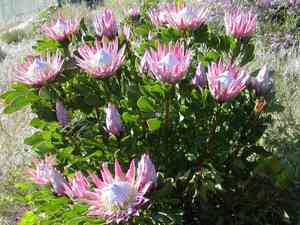
King protea reproduces most effectively via cuttings taken in the spring and summer seasons. Anticipate a moderate level of challenge in propagation, with successful outcomes indicated by the appearance of new foliage and root formation. Provide a growing substrate that drains efficiently and maintain sufficient atmospheric moisture.
Optimal Period for King Protea Propagation
Propagation Method
Cutting
Propagation Period
Spring, Summer
Tools Required for King Protea Propagation
Sharp pruning shears
Crucial for making clean cuts on semi-hardwood stems of king protea without harming plant tissue. A precise cut minimizes infection risk and promotes better healing for cuttings.
Rooting hormone
Stimulates root formation on king protea cuttings. Applying rooting hormone to the stem's base boosts root initiation, vital for new plant establishment.
Sterile potting mix
Offers a pathogen-free substrate for king protea cuttings to develop roots. The mix's sterile nature lowers the chance of soil-borne diseases affecting delicate new roots.
Propagation tray or pots
Holds the sterile potting mix and creates a controlled environment for king protea cuttings. These containers help maintain consistent moisture and temperature, key for successful root growth.
Plastic cover or propagation dome
Generates a humid microclimate around king protea cuttings, essential to prevent dehydration before they can establish root systems and absorb water efficiently.
Heat mat
Provides a steady heat source to maintain an ideal temperature for root development in king protea cuttings, especially important in cooler climates or seasons.
Misting system or spray bottle
Offers a gentle method to keep king protea cuttings hydrated without washing away rooting hormone or disturbing fragile new roots with heavy watering.
Steps to Propagate King Protea
Propagation Method
Cutting
Difficulty Level
Moderately Challenging
Post-Propagation Care for Your King Protea
Post-Propagation Care for Your King Protea
King protea needs well-draining soil and a location with full sun to partial shade. Water king protea deeply but infrequently, allowing the soil to dry out slightly between waterings. Protect from frost, and apply a low-phosphorus, slow-release fertilizer in early spring. Prune spent flowers to encourage new growth and deadhead regularly to maintain plant health and appearance. Be mindful of root rot by avoiding excessive watering.
Common Errors to Avoid When Propagating King Protea
Overwatering
Excessive watering of king protea can lead to root rot, as these plants prefer well-drained soil and are prone to fungal diseases when kept too moist.
Using a non-acidic or heavy soil mix
Planting king protea in non-acidic or clay-rich soil can impede root growth and drainage, causing stress and potential plant death.
Excessive fertilization
Applying too much fertilizer to king protea can result in leaf burn and poor flower development, as king protea requires low nutrient levels.
Planting in deep shade
While king protea can tolerate some shade, excessive shading can lead to leggy growth and reduced flowering.
Over-pruning
Excessive pruning of king protea can stress the plant and diminish its ability to flower, as it blooms on old wood.
Advice for Propagating King Protea
Adequate soil preparation
Utilizing a well-draining, acidic soil mix helps mimic king protea's natural growing conditions and supports healthy root development.
Moderate watering
Providing king protea with moderate watering, allowing the soil to dry out between waterings, promotes strong root systems.
Limited fertilizer
Using a low-phosphorus, slow-release fertilizer minimizes the risk of over-fertilizing and supports healthy growth in king protea.
Appropriate sunlight
Ensuring king protea receives ample sunlight with some protection during the hottest part of the day encourages healthy growth and flowering.
Judicious pruning
Gentle pruning to remove dead flowers and shape king protea after flowering preserves the plant's energy for future blooms.



