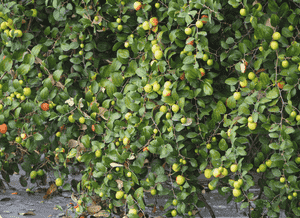
Indian jujube (Ziziphus mauritiana)
Also known as: Dunks, Chinese date
The indigo plant (*Indigofera tinctoria*) is a remarkable addition to subtropical gardens. This plant has a rich history of domestication, spanning around 4,000 years. In Burma, it is particularly valued for producing a dark blue dye, which is extensively used to color delicate silks. Unlike its wild counterparts, the cultivated varieties of indigo have been specifically developed for their dye-producing qualities.
In This Article
Attributes of Indian jujube
Lifespan
Perennial
Plant Type
Tree, Shrub
Plant Height
15 m
Spread
4.5 m
Leaf Color
Green
Flower Size
2 mm to 3 mm
Flower Color
White Yellow
Images of Indian jujube
Quickly Identify Indian jujube
1
The identification of Ziziphus mauritiana can be made by observing its shiny, dark green leaves that are oval to ovate in shape, and its small, greenish-yellow flowers. The fruits are round to oval, turning from green to brown or dark orange as they ripen.
Scientific Classification of Indian jujube
Phylum
Vascular plants
Class
Dicotyledons
Order
Roses, elms, figs, and allies
Family
Buckthorn
Genus
Jujube
Species
Indian jujube
Planting and Growing of Indian jujube
Care Difficulty
Easy
Watering Schedule
Every 4 days
Sunlight Requirements
Full sun
Sunshine Duration
6-8 hours
Ideal Temperature
68-86℉
Soil Type
Potting Mix, Peat Mix
Soil pH
6.5-7.5
Fertilizer Type
Balanced
Pruning Season
Spring, Summer
Pruning Area
Branches, Leaves
Pruning Frequency
2 times a year
Repotting Season
Spring
Pot Type
Plastic, Ceramic
 How to Water Indian jujube?
Ziziphus mauritiana requires about 500 milliliters of water per session. The principle is to thoroughly saturate the soil until water begins to trickle out of the drainage holes at the bottom of the pot. This ensures that the entire root system receives moisture, promoting healthy growth.
What are the symptoms of an underwatered Indian jujube?
›
What should I do if my Indian jujube is not getting enough water?
›
What are the symptoms of an overwatered Indian jujube?
›
How to save an overwatered Indian jujube?
›
 What Are the Sunlight Requirements for Indian jujube?
Ziziphus mauritiana prefers full sun with at least 6 to 8 hours of direct sunlight daily. This light range supports robust growth, flowering, and fruiting cycles, maximizing the plant's health and output.
What are the ideal lighting conditions for Ziziphus mauritiana?
›
How can optimal light conditions be achieved for this plant?
›
What benefits does Ziziphus mauritiana experience under ideal lighting?
›
 What Is the Ideal Temperature Range for Indian jujube?
The ideal temperature range for Ziziphus mauritiana is between 68°F and 86°F. This range is essential for the optimal growth and fruit production of the plant. At these temperatures, the plant can perform photosynthesis efficiently and maintain healthy metabolic rates.
 What Soil is Best for Indian jujube?
Ziziphus mauritiana thrives in well-drained soil, which prevents waterlogging and root rot. Ensuring excellent drainage aids in oxygen availability for roots, thereby promoting healthier growth. The plant benefits from nutrient-rich loamy soils that provide essential macro and micronutrients, essential for vigorous growth and fruit production, enhancing both yield and fruit quality. Ziziphus mauritiana prefers soil that retains moderate moisture without becoming soggy. This balances water supply, reducing stress during dry spells and ensuring steady plant growth.
 How to Fertilize Indian jujube?
Ziziphus mauritiana, also known as Indian jujube, requires a balanced approach to fertilization. Typically, a ratio of NPK 10-10-10 is ideal. For liquid fertilizers, use about 1 cup diluted in 5 liters of water per plant during the growing season.
 How to Prune Indian jujube?
Begin by assessing the overall structure of your Ziziphus mauritiana. Identify and remove any dead or weak branches close to the trunk. Focus on opening up the tree's canopy to allow sunlight to penetrate, improving fruit production. Trim away any cross branches to prevent rubbing and potential infection points. Always use clean and sharp tools for precise cuts. When shaping the tree, aim for a balanced structure with a strong central leader. You can also prune to encourage a vase shape to maximize sunlight exposure for lower limbs. Uniformly space out the main scaffold branches for a more aesthetically pleasing appearance and optimal growth.
More About Pruning Techniques→
 How to Propagate Indian jujube plant?
1
Harvest seeds from ripe Ziziphus mauritiana fruits during the summer months. Clean the pulp thoroughly to prevent any rotting during storage or planting.
2
Select healthy, semi-hardwood stems from the plant during late spring. Cut them into segments approximately 15 cm long, making sure each segment has at least two nodes.
3
Perform grafting in early spring using healthy scion and rootstock. Make clean, diagonal cuts and bind the grafted areas securely to allow proper fusion.
 How to Repot Indian jujube plant?
1
Ziziphus mauritiana should be repotted when its roots start circling the pot’s bottom, or when you notice slowed growth despite ample watering and sunlight. These are signs that the plant has outgrown its current living conditions, requiring more space for healthy development.
2
Select a pot that is 2-3 inches larger in diameter than the current one. The new pot should have adequate drainage holes to prevent waterlogging, which can lead to root rot. A slightly larger pot encourages healthy root expansion without overwhelming the plant.
3
Opt for a well-draining sandy loam soil mixture. This soil type allows for good drainage while retaining enough moisture necessary for healthy root development. It helps to prevent water retention issues that could lead to root diseases.



