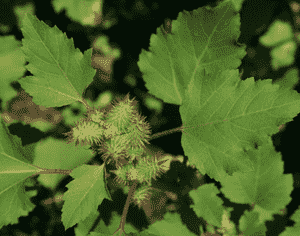
Rough cocklebur (Xanthium strumarium)
Also known as: Common cocklebur, Large cocklebur, Canada cocklebur
Rough cocklebur (Xanthium strumarium) is likely native to North America but has become widely naturalized around the world. The burred seed pod is buoyant and can be dispersed along waterways in addition to becoming hooked in the fur of passing animals. The plant has been used for medicinal purposes but is also quite toxic and dangerous.
Images of Rough cocklebur
Quickly Identify Rough cocklebur
1
Robust stem with short white hairs and dark streaks, reaching up to 3 feet (90 cm) in height.
2
Broad, oval to heart-shaped leaves up to 8 inches (20 cm) long, with sandpaper texture.
3
Spiny, bur-like seed pods that aid in seed dispersal, measuring 0.5 to 1 inch (1.3 to 2.5 cm).
4
Distinctive fruit with hooked prickles, 1/2 to 1.5 inches (1.3 to 3.8 cm) long, in brown or green hues.
5
Greenish, axillary flowers lacking petals and scent, blooming in late summer to early fall.
Scientific Classification of Rough cocklebur
Phylum
Vascular plants
Class
Dicotyledons
Order
Asters bellflowers fanflowers and allies
Family
Daisy
Genus
Cocklebur
Species
Xanthium strumarium

