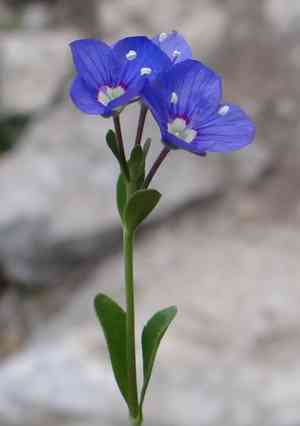
Rock speedwell (Veronica fruticans)
Also known as: Alpine speedwell
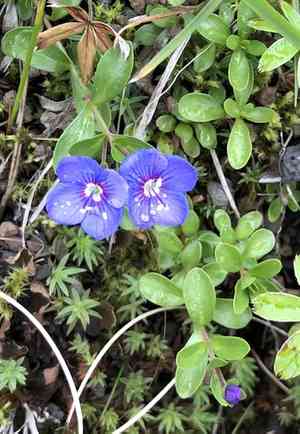
The Felsen-Ehrenpreis, or Veronica fruticans, is a perennial herbaceous plant that typically grows to a height of 5 to 20 cm. Its stems are woody at the base and covered with short hairs. The leaves are primarily sessile or have very short petioles. They exhibit a simple leaf blade that ranges from narrow to wide-oval in shape, measuring 5 to 20 mm in length, with margins that can be either entire or finely toothed.
In This Article
Attributes of Rock speedwell
Lifespan
Perennial
Plant Type
Shrub
Plant Height
5 cm to 10 cm
Spread
20 cm
Leaf Color
Green
Flower Size
1-2 cm
Flower Color
Purple Blue Pink
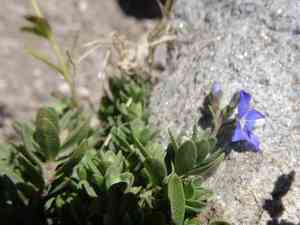
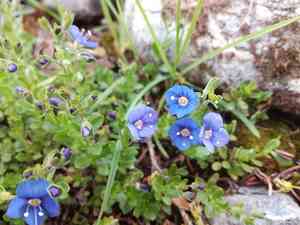
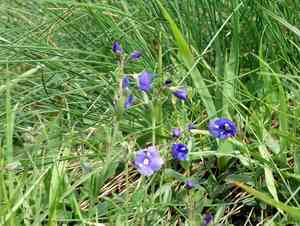
Images of Rock speedwell
Quickly Identify Rock speedwell
1
This plant can be identified by its low-growing, woody stems, its small, oval-shaped leaves, and its clusters of bright blue, tubular flowers that appear in summer.
Scientific Classification of Rock speedwell
Phylum
Vascular plants
Class
Dicotyledons
Order
Lamiales
Family
Plantain
Genus
Speedwells
Species
Rock speedwell
Planting and Growing of Rock speedwell
Care Difficulty
Easy
Watering Schedule
Every 4 days
Sunlight Requirements
Full sun
Sunshine Duration
6-10 hours
Ideal Temperature
50-68℉
Soil Type
Potting Mix, Peat Mix
Soil pH
6.5-7.5
Fertilizer Type
Balanced
Pruning Season
Spring, Summer
Pruning Area
Branches, Leaves
Pruning Frequency
2 times a year
Repotting Season
Spring
Pot Type
Plastic, Ceramic
 How to Water Rock speedwell?
For Veronica fruticans, it is ideal to water with approximately 250 milliliters of water per session. The goal is to moisten the soil thoroughly without saturating it, ensuring water reaches the root zones but avoids waterlogging.
What are the symptoms of an underwatered Rock speedwell?
›
What should I do if my Rock speedwell is not getting enough water?
›
What are the symptoms of an overwatered Rock speedwell?
›
How to save an overwatered Rock speedwell?
›
 What Are the Sunlight Requirements for Rock speedwell?
Veronica fruticans thrives best in conditions that provide full sun to partial sun exposure. Over time, consistent optimal lighting ensures maximum blooming and maintains the plant's dense growth habit.
What type of lighting does Veronica fruticans prefer?
›
How can I provide ideal lighting conditions for Veronica fruticans?
›
What benefits does ideal lighting offer to Veronica fruticans?
›
 What Is the Ideal Temperature Range for Rock speedwell?
The ideal temperature range for Veronica fruticans is between 50°F and 68°F. This range is optimal for its growth and flowering stages, ensuring that the plant can photosynthesize efficiently without excess stress or wilting.
 What Soil is Best for Rock speedwell?
Veronica fruticans thrives in well-drained soil, preventing waterlogging, which can cause root rot. This requirement ensures that the plant remains healthy and robust, maximally absorbing nutrients without the risk of overwatering. A nutrient-rich medium is essential for Veronica fruticans, as it supports vigorous growth and vibrant flowering. Such a soil enhances the plant's development and resilience against pests and diseases. Soil with moderate moisture retention is beneficial for Veronica fruticans. It ensures consistent hydration without saturation, promoting steady growth and reducing the need for frequent watering.
 How to Fertilize Rock speedwell?
Veronica fruticans thrives on balanced nutrient intake, so it's crucial to provide moderate amounts of fertilizer. For liquid fertilizers, a dilution of 1:4 (fertilizer:water) is ideal per application. For slow-release granules, use about 20 grams per square meter to avoid excessive nutrient load.
 How to Prune Rock speedwell?
Begin by inspecting the plant for any dead or diseased branches. Remove these first to prevent the spread of any pathogens. Next, trim back stems that appear leggy or are growing beyond the desired shape of the plant. Make your cuts just above a node to encourage new growth. Best done early in the active growing season to allow the plant time to fill out and develop new blooms. Prune Veronica fruticans in early spring as growth begins or immediately after flowering to maintain its size and shape. Spring pruning helps stimulate fresh growth, while summer pruning can encourage a second bloom. Careful timing ensures the plant remains healthy and lush throughout its growing period.
More About Pruning Techniques→
 How to Propagate Rock speedwell plant?
1
Collect seeds from mature Veronica fruticans plants and store them in a cool, dry place until ready for planting. In early spring, sow the seeds in a well-draining seed-starting mix, covering them lightly with soil. Water gently to avoid dislodging the seeds and cover with a humidity dome.
2
Select healthy, disease-free stems from the parent plant and make a 4-6 inch cutting below a node. Remove lower leaves to prevent decay and dip the cut end in rooting hormone to promote root development. Insert the cutting into a pot filled with a mixture of peat and perlite and water it lightly.
3
In early spring, identify a mature plant with substantial growth. Carefully dig around the plant to expose the root system, and use a sharp knife or spade to separate the plant into smaller sections, ensuring each has a healthy root system. Replant the divisions immediately in prepared ground or containers.
 How to Repot Rock speedwell plant?
1
Repot Veronica fruticans when you notice it's becoming root-bound in its current pot. Also, when the soil dries out too quickly or roots emerge from the drainage holes, it's time for a move. These signs indicate the plant is ready for more space.
2
Choose a pot that's one size larger than the current one with adequate drainage holes. A slightly larger pot prevents overwatering, supporting healthy root development. Opt for materials like clay that support moisture evaporation.
3
Select a well-draining garden soil mix with added perlite or sand for repotting. This blend ensures that excessive water drains effortlessly, thus mitigating root rot and promoting vigorous growth.



