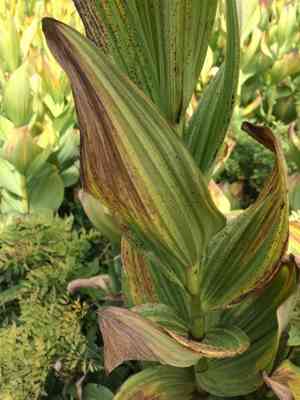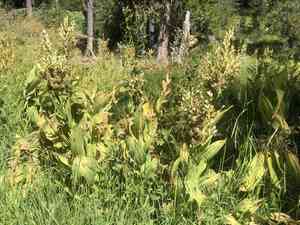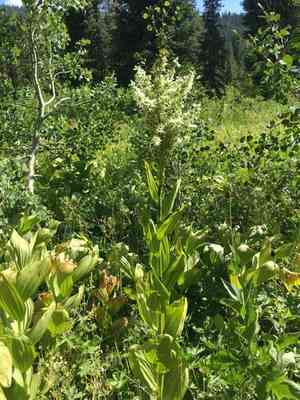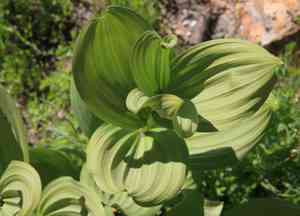
California false hellebore(Veratrum californicum)

California false hellebore (Veratrum californicum)

Also known as: Cebadilla, White false hellebore

The Western False Hellebore (Veratrum californicum) is a highly toxic plant native to the United States. It is found from the southwestern U.S. through the Rocky Mountains and into Alaska. This plant can disrupt normal gestation and has been known to cause birth defects in animals.

Attributes of California false hellebore

Lifespan
Perennial
Plant Type
Herb
Plant Height
91 cm to 1.8 m
Spread
60 cm
Leaf Color
Green
Flower Size
30 cm to 60 cm
Flower Color
White Green

ForwardPlant - Identify plants with a snap

Identify and diagnose plants, get toxicity alerts, and explore safety guides for all types of fungi.

Try for Free

Images of California false hellebore
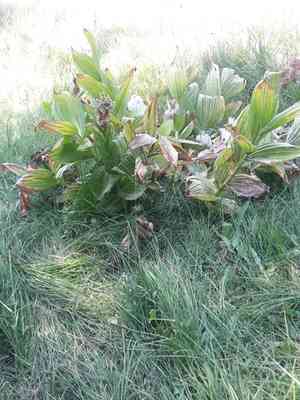
California false hellebore(Veratrum californicum)

Quickly Identify California false hellebore

1
Veratrum californicum can be identified by its tall, stout stems, broad leaves with parallel veins, and dense clusters of small white to greenish flowers in a panicle arrangement.

Scientific Classification of California false hellebore

Phylum
Vascular plants
Class
Monocotyledons
Order
Liliales
Family
Bunchflower
Genus
False hellebores
Species
California false hellebore

Planting and Growing of California false hellebore

Care Difficulty
Hard
Watering Schedule
Every 2 days
Sunlight Requirements
Full sun
Sunshine Duration
6-10 hours
Ideal Temperature
65-75℉
Soil Type
Potting Mix, Peat Mix
Soil pH
6.5-7.5
Fertilizer Type
Balanced
Pruning Season
Spring, Summer
Pruning Area
Branches, Leaves
Pruning Frequency
2 times a year
Repotting Season
Spring
Pot Type
Plastic, Terracotta

water icon How to Water California false hellebore?

Veratrum californicum prefers moist conditions, yet it despises waterlogged soil. It needs about 250 ml of water per watering session, ensuring the soil is thoroughly damp but not drenched. This simulates its natural environment, where the ground is consistently moisture-laden without suffocation.
What are the symptoms of an underwatered California false hellebore?
What should I do if my California false hellebore is not getting enough water?
What are the symptoms of an overwatered California false hellebore?
How to save an overwatered California false hellebore?

sunlight icon What Are the Sunlight Requirements for California false hellebore?

Sunlight Requirements: Full sun, Partial sun
Duration of light: 4 to 6 hours
A balance of full to partial sun is ideal, providing 4 to 6 hours of sunlight. This enhances photosynthesis and supports healthy foliage while avoiding light-induced stress.
What are the lighting needs?
How to achieve ideal lighting?
Benefits of ideal lighting?

temperature icon What Is the Ideal Temperature Range for California false hellebore?

Ideal Temperature: 65 ~ 75℉
The ideal temperature range for Veratrum californicum, also known as California False Hellebore, is between 65°F and 75°F. Within this range, the plant can perform optimal physiological functions necessary for growth, such as photosynthesis and nutrient absorption. Keeping the plant within this temperature window ensures robust growth and healthy foliage.

soil icon What Soil is Best for California false hellebore?

Soil type: Loam, Sandy loam
Soil PH: 6.5 ~ 7.5
Veratrum californicum thrives in well-drained soil to prevent root rot. Ensuring proper drainage is beneficial as it allows the plant to absorb nutrients effectively without waterlogging. Soil rich in organic matter provides essential nutrients and maintains moisture retention. This supports healthier growth by ensuring the plant has a steady supply of nutrients. Regularly moist soil supports the growth of Veratrum californicum. Consistent moisture prevents the plant from experiencing drought stress, promoting lush foliage development.

fertilize icon How to Fertilize California false hellebore?

Fertilizer type: Balanced
Veratrum californicum thrives with balanced feeding. Use a diluted liquid fertilizer at half-strength for routine feedings, and a slow-release granular fertilizer for sustained nourishment. Monitor plant response to adjust amounts if needed.

prune icon How to Prune California false hellebore?

Pruning Time: Spring, Summer, Autumn
Carefully inspect the plant for any brown, wilted, or dead leaves. Use your sterilized shears to cut these parts away at the base, avoiding damage to the healthy stems. Look for any bunches of stems that are overly crowded. Thin these out by selectively cutting some of the stems at their base. This will enhance air circulation and minimize the risk of fungal infections, promoting the overall health of the plant.

propagate icon How to Propagate California false hellebore plant?

Propagate Time: Early spring, Late spring
1
Begin by filling seed trays with a well-draining potting mix. Sow the seeds evenly across the surface and cover with a thin layer of soil. Veratrum californicum seeds require darkness for germination, so ensure they are adequately covered.
2
Place the seed trays in a location with indirect sunlight, maintaining a temperature around 60-70°F (15-20°C). Use a heating mat if necessary to maintain optimal warmth, as it promotes faster germination.
3
Keep the soil consistently moist but not waterlogged. Use a fine mist spray bottle to water the seeds lightly, preventing the soil from shifting or the seeds from being disturbed.

repot icon How to Repot California false hellebore plant?

Repotting frequency: Every 2-3 years
1
Veratrum californicum should be repotted when you notice roots emerging from the drainage holes, indicating root-bound conditions. Additionally, if the plant seems stunted or the soil dries out too quickly, it might be time for a refresh.
2
Select a pot that is slightly larger than the current one, with ample drainage holes. This prevents waterlogging, encourages root aeration, and provides the plant adequate space to thrive without excess soil retaining too much moisture.
3
Choose a well-draining, nutrient-rich soil mix. Combining organic matter with perlite ensures the soil retains essential nutrients while providing excellent drainage, preventing the risk of root rot that can harm Veratrum californicum.

ForwardPlant - Identify plants with a snap

Find the best spots for them to optimize their health, simply using your phone.

Try for Free

Toxicity of California false hellebore

Is California false hellebore toxic to humans?

Although every part of the California false hellebore is extremely toxic to humans when consumed, the roots, rhizomes, and shoots are the most poisonous. This toxicity arises from the various alkaloids present in the plant. Signs of poisoning from California false hellebore include a burning sensation and irritation in the mouth and throat, excessive salivation, headaches, cold sweats, unsteady walking, vomiting, rapid and irregular heartbeat, shallow breathing, comatose states, and seizures. In severe instances, consumption of California false hellebore can lead to death.

Is California false hellebore toxic to cat?

California false hellebore presents a moderate toxicity risk to cats if any part of the plant is ingested. All parts of the plant are toxic, meaning that cats can experience poisoning through consumption. After exposure, affected cats may show symptoms of physical discomfort or illness, highlighting the necessity for pet owners to supervise their pets' interactions with plants. If a cat does ingest California false hellebore, it is crucial for owners to promptly seek professional assistance from a veterinary clinic to alleviate symptoms and avoid additional health issues.

Is California false hellebore toxic to dog?

California false hellebore presents a moderate risk of toxicity to dogs. Any part of this plant can be harmful if ingested, making all its components toxic to canines. If a dog consumes california false hellebore, it might show signs such as gastrointestinal distress, lethargy, and potentially cardiovascular irregularities. Given the seriousness of these symptoms, dog owners must vigilantly supervise their pets and restrict their access to california false hellebore. If poisoning is suspected, seeking immediate veterinary attention is essential to secure the best possible recovery for the affected pet.

Identify toxic plants for your safety

Learn which plants are harmful to you and your pets, and make informed choices for a safer home!

Try for Free
WARNING
The judgment on toxicity and danger is for reference only. We DO NOT GUARANTEE any accuracy of such judgment. Therefore, you SHALL NOT rely on such judgment. It is IMPORTANT TO SEEK PROFESSIONAL ADVICE in advance when necessary.
More About Toxic Techniques