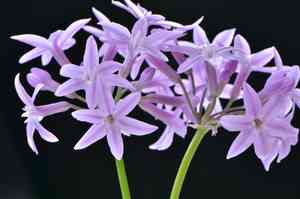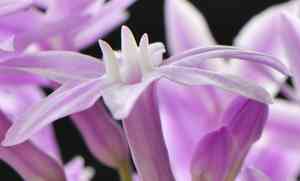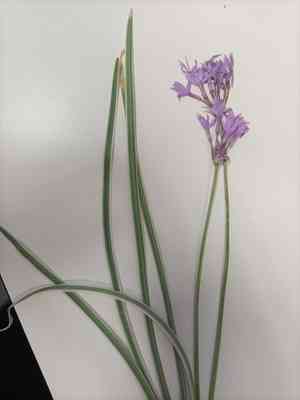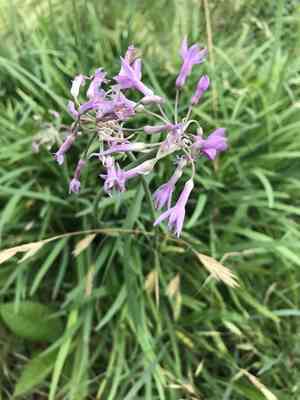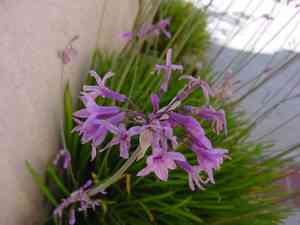
Society garlic(Tulbaghia violacea)

Society garlic (Tulbaghia violacea)

Also known as: Pink agapanthus, Spring flowers

Society garlic (Tulbaghia violacea) is a perennial that thrives in clusters and is frequently used for border planting. It can also serve as a ground cover when planted in large groups. The stalks release a garlic-like scent, giving the plant its common name. Society garlic favors full sunlight and well-drained soil.

Attributes of Society garlic

Lifespan
Perennial
Plant Type
Herb
Plant Height
60 cm
Spread
25 cm
Leaf Color
Green Gray Silver
Flower Size
2 cm
Flower Color
Purple Pink Blue Lavender Violet

PlantJoy - Identify plants with a snap

Identify and diagnose plants, get toxicity alerts, and explore safety guides for all types of fungi.

Try for Free

Images of Society garlic

Society garlic(Tulbaghia violacea)

Quickly Identify Society garlic

1
Linear, arching, grass-like leaves emit strong garlic scent when bruised.
2
Smooth, cylindrical stems with vibrant green color, resembling succulents.
3
Distinctive triangular fruit capsule with textured surface and black seeds.
4
Lilac-pink flowers on 20-inch stalks with fragrant, pointed tepals and tubular corolla.
5
Evergreen foliage resists cool temperatures, producing umbels of lavender flowers.

Scientific Classification of Society garlic

Phylum
Vascular plants
Class
Monocotyledons
Order
Asparagus and allies
Family
Amaryllis
Genus
Wild garlic
Species
Society garlic

Planting and Growing of Society garlic

Care Difficulty
Easy
Watering Schedule
Every 4 days
Sunlight Requirements
Full sun
Sunshine Duration
4-8 hours
Ideal Temperature
65-75℉
Soil Type
Potting Mix, Peat Mix
Soil pH
6.5-7.5
Fertilizer Type
Balanced
Pruning Season
Spring, Summer
Pruning Area
Branches, Leaves
Pruning Frequency
2 times a year
Repotting Season
Spring
Pot Type
Ceramic, Plastic

water icon How to Water Society garlic?

For Tulbaghia violacea, it's crucial to water until the soil is thoroughly moist but not soggy. The goal is to allow the water to penetrate deeply into the root zone while still letting excess water drain away. This means applying approximately 200 ml of water per session, ensuring that the top inch of soil feels consistently damp but not waterlogged.
What are the symptoms of an underwatered Society garlic?
What should I do if my Society garlic is not getting enough water?
What are the symptoms of an overwatered Society garlic?
How to save an overwatered Society garlic?
More About Watering Techniques

sunlight icon What Are the Sunlight Requirements for Society garlic?

Sunlight Requirements: Full sun, Partial sun
Duration of light: 6 to 8 hours
Tulbaghia violacea prefers full to partial sun exposure, ideally 6 to 8 hours daily. This optimal lighting promotes healthy foliage and abundant flowering, enhancing the plant’s decorative appeal.
What is the preferred light exposure for Tulbaghia violacea?
How can I achieve the ideal lighting conditions?
What benefits does ideal light exposure offer?
More About Sunlight Requirements Techniques

temperature icon What Is the Ideal Temperature Range for Society garlic?

Ideal Temperature: 65 ~ 75℉
Tulbaghia violacea thrives best in temperatures ranging from 65°F to 75°F. This range provides the optimal conditions for its metabolic processes, including photosynthesis and nutrient absorption. When temperatures are within this range, the plant can maximize growth and flowering, producing vibrant and fragrant blooms. Such conditions mimic its natural habitat in South Africa, ensuring it remains healthy and resilient.

soil icon What Soil is Best for Society garlic?

Soil type: Loam, Sandy loam
Soil PH: 6.5 ~ 7.5
Tulbaghia violacea thrives in well-drained soil as it prevents waterlogging, which can lead to root rot. The balance between moisture retention and drainage allows the plant to absorb nutrients effectively while avoiding over-saturation. This plant requires soil with moderate nutrient content, ensuring it has access to the necessary minerals for healthy growth. Fertile soil supports robust flowering and vibrant foliage, enhancing the aesthetic appeal of the plant. Tulbaghia violacea prefers slightly acidic to neutral pH levels, accommodating its root system's absorption of essential nutrients. This pH range optimizes enzyme function and nutrient uptake, promoting vigorous growth. More About Soil

fertilize icon How to Fertilize Society garlic?

Fertilizer type: Balanced
The recommended amount of fertilizer for Tulbaghia violacea should ideally be a balanced formula. For liquid fertilizer, use approximately half the recommended dosage on the package, ensuring not to overload the sensitive roots. This careful measurement supports vigorous growth without causing nutrient burn. More About Fertilizing Techniques

prune icon How to Prune Society garlic?

Pruning Time: Spring, Summer, Autumn
The optimal time to prune Tulbaghia violacea is right after the flowering period. This ensures that the plant can direct its energy towards new growth and the development of future blooms. Always use sharp, clean pruning shears to avoid tearing or damaging the plant tissue. Clean tools reduce the risk of introducing pests or diseases into the plant during pruning. More About Pruning Techniques

propagate icon How to Propagate Society garlic plant?

Propagate Time: Early spring, Late spring, Early summer
1
Collect seeds from mature Tulbaghia violacea plants. Clean and dry them before sowing to prevent fungal diseases. Store in a cool, dry place until you are ready to plant them.
2
Fill a seed tray with a well-draining soil mix and gently scatter the seeds on top. Lightly cover them with a thin layer of soil. Water gently to ensure adequate moisture without washing away the seeds.
3
Dig out mature plants carefully with a garden trowel, preserving as many roots as possible. Split the clump into smaller sections, ensuring each division has healthy roots and shoots.
More About Propagating Techniques

repot icon How to Repot Society garlic plant?

Repotting frequency: Every 2-3 years
1
Observe your Tulbaghia violacea and look for signs like roots growing out of the drainage holes, slow growth, or soil that dries quickly. These are indicators that it's time to repot and offer your plant new space to thrive.
2
Select a pot that's around 2-3 inches larger in diameter than the current one. This ensures adequate space for root growth without overwhelming the plant. Ideally, use a pot with drainage holes to prevent waterlogging.
3
Use a well-draining potting mix, ideally with added sand or perlite. This type of soil prevents root rot and allows excess water to escape, keeping the roots healthy and promoting vigorous growth.

PlantJoy - Identify plants with a snap

Find the best spots for them to optimize their health, simply using your phone.

Try for Free

Toxicity of Society garlic

Is Society garlic toxic to humans?

Society garlic contains toxins throughout its entire structure and typically poses minimal risk to humans unless consumed in large quantities or if an individual has heightened sensitivity to saponins or sulfur compounds. Generally, the most common effects are nausea or abdominal discomfort. Nevertheless, consuming a significant amount could trigger severe gastrointestinal issues, such as vomiting, colic, diarrhea, and potentially irreversible harm to the intestines. A notable indication of poisoning from this plant is the constriction of the pupils. Young children represent the group most likely to ingest this plant, and they are also at a greater risk of poisoning due to their lower body weight and more vulnerable systems. It is advisable to keep these plants out of reach of your young children.

Is Society garlic toxic to cat?

Society garlic exhibits a moderate level of toxicity for cats. If felines consume any part of this plant, they may suffer from poisoning. Signs of physical discomfort or illness can manifest once ingested, revealing the possibility of poisoning. Therefore, it is essential for cat owners to remain alert and ensure that their pets do not encounter society garlic. Should there be any suspicion of poisoning, obtaining immediate veterinary care is vital. Swift action by seeking treatment at a veterinary clinic can prove to be life-saving for the affected cats.

Is Society garlic toxic to dog?

Society garlic carries a moderate level of toxicity for dogs. Should a dog consume any portion of this plant, there is a risk of poisoning. The entire plant is toxic, which means that the ingestion of leaves, flowers, stems, or roots can result in negative health effects. Signs of poisoning in dogs may include gastrointestinal distress, vomiting, and diarrhea. It is vital for dog owners to closely observe their pets and restrict their access to society garlic. If a dog does consume any part of society garlic, it is imperative to seek prompt veterinary assistance to ensure the best possible health outcome for the pet.

Identify toxic plants for your safety

Learn which plants are harmful to you and your pets, and make informed choices for a safer home!

Try for Free
WARNING
The judgment on toxicity and danger is for reference only. We DO NOT GUARANTEE any accuracy of such judgment. Therefore, you SHALL NOT rely on such judgment. It is IMPORTANT TO SEEK PROFESSIONAL ADVICE in advance when necessary.
More About Toxic Techniques