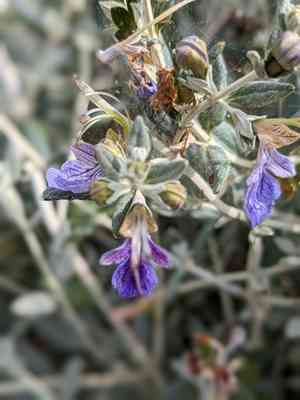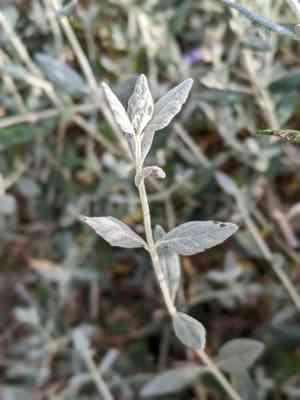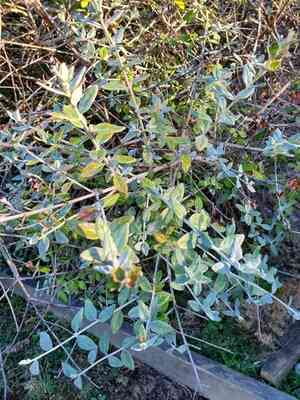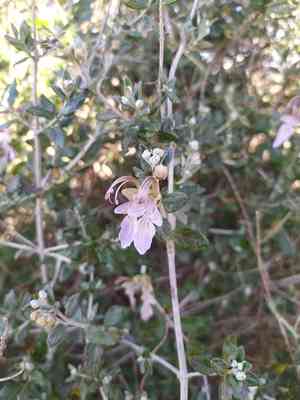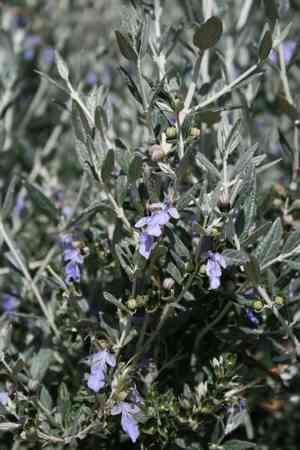
Tree germander(Teucrium fruticans)

Tree germander (Teucrium fruticans)

Also known as: Silver germander

Tree germander (Teucrium fruticans) is a hardy evergreen shrub that reaches heights of 1.2 to 2.5 meters. Its aromatic, grey-green leaves have silvery undersides that create a striking visual effect. The plant produces lavender-blue flowers nearly year-round, attracting pollinators like bees and butterflies. Known for its durability, tree germander is drought-tolerant and resilient against wind and salt spray, making it an excellent option for coastal or seaside gardens.

Attributes of Tree germander

Lifespan
Perennial
Plant Type
Shrub
Plant Height
1 m
Spread
4 m
Leaf Color
Green White
Flower Size
2.5 cm
Flower Color
Blue Purple

ForwardPlant - Identify plants with a snap

Identify and diagnose plants, get toxicity alerts, and explore safety guides for all types of fungi.

Try for Free

Images of Tree germander

Tree germander(Teucrium fruticans)

Quickly Identify Tree germander

1
Teucrium fruticans can be identified by its silvery, aromatic leaves and small, tubular, blue to lavender flowers. The leaves are opposite, ovate to lanceolate, and covered with fine hairs that give them a silvery appearance. The flowers are borne in loose spikes and appear mainly in late spring to early summer.

Scientific Classification of Tree germander

Phylum
Vascular plants
Class
Dicotyledons
Order
Lamiales
Family
Mint
Genus
Germanders
Species
Tree germander

Planting and Growing of Tree germander

Care Difficulty
Easy
Watering Schedule
Every 3 days
Sunlight Requirements
Full sun
Sunshine Duration
6-10 hours
Ideal Temperature
60-75℉
Soil Type
Potting Mix, Peat Mix
Soil pH
6.5-7.5
Fertilizer Type
Balanced
Pruning Season
Spring, Summer
Pruning Area
Branches, Leaves
Pruning Frequency
2 times a year
Repotting Season
Spring
Pot Type
Plastic, Ceramic

water icon How to Water Tree germander?

When watering Teucrium fruticans, aim to provide approximately 500 ml of water each session. The key principle is to ensure that the soil is thoroughly moistened without becoming waterlogged. This means watering until you see a slight runoff from the drainage holes at the bottom of the pot, which indicates the soil is saturated but not overly wet.
What are the symptoms of an underwatered Tree germander?
What should I do if my Tree germander is not getting enough water?
What are the symptoms of an overwatered Tree germander?
How to save an overwatered Tree germander?

sunlight icon What Are the Sunlight Requirements for Tree germander?

Sunlight Requirements: Full sun, Partial sun
Duration of light: 6 to 8 hours
Teucrium fruticans ideally requires full sun for 6 to 8 hours a day. Ideal lighting promotes vigorous growth, rich leaf coloration, and frequent blooming, enhancing the plant's aesthetic appeal and ecological contribution.
What is the ideal lighting for Teucrium fruticans?
How can I ensure ideal lighting for Teucrium fruticans?
What benefits does Teucrium fruticans gain from ideal lighting?
More About Sunlight Requirements Techniques

temperature icon What Is the Ideal Temperature Range for Tree germander?

Ideal Temperature: 60 ~ 75℉
The ideal temperature range for Teucrium fruticans, also known as Bush Germander, is between 60°F to 75°F. This temperature range ensures optimal growth and flowering. It maintains the plant's metabolism at an optimal level, thus promoting lush foliage and vibrant flowers. Staying within this bracket helps mimic the plant's native Mediterranean climate, providing conditions that support its natural growth cycle.

soil icon What Soil is Best for Tree germander?

Soil type: Sandy loam, Loam, Calcareous soil
Soil PH: 6.5 ~ 7.5
Teucrium fruticans thrives in well-drained soil to prevent waterlogging, which can cause root rot. Optimal drainage ensures the roots have access to necessary oxygen, encouraging healthy growth. While relatively low maintenance, Teucrium fruticans benefits from a nutrient-rich soil that provides essential minerals. This nurtures vibrant foliage and supports robust flowering. Teucrium fruticans prefers soil with moderate fertility, as overly fertile soil may lead to excessive leaf growth and reduced flowering. Balancing nutrients ensures a harmonious growth cycle.

fertilize icon How to Fertilize Tree germander?

Fertilizer type: Balanced
For Teucrium fruticans, use a balanced liquid fertilizer diluted to half the recommended strength. Apply about 100 ml per plant per session to avoid nutrient burn while promoting healthy growth.

prune icon How to Prune Tree germander?

Pruning Time: Spring, Summer, Autumn
Use clean, sharp pruning shears to trim back leggy or unruly branches. Focus on cutting just above a pair of leaves or a node to encourage denser growth. Maintain a natural dome shape for optimal aesthetic and health benefits. To enhance flowering, prune the plant after the first bloom of the season. Cutting back by one-third allows the plant to conserve energy and directs nutrients towards developing new buds, resulting in a flourishing display. More About Pruning Techniques

propagate icon How to Propagate Tree germander plant?

Propagate Time: Spring,Early spring,Late spring
1
Choose a healthy, non-flowering stem from the parent plant. The stem should be around 10 centimeters long. This ensures the plant can focus its energy on root development rather than supporting flowers or fruit.
2
Remove the leaves from the lower half of the cutting, leaving a couple of leaves at the top. This minimizes water loss through transpiration while allowing photosynthesis to continue.
3
Dip the cut end of the stem in rooting hormone and plant it in a pot filled with a mix of potting soil and sand or perlite for drainage. Water the cutting lightly to settle the soil around it.
More About Propagating Techniques

repot icon How to Repot Tree germander plant?

Repotting frequency: Every 2-3 years
1
Teucrium fruticans typically shows signs of needing a repot when its roots begin to circle the container it's in or grow through the drainage holes. Additionally, if the plant seems stunted or water drains too quickly through the pot, it's likely time to give it room to grow, usually occurring every 2-3 years.
2
Choose a pot that is about 1-2 inches larger in diameter than the current one. It should have adequate drainage holes to prevent water stagnation. Clay pots are a good choice for this plant as they allow the soil to dry out more quickly, providing the airy conditions Teucrium fruticans prefers.
3
Opt for a well-drained sandy soil mix. This type of soil prevents waterlogging, providing excellent drainage while retaining necessary nutrients. A mix that includes sand and perlite can help maintain the right consistency and promotes healthy root development without risking root rot.

ForwardPlant - Identify plants with a snap

Find the best spots for them to optimize their health, simply using your phone.

Try for Free

Toxicity of Tree germander

Is Tree germander toxic to humans?

Tree germander exhibits a moderate level of toxicity in humans, and the entire plant can lead to poisoning if ingested. When individuals accidentally consume parts of tree germander, they may experience a variety of symptoms that reflect its toxic characteristics. These symptoms may include gastrointestinal issues, such as nausea, vomiting, and diarrhea, in addition to more serious reactions, including potential liver damage or neurological symptoms, which could manifest as headaches, dizziness, or confusion. The intensity of these symptoms is influenced by the quantity ingested and the individual’s sensitivity. It is crucial for individuals to recognize the potential dangers linked with tree germander and to prevent accidental ingestion, particularly in areas where this plant is found.

Identify toxic plants for your safety

Learn which plants are harmful to you and your pets, and make informed choices for a safer home!

Try for Free
WARNING
The judgment on toxicity and danger is for reference only. We DO NOT GUARANTEE any accuracy of such judgment. Therefore, you SHALL NOT rely on such judgment. It is IMPORTANT TO SEEK PROFESSIONAL ADVICE in advance when necessary.
More About Toxic Techniques