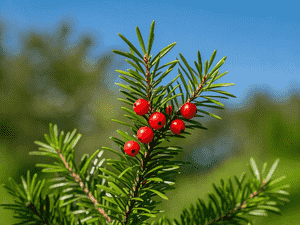
Common yew(Taxus baccata)

Common yew (Taxus baccata)

Also known as: Yew

The European yew (Taxus baccata) is a medium-sized evergreen tree known for its toxicity; nearly every part of the tree is poisonous and can be fatal if ingested. This species is indigenous to Europe, regions of Africa, Iran, and southwest Asia. Historically, the durable wood of the European yew was utilized in crafting English longbows, which were significant in medieval warfare.

Attributes of Common yew

Lifespan
Perennial
Plant Type
Tree, Shrub
Plant Height
10 m to 20 m
Spread
6 m
Leaf Color
Green Yellow
Flower Size
3 mm to 6 mm
Flower Color
Yellow Green

PlantJoy - Identify plants with a snap

Identify and diagnose plants, get toxicity alerts, and explore safety guides for all types of fungi.

Try for Free

Images of Common yew

Common yew(Taxus baccata)

Quickly Identify Common yew

1
Needle-like leaves, 0.5-1.5 inches (1.3-3.8 cm) long, with yellowish-green undersides.
2
Male cones yellowish, female arils red; no traditional flowers present.
3
Bright red arils encasing toxic seed, visually striking against green.
4
Linear leaves in pairs on the stem, shiny dark green upper surface.
5
Rugged reddish-brown bark with scaly texture, revealing lighter underbark over time.

Scientific Classification of Common yew

Phylum
Vascular plants
Class
Conifers
Order
Pines and allies
Family
Yew
Genus
Yews
Species
Common yew

Planting and Growing of Common yew

Care Difficulty
Easy
Watering Schedule
Every 2 days
Sunlight Requirements
Partial sun
Sunshine Duration
4-8 hours
Ideal Temperature
60-75℉
Soil Type
Potting Mix, Peat Mix
Soil pH
6.5-7.5
Fertilizer Type
Balanced
Pruning Season
Spring, Summer
Pruning Area
Branches, Leaves
Pruning Frequency
2 times a year
Repotting Season
Spring
Pot Type
Ceramic, Plastic

water icon How to Water Common yew?

When watering Taxus baccata, aim to provide around 500 milliliters each time. The soil should be evenly moist, but not waterlogged, ensuring that the water permeates the soil without pooling.
What are the symptoms of an underwatered Common yew?
What should I do if my Common yew is not getting enough water?
What are the symptoms of an overwatered Common yew?
How to save an overwatered Common yew?
More About Watering Techniques

sunlight icon What Are the Sunlight Requirements for Common yew?

Sunlight Requirements: Partial sun, Full shade
Duration of light: Two to five hours
Taxus baccata thrives under two to five hours of afternoon shade or filtered sunlight. Ideal light conditions ensure robust growth, rich foliage color, and improved disease resistance, promoting overall plant vitality.
What is the preferred sunlight exposure for Taxus baccata?
How can I achieve ideal light conditions for my Taxus baccata?
What are the benefits of providing ideal lighting conditions?
More About Sunlight Requirements Techniques

temperature icon What Is the Ideal Temperature Range for Common yew?

Ideal Temperature: 60 ~ 75℉
Taxus baccata, commonly known as the English Yew, ideally grows in temperatures ranging from 60°F to 75°F. This range provides optimal conditions for its physiological processes, ensuring healthy growth and foliage development. Maintaining this temperature helps the plant efficiently photosynthesize and metabolize nutrients.

soil icon What Soil is Best for Common yew?

Soil type: Loam, Clay soil, Sandy loam
Soil PH: 6.5 ~ 7.5
Taxus baccata thrives in well-drained soil which prevents waterlogging and subsequent root rot. Ensuring good drainage improves aeration in the soil, providing the roots with enough oxygen for optimal growth and health. This plant benefits from fertile soil enriched with organic matter. Nutrient-rich soil enhances the growth rate and vigor of the taxus, supporting robust foliage and vitality. While well-drained, the soil should retain moderate moisture to prevent extreme dryness. This balance prevents stress from drought conditions, ensuring the yew remains lush and healthy. More About Soil

fertilize icon How to Fertilize Common yew?

Fertilizer type: Balanced
For Taxus baccata, fertilization should be done conservatively as it is a slow-growing plant. Use a balanced 10-10-10 fertilizer, and apply approximately 450 grams per mature plant per year. Ensure to adjust the amount depending on plant age and growth setting.

prune icon How to Prune Common yew?

Pruning Time: Spring, Summer
Start by identifying any dead, damaged, or diseased branches and remove them. Look for branches that disrupt the plant’s natural shape or are growing inward and cut them back to maintain an appealing form. Cut branches back to the point just above a bud or a lateral branch. This encourages the plant to form new, healthier growth. Ensure your cuts are clean and at a slight angle to prevent water accumulation that can lead to rot. After addressing the structural pruning, focus on maintaining the overall shape of the Taxus baccata. Prune the tips of the plant to encourage fuller growth, aiming to create a slight taper from base to top for even light distribution. More About Pruning Techniques

propagate icon How to Propagate Common yew plant?

Propagate Time: Early spring, Late winter
1
Collect Taxus baccata seeds from mature cones in late autumn. Ensure the seeds are fully developed and separate them from the fruit pulp before storing in a cool, dry place until sowing.
2
Cut healthy, non-flowering stems of about 10-15 cm in length during early spring. Remove the lower leaves to reduce moisture loss and dip the cut end in rooting hormone to enhance root development.
3
Sow the prepared seeds in seed trays filled with well-draining soil in late winter. Maintain consistent moisture by covering the trays with clear plastic or glass, and keep them at a temperature of 15-20°C to aid germination.
More About Propagating Techniques

repot icon How to Repot Common yew plant?

Repotting frequency: Every 2-3 years
1
Look for signs like roots growing out of the drainage holes or the plant becoming pot-bound with minimal soil visible. This indicates it's time for fresh accommodations to promote healthy growth!
2
Choose a pot that is slightly larger than the current one, with excellent drainage holes. This prevents waterlogging, which is crucial for avoiding root rot in Taxus baccata.
3
Opt for a well-draining, sandy loam soil mix. This composition ensures adequate drainage while providing sufficient nutrients, emulating their natural habitat conditions and promoting robust growth.

PlantJoy - Identify plants with a snap

Find the best spots for them to optimize their health, simply using your phone.

Try for Free

Toxicity of Common yew

Is Common yew toxic to humans?

The common yew presents a significant toxicity threat to humans if ingested. Each component of the plant, including its leaves, seeds, and bark, harbors harmful compounds like taxine-derived alkaloids, taxane-derived substances, and glycosides. When consumed, even in minimal quantities, these compounds can interfere with the body’s cardiac and nervous functions. Poisoning symptoms occur rapidly and may include challenges in breathing, muscle tremors, vomiting, convulsions, and potentially lethal cardiac arrhythmia. Given its high level of toxicity, unintentional consumption of any part of the common yew could result in serious health issues, highlighting the utmost importance of exercising caution around this plant.

Is Common yew toxic to cat?

The common yew (Taxus baccata) is notorious for its highly lethal toxicity, found in all parts of the plant, but particularly concentrated in its vibrant red berries. Ingestion can lead to symptoms such as muscle tremors, seizures, and potentially fatal cardiac failure. Urgent veterinary intervention is essential to manage the symptoms and avert a tragic outcome.

Is Common yew toxic to dog?

The common yew is regarded as one of the most poisonous plants globally, making it essential to ensure your dog stays far away from it. Every part of this plant is highly toxic. Signs of ingestion may include tremors, respiratory difficulties, vomiting, seizures, and potentially fatal acute heart failure. If you believe your pet has ingested common yew, contact your veterinarian IMMEDIATELY.

Identify toxic plants for your safety

Learn which plants are harmful to you and your pets, and make informed choices for a safer home!

Try for Free
WARNING
The judgment on toxicity and danger is for reference only. We DO NOT GUARANTEE any accuracy of such judgment. Therefore, you SHALL NOT rely on such judgment. It is IMPORTANT TO SEEK PROFESSIONAL ADVICE in advance when necessary.
More About Toxic Techniques

