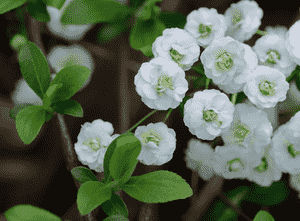
Bridal wreath spirea (Spiraea prunifolia)
Also known as: Bridalwreath spirea
The Yoshino cherry (Prunus × yedoensis) is a flowering tree indigenous to China, Korea, and Japan. Renowned for its striking spring blossoms, it is frequently grown as an ornamental tree in gardens. This tree is favored for its ease of cultivation and its stunning floral display.
In This Article
Attributes of Bridal wreath spirea
Lifespan
Perennial
Plant Type
Shrub
Plant Height
3 m
Spread
1.8 m to 2.5 m
Leaf Color
Green Blue Silver
Flower Size
1 cm to 1.2 cm
Flower Color
White
Images of Bridal wreath spirea
Quickly Identify Bridal wreath spirea
1
Twiggy growth with fountain-like form, 4-8 feet (1.2-2.4 meters) tall and wide.
2
Double white flowers, 1/3 inch (0.85 cm) wide, on arching branches in spring.
3
Dry, brown follicles persist through winter, adding interest to bare branches.
4
Slender stem with zig-zag pattern, less than 0.4 inches (1 cm) thick, glabrous.
5
Smooth, elegant trunk with brown bark exfoliating in thin layers, around 1/8 inch (3 mm) thick.
Scientific Classification of Bridal wreath spirea
Phylum
Vascular plants
Class
Dicotyledons
Order
Roses, elms, figs, and allies
Family
Rose
Genus
Spirea
Species
Bridal wreath spirea
Planting and Growing of Bridal wreath spirea
Care Difficulty
Easy
Watering Schedule
Every 2 days
Sunlight Requirements
Full sun
Sunshine Duration
6-10 hours
Ideal Temperature
60-75℉
Soil Type
Potting Mix, Peat Mix
Soil pH
6.5-7.5
Fertilizer Type
Balanced
Pruning Season
Spring, Summer
Pruning Area
Branches, Leaves
Pruning Frequency
2 times a year
Repotting Season
Spring
Pot Type
Plastic, Ceramic
 How to Water Bridal wreath spirea?
When watering Spiraea prunifolia, aim to provide approximately 500 milliliters per session, ensuring that the soil is thoroughly soaked without flooding the roots. The water should penetrate deeply to reach the root zone, promoting robust growth and preventing shallow root development.
What are the symptoms of an underwatered Bridal wreath spirea?
›
What should I do if my Bridal wreath spirea is not getting enough water?
›
What are the symptoms of an overwatered Bridal wreath spirea?
›
How to save an overwatered Bridal wreath spirea?
›
 What Are the Sunlight Requirements for Bridal wreath spirea?
Spiraea prunifolia should ideally be in full sun to partial sun. Sufficient sunlight supports vibrant blooms and healthy foliage, ensuring the shrub remains a garden highlight through its flowering season.
More About Sunlight Requirements Techniques→
Which lighting conditions are ideal for Spiraea prunifolia?
›
How can you ensure Spiraea prunifolia receives ideal sunlight?
›
What are the benefits of providing ideal lighting for Spiraea prunifolia?
›
 What Is the Ideal Temperature Range for Bridal wreath spirea?
The optimal temperature range for Spiraea prunifolia is between 60°F and 75°F. This range is ideal because it supports active growth and healthy flowering, which are crucial for the aesthetic and structural development of the plant. At these temperatures, the plant can efficiently carry out photosynthesis and other metabolic functions, leading to vital growth.
 What Soil is Best for Bridal wreath spirea?
Spiraea prunifolia thrives best in soil that provides excellent drainage. This quality ensures that water does not stagnate around the roots, preventing root rot and promoting healthy plant growth. This plant benefits from soil teeming with organic matter. Nutrient-rich soil supports robust growth, enhancing the spirea's overall vitality and the production of its beautiful white blooms. While drainage is critical, the soil should equally be capable of retaining some moisture. This balance allows Spiraea prunifolia to enjoy both water availability and protection from drought conditions.
More About Soil→
 How to Fertilize Bridal wreath spirea?
When fertilizing Spiraea prunifolia, use a balanced fertilizer with an N-P-K ratio like 10-10-10. For liquid fertilizer, apply approximately 1/2 teaspoon per gallon of water per application. For slow-release, use about 1/4 cup per plant once every four months.
More About Fertilizing Techniques→
 How to Prune Bridal wreath spirea?
Start by removing any dead, damaged, or diseased branches. Then, focus on thinning out overcrowded areas to improve air circulation and allow light to penetrate the inner branches. Cut back the oldest stems to promote vigorous new growth. After flowering, prune back spent flower stems to enhance the shrub’s shape. For best results, cut just above a healthy bud, and aim for a natural look by selectively trimming branches rather than shearing the plant into a uniform shape.
More About Pruning Techniques→
 How to Propagate Bridal wreath spirea plant?
1
Select healthy branches of about 5-6 inches long from the Spiraea prunifolia plant. Use sterilized pruning shears to cut just below a node. Remove the leaves on the lower part to focus energy on root development.
2
Dip the cut end of the Spiraea prunifolia cutting in rooting hormone. This step promotes root growth and should be done right before you plant the cutting in potting mix to enhance root development.
3
Insert the prepared cuttings into a pot filled with a well-draining potting mix. Place the pot in a warm, bright area but not under direct sunlight. Maintain adequate moisture without waterlogging the soil.
 How to Repot Bridal wreath spirea plant?
1
The best time to repot Spiraea prunifolia is when you notice that the plant's roots start to circle around the bottom of the pot or emerge from the drainage holes. These are clear signals that the plant needs more space to grow, which typically occurs every few years depending on the growth rate.
2
Choose a pot that is one size larger than the current one, with drainage holes. A slightly larger pot allows roots to spread comfortably, promoting healthier growth. Proper drainage prevents water-logged soil, which can lead to root rot. Material and color can also be considered for aesthetic and heat management purposes.
3
Opt for a well-draining potting mix that's rich in organic matter. Good drainage is crucial to prevent water accumulation at the roots. A soil mix including peat moss, perlite, and a bit of sand ensures both aeration and moisture retention, offering a balanced environment for root development.



