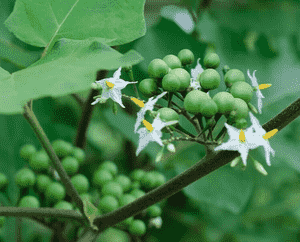
Turkey berry(Solanum torvum)

Turkey berry (Solanum torvum)

Also known as: Platebrush, Prickly nightshade, Pea eggplant, Pea aubergine

The *Solanum torvum*, also known as Turkey Berry, is a spiny, upright perennial plant. It features white, tubular flowers and yields bitter-tasting berries commonly utilized in soups and sauces.

Attributes of Turkey berry

Lifespan
Perennial
Plant Type
Shrub
Plant Height
2 m to 3 m
Spread
1.5 m
Leaf Color
Green Blue
Flower Size
2.5 cm
Flower Color
White

ForwardPlant - Identify plants with a snap

Identify and diagnose plants, get toxicity alerts, and explore safety guides for all types of fungi.

Try for Free

Images of Turkey berry

Turkey berry(Solanum torvum)

Quickly Identify Turkey berry

1
Solanum torvum can be identified by its thorny stems, lobed leaves, and clusters of small, yellow berries. The plant typically grows as a shrub and can be recognized by its bright green foliage and slightly hairy leaves. Its flowers are small, white, and star-shaped, appearing in clusters.

Scientific Classification of Turkey berry

Phylum
Vascular plants
Class
Dicotyledons
Order
Nightshades, bindweeds, gooseweeds, and allies
Family
Nightshade
Genus
Nightshades
Species
Turkey berry

Planting and Growing of Turkey berry

Care Difficulty
Easy
Watering Schedule
Every 3 days
Sunlight Requirements
Partial sun
Sunshine Duration
4-8 hours
Ideal Temperature
68-86℉
Soil Type
Potting Mix, Peat Mix
Soil pH
6.5-7.5
Fertilizer Type
Balanced
Pruning Season
Spring, Summer
Pruning Area
Branches, Leaves
Pruning Frequency
2 times a year
Repotting Season
Spring
Pot Type
Ceramic, Plastic

water icon How to Water Turkey berry?

Solanum torvum, commonly known as Turkey Berry, requires moderate watering. Ensure that the soil remains consistently moist but not waterlogged. Watering should be deep enough to reach the roots, allowing about 500 milliliters per session to ensure adequate hydration without drowning the plant.
What are the symptoms of an underwatered Turkey berry?
What should I do if my Turkey berry is not getting enough water?
What are the symptoms of an overwatered Turkey berry?
How to save an overwatered Turkey berry?

sunlight icon What Are the Sunlight Requirements for Turkey berry?

Sunlight Requirements: Partial sun, Full sun
Duration of light: 4 to 8 hours
Partial to full sunlight is ideal for Solanum torvum, providing the plant with enough energy for photosynthesis while preventing foliage damage. This light exposure supports healthy growth and abundant flowering.
What is the best time of day for sunlight exposure?
How can I ensure Solanum torvum receives sufficient light indoors?
What are the signs that Solanum torvum is thriving under ideal light conditions?

temperature icon What Is the Ideal Temperature Range for Turkey berry?

Ideal Temperature: 68 ~ 86℉
The ideal temperature range for growing Solanum torvum is between 68°F and 86°F. This range provides optimal conditions for both vegetative and reproductive growth. When temperatures fall within this range, plants can efficiently perform photosynthesis, nutrient uptake, and water usage, leading to robust plant development and enhanced fruit production. Ensuring that temperatures stay within these bounds also minimizes stress on the plant, promoting disease resistance and a healthier lifecycle.

soil icon What Soil is Best for Turkey berry?

Soil type: Loam, Sandy loam
Soil PH: 6.5 ~ 7.5
Solanum torvum thrives in well-drained soil that prevents waterlogging, ensuring the roots stay healthy and oxygenated. This prevents root rot and supports vigorous growth. Rich, fertile soil provides essential nutrients, promoting lush foliage and abundant fruiting. Nutrient availability is crucial for sustaining its robust growth and development. Incorporating organic matter enhances soil structure and moisture retention, benefiting Solanum torvum by providing a steady nutrient supply and preventing drought stress.

fertilize icon How to Fertilize Turkey berry?

Fertilizer type: Balanced
For Solanum torvum, apply a balanced fertilizer at a rate of 10 grams per square meter. Ensure the fertilizer is evenly distributed to promote healthy and robust growth. When using liquid fertilizers, dilute them according to the manufacturer's instructions to prevent nutrient burn.

prune icon How to Prune Turkey berry?

Pruning Time: Spring, Summer, Autumn
Solanum torvum, commonly known as Turkey Berry, has a shrubby and sprawling nature. Before pruning, identify the main stems, lateral branches, and any suckers. Knowing the plant's structure helps in making strategic cuts to encourage robust growth and fruit production. Use clean, sharp pruning shears to make cuts. Begin by removing dead or diseased branches, cutting back to healthy wood. Trim any suckers that sap energy. Aim to open up the center of the plant for better air circulation and light penetration, improving overall plant health. Prune to maintain the desired size and shape, typically keeping the plant between 3 to 6 feet tall. Cut back overgrown branches to a lateral bud or branch. Regular pruning helps control the size, making harvest easier and enhancing the aesthetic appeal of your garden.

propagate icon How to Propagate Turkey berry plant?

Propagate Time: Spring, Early Summer, Late Spring
1
Choose robust and healthy seeds or cuttings for propagation. Look for seeds that are uniform in size and free from any signs of pest damage, and select cuttings from vigorous, disease-free sections of the plant for successful propagation.
2
Prepare a well-draining growth medium using a mix of potting soil and sand or perlite. This mix should be moist but not waterlogged to encourage strong root development while preventing rot.
3
Sow the seeds or place the cuttings in the prepared growth medium. Gently firm the soil around them and water lightly. Place them in a location with indirect sunlight and maintain a consistent temperature to enhance germination and root growth.

repot icon How to Repot Turkey berry plant?

Repotting frequency: Every 1-2 years
1
Repotting should be considered when the roots start to encircle the pot's perimeter or grow out of drainage holes. Also, if water sits on the surface for extended periods, it's a sign the soil is compacted. Spring and early summer are ideal times for repotting as the plant can recover quickly during its growing period.
2
Select a pot that is 2 inches larger in diameter than the current one. It should have drainage holes to prevent waterlogging, which can lead to root rot. A slightly larger size gives ample space for root development without overwhelming the plant.
3
Select a well-draining, rich loam soil to ensure adequate nutrients and prevent water retention. This will promote healthy root growth and distribute moisture evenly, reducing the risk of root diseases.

ForwardPlant - Identify plants with a snap

Find the best spots for them to optimize their health, simply using your phone.

Try for Free

Toxicity of Turkey berry

Is Turkey berry toxic to humans?

The Turkey berry plant is known for its toxicity. Its leaves and unripe berries contain solanaceous steroidal glycoalkaloids, which are the culprits of its poisonous nature. The ingestion of these toxins can lead to a range of gastrointestinal and neurological symptoms, which may vary from mild to severe. Factors such as the quantity of berries consumed, along with the age and weight of the individual, play a significant role in determining the severity of these symptoms. Common side effects include nausea, vomiting, diarrhea, and abdominal pain. Neurological manifestations may present as dizziness, confusion, or lethargy, while more severe symptoms can include slurred speech, facial paralysis, hypertension, and muscular weakness. It's important to note that ripe berries are considered non-toxic; however, distinguishing between ripe and unripe berries can be quite challenging.

Is Turkey berry toxic to cat?

Turkey berry possesses a moderate toxicity level for felines. Cats may unknowingly consume parts of the plant, especially the stem and leaves, resulting in poisoning. The glycoalkaloids contained within the plant are responsible for its toxic effects. If ingested, a cat might display various symptoms indicating discomfort. Due to the associated risks, it is crucial for cat owners to vigilantly monitor their pets and obtain prompt veterinary assistance if any signs of poisoning become evident.

Is Turkey berry toxic to dog?

The turkey berry plant species poses a risk of moderate toxicity to dogs. Canines may accidentally consume various parts of this plant, especially the leaves and stems, which are recognized for their toxic properties. If ingested, dogs may display symptoms that suggest poisoning. These can manifest as gastrointestinal distress, lethargy, or more serious indications, depending on the quantity ingested. The toxic nature of turkey berry is attributed to the presence of glycoalkaloids. It is essential for dog owners to vigilantly supervise their pets and restrict their access to turkey berry. Should a dog consume any part of the turkey berry, it is critical to seek immediate veterinary assistance to ensure the best potential outcome for the animal.

Identify toxic plants for your safety

Learn which plants are harmful to you and your pets, and make informed choices for a safer home!

Try for Free
WARNING
The judgment on toxicity and danger is for reference only. We DO NOT GUARANTEE any accuracy of such judgment. Therefore, you SHALL NOT rely on such judgment. It is IMPORTANT TO SEEK PROFESSIONAL ADVICE in advance when necessary.
More About Toxic Techniques

