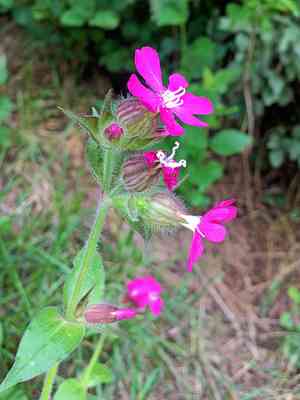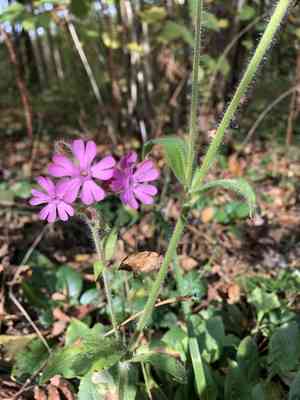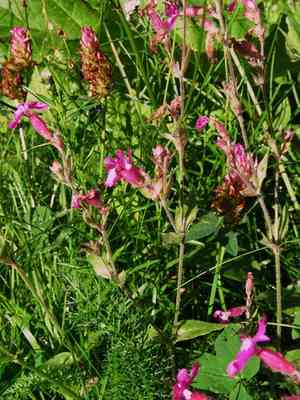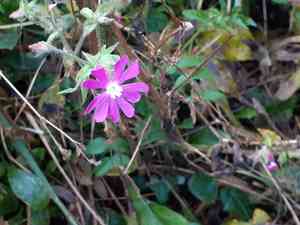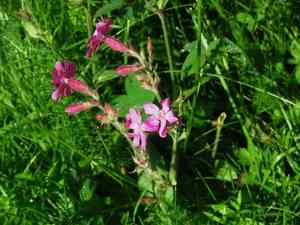
Red campion(Silene dioica)

Red campion (Silene dioica)

Also known as: Rough robin

The Sweet William (Dianthus barbatus) is a biennial or short-lived perennial with striking dark pink to red blooms. Commonly planted along garden borders, it requires minimal upkeep once established and is particularly attractive to moths, butterflies, and bees.

Attributes of Red campion

Lifespan
Perennial, Biennial
Plant Type
Herb
Plant Height
60 cm to 90 cm
Spread
60 cm
Leaf Color
Green
Flower Size
1.8 cm to 2.5 cm
Flower Color
Pink Red Purple

ForwardPlant - Identify plants with a snap

Identify and diagnose plants, get toxicity alerts, and explore safety guides for all types of fungi.

Try for Free

Images of Red campion

Red campion(Silene dioica)

Quickly Identify Red campion

1
Silene dioica can be identified by its hairy stems and leaves, five-petaled red to pink flowers with a deeply notched appearance, and its distinctive seed capsules. The plant also features opposite leaves with a slightly sticky texture.

Scientific Classification of Red campion

Phylum
Vascular plants
Class
Dicotyledons
Order
Caryophyllales
Family
Pink
Genus
Campions
Species
Red campion

Planting and Growing of Red campion

Care Difficulty
Easy
Watering Schedule
Every 4 days
Sunlight Requirements
Partial sun
Sunshine Duration
6-12 hours
Ideal Temperature
60-75℉
Soil Type
Potting Mix, Peat Mix
Soil pH
6.5-7.5
Fertilizer Type
Balanced
Pruning Season
Spring, Summer
Pruning Area
Branches, Leaves
Pruning Frequency
2 times a year
Repotting Season
Spring
Pot Type
Plastic, Terracotta

water icon How to Water Red campion?

The Silene dioica prefers moist but well-drained soil. Aim to water enough so the topsoil is consistently damp. However, ensure it is not waterlogged — the roots should not sit in water. Check the top 2 centimeters of soil, and if it's dry, give approximately 200 mL of water per plant.
What are the symptoms of an underwatered Red campion?
What should I do if my Red campion is not getting enough water?
What are the symptoms of an overwatered Red campion?
How to save an overwatered Red campion?

sunlight icon What Are the Sunlight Requirements for Red campion?

Sunlight Requirements: Partial sun
Duration of light: 4 to 6 hours
Silene dioica prefers partial sun. This basking regime is perfect for maximizing its blooming and growth potential while minimizing light stress.
What is the ideal light condition for Silene dioica?
How to achieve ideal lighting for Silene dioica?
What happens if Silene dioica receives ideal lighting?
More About Sunlight Requirements Techniques

temperature icon What Is the Ideal Temperature Range for Red campion?

Ideal Temperature: 60 ~ 75℉
For optimal growth, Silene dioica thrives in temperatures between 60 and 75 degrees Fahrenheit. This range ensures appropriate metabolic processes and promotes healthy development. Maintaining consistent temperatures in this range helps in achieving vibrant flowering.

soil icon What Soil is Best for Red campion?

Soil type: Loam, Sandy loam, Clay soil
Soil PH: 6.5 ~ 7.5
Silene dioica thrives in well-draining soil to prevent root rot caused by waterlogging. Adequately drained soil ensures sufficient oxygen reach to roots, promoting healthy plant growth. This plant prefers nutrient-rich soils, providing essential minerals required for robust growth and flowering. A fertile soil environment supports more vibrant and sustained blooms. A soil that balances moisture retention without becoming waterlogged helps maintain the necessary hydration levels for Silene dioica, crucial during dry spells for continuous plant health.

fertilize icon How to Fertilize Red campion?

Fertilizer type: Balanced
Silene dioica prefers a balanced approach when it comes to fertilization. Use a well-balanced fertilizer, such as a 10-10-10 NPK mix. For liquid fertilizers, dilute them to half the recommended strength to avoid overfertilization. When applying solid fertilizers, use about 20 grams per square meter, ensuring even distribution.

prune icon How to Prune Red campion?

Pruning Time: Spring, Summer
Begin by identifying any dead or damaged stems and trim them back to the base. Focus on cutting above nodes where new growth emerges to encourage branching. Snip away older, elongated stems to stimulate fresh growth. Maintaining a compact form not only supports vibrant blooms but also enhances the plant's overall appearance. More About Pruning Techniques

propagate icon How to Propagate Red campion plant?

Propagate Time: Spring, Early spring
1
Fill a seed tray with a well-draining seed-starting mix. Sow Silene dioica seeds lightly on the surface, covering them with a thin layer of soil. Water gently to settle the soil, and keep the tray in a light, warm location with consistent moisture.
2
Select healthy stems from the parent plant during early spring. Use sharp pruning shears to cut 4-6 inch long cuttings just below a node. Remove lower leaves to prevent rot and immerse the cut end in rooting hormone for a better root formation.
3
Prepare a well-lit area with indirect sunlight for the cuttings or seeds. Ensure that the temperature remains consistent to facilitate growth. Use clean pots or trays and provide some humidity, which can be achieved by covering cuttings with a plastic dome.
More About Propagating Techniques

repot icon How to Repot Red campion plant?

Repotting frequency: Every 2-3 years
1
Repot Silene dioica when you notice roots coming out of the drainage holes or when the plant becomes top-heavy. These signs indicate that it's outgrowing its current container. Additionally, if the soil has compacted and is draining poorly, it’s a signal that repotting is needed.
2
Select a pot that is one size larger than the current one, ensuring it has adequate drainage holes. A slightly larger pot provides room for growth without overwhelming the roots. Choosing a lightweight material, like terracotta, helps manage moisture levels effectively.
3
Opt for a well-draining loamy soil mix which retains enough moisture but allows excess water to escape. This reduces the risk of root rot and ensures roots receive adequate aeration, promoting healthy plant development.

ForwardPlant - Identify plants with a snap

Find the best spots for them to optimize their health, simply using your phone.

Try for Free

Toxicity of Red campion

Is Red campion toxic to cat?

Red campion possesses a low level of toxicity for felines and can lead to poisoning when ingested in significant amounts. Since every part of the plant harbors toxic compounds, any intake of red campion poses a danger. Affected cats may exhibit various signs of physical unease, signaling distress caused by the consumed plant matter. In these situations, it is vital for cat owners to promptly consult a veterinarian to guarantee their pet receives the necessary medical attention.

Is Red campion toxic to dog?

The plant species known as red campion possesses a low level of toxicity to dogs. If consumed in significant quantities, dogs have the potential to suffer from poisoning due to this plant. It is vital for dog owners to recognize that every part of red campion is deemed toxic and may pose a threat to the health of their pets. Should a dog ingest any portion of the red campion, they might display symptoms such as gastrointestinal distress, vomiting, or diarrhea. Given the risk of poisoning, it is imperative for owners to keep a close watch on their pets and restrict access to this plant. If a dog does consume red campion, seeking immediate veterinary attention is essential, as timely medical intervention is crucial for the well-being of the affected animal.

Identify toxic plants for your safety

Learn which plants are harmful to you and your pets, and make informed choices for a safer home!

Try for Free
WARNING
The judgment on toxicity and danger is for reference only. We DO NOT GUARANTEE any accuracy of such judgment. Therefore, you SHALL NOT rely on such judgment. It is IMPORTANT TO SEEK PROFESSIONAL ADVICE in advance when necessary.
More About Toxic Techniques