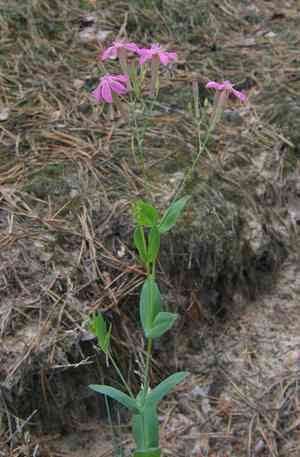
Sweet william catchfly (Silene armeria)
Also known as: Sweet William catchfly, None-so-pretty
This plant typically ranges from 20 to 70 cm in height. Its leaves are numerous, smooth, and measure between 2.5 and 5 cm in length, taking on an elliptic to narrowly oval shape. In the British Isles, it blooms from June to October, featuring clusters of pink or lavender flowers at the tips of its stems. The stems can be either hairless or slightly hairy with sticky patches, particularly just below the flower clusters.
In This Article
Attributes of Sweet william catchfly
Lifespan
Annual
Plant Type
Herb
Plant Height
30 cm to 46 cm
Spread
40 cm
Leaf Color
Green
Flower Size
1.3 cm
Flower Color
Purple Pink
Quickly Identify Sweet william catchfly
1
Silene armeria can be identified by its sticky stems and lanceolate (lance-shaped) leaves. The flowers are typically pink to reddish-purple and form in dense clusters at the top of the stems. The petals are notched and have a distinct, sweet fragrance.
Scientific Classification of Sweet william catchfly
Phylum
Vascular plants
Class
Dicotyledons
Order
Pinks, cacti, and allies
Family
Pink
Genus
Campions
Species
Sweet william catchfly
Planting and Growing of Sweet william catchfly
Care Difficulty
Easy
Watering Schedule
Every 8 days
Sunlight Requirements
Full sun
Sunshine Duration
4-6 hours
Ideal Temperature
60-75℉
Soil Type
Potting Mix, Peat Mix
Soil pH
6.5-7.5
Fertilizer Type
Balanced
Pruning Season
Spring, Summer
Pruning Area
Branches, Leaves
Pruning Frequency
Once a year
Repotting Season
Spring
Pot Type
Plastic, Ceramic
 How to Water Sweet william catchfly?
Silene armeria thrives with just enough moisture. When watering, aim to saturate the soil until it feels moist about an inch below the surface. Too much water can cause root rot, while too little will hinder its vibrant blooms. Adjust the watering amount according to your environment; if the topsoil dries quickly, slightly increase watering. Remember to always check the soil's moisture before watering again.
What are the symptoms of an underwatered Sweet william catchfly?
›
What should I do if my Sweet william catchfly is not getting enough water?
›
What are the symptoms of an overwatered Sweet william catchfly?
›
How to save an overwatered Sweet william catchfly?
›
 What Are the Sunlight Requirements for Sweet william catchfly?
Silene armeria prospers in full to partial sun conditions. Adequate sunlight fosters healthier growth, vibrant blooms, and elongated lifespan, making it a cornerstone for successful cultivation in gardens or pots.
More About Sunlight Requirements Techniques→
How much sunlight does Silene armeria need?
›
What solutions help achieve ideal lighting?
›
What benefits are gained from ideal light?
›
 What Is the Ideal Temperature Range for Sweet william catchfly?
The ideal temperature range for Silene armeria is between 60°F and 75°F. This range ensures optimal growth and flowering, as the plant can efficiently carry out photosynthesis and other metabolic processes. Maintaining this temperature range will help in achieving the best foliage and blooms, contributing to a healthy plant life cycle.
 What Soil is Best for Sweet william catchfly?
Silene armeria thrives in well-drained soils that prevent waterlogging, promoting healthy root growth and minimizing the risk of root rot. This ensures the plant receives ample oxygen, vital for its overall development and vibrant blooms. For optimal growth, Silene armeria prefers soils enriched with nutrients. This supports its vigorous growth habit and helps produce an abundance of flowers, offering a colorful display in your garden. While Silene armeria appreciates nutrient-rich soils, it does not require overly fertile conditions. The plant flourishes in moderately fertile soil, maintaining its structural integrity and floral output without excessive vegetative growth.
 How to Fertilize Sweet william catchfly?
Silene armeria appreciates a balanced amount of nutrients. For liquid fertilizers, use half the recommended dose as per the product label, approximately 10 ml mixed with one liter of water. This gentle feeding supports vigorous growth without overwhelming the plant. For slow-release fertilizers, apply a small handful, around 25 grams, gently worked into the soil surrounding the base of the plant.
 How to Prune Sweet william catchfly?
Start by inspecting your Silene armeria for any dead or diseased stems. Use clean, sharp scissors to cut these away, ensuring you make clean cuts just above a leaf node to encourage new growth. Regular pruning encourages a bushier appearance and can lead to continuous flowering throughout the season. To keep your Silene armeria looking tidy, consider shaping it into a uniform dome by gently trimming uneven or overgrown sections. This method not only enhances the plant's aesthetic appeal but also allows light and air to penetrate the inner sections, promoting overall plant health.
More About Pruning Techniques→
 How to Propagate Sweet william catchfly plant?
1
Use a well-draining potting mix to fill seed trays or pots, ensuring it is lightly moistened. A soil-less peat-based mix with added perlite is recommended for optimal drainage and aeration.
2
Sprinkle the Silene armeria seeds evenly over the surface of the prepared soil and gently press them down without completely burying them, as light enhances germination. Cover with a light layer of soil or sand.
3
Select a healthy, non-flowering stem and use pruning shears to make a clean cut below a node. Remove the lower leaves to reduce moisture loss and dip the cut end into rooting hormone to facilitate faster rooting.
 How to Repot Sweet william catchfly plant?
1
Silene armeria shows signs for repotting when its roots begin to emerge from the drainage holes or the plant growth becomes stunted. Ideal times are spring or summer, during its active growth phase, ensuring it quickly adapts to the new pot.
2
Select a pot slightly larger than the current one, ensuring it has adequate drainage holes. A pot that's too large can retain excess moisture, potentially leading to root rot. The material should be appropriate for your climate; clay pots can help with air circulation in humid areas.
3
Use a well-draining potting mix that contains a blend of peat, perlite, and sand. This mix ensures the roots receive necessary aeration, promoting healthy growth and preventing waterlogging, which is vital for Silene armeria’s health.
Learn More About Sweet william catchfly Diseases
Anthracnose
Bacterial Leaf Spot
Bacterial Soft Rot
Bacterial Wilt
Chemical Injury
Crown Gall
Cyst Nematode
Damping-off
Downy Mildew
Drought Stress
Fusarium Wilt
Gray Mold
Leaf Spot
Mosaic
Nutrient Deficiency
Nutrient Toxicity
Powdery Mildew
Root Rot
Root-knot Nematode
Rusts
Sooty Mold
Spider Mites
Temperature Stress
Thrips Damage
White Mold



