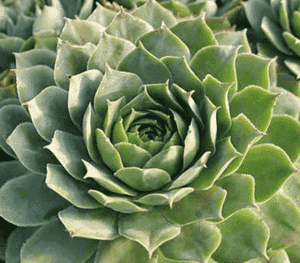
Common houseleek (Sempervivum tectorum)
Also known as: Roof houseleek, Jupiter's eye, Sengreen, Thor's beard
"Sempervivum" translates to "always living" in Latin. The common houseleek earns this name due to its remarkable resilience, thriving in the tough conditions of its native southern European mountains, including drought, intense sunlight, and harsh winters. Traditionally, it has been cultivated on European rooftops, where it was thought to protect homes from lightning. The plant also produces offsets around the main rosette, which is why it’s sometimes called "Hens and Chicks."
In This Article
Attributes of Common houseleek
Lifespan
Perennial
Plant Type
Succulent, Herb
Plant Height
15 cm to 50 cm
Spread
6 cm to 30 cm
Leaf Color
Green Red Blue Purple Yellow Gray
Flower Size
5 cm to 7 cm
Flower Color
Purple Pink Red Yellow
Images of Common houseleek
Quickly Identify Common houseleek
1
Rosette-shaped clusters of thick, fleshy leaves, up to 4 inches (10 cm) in diameter.
2
Leaves with pointed, slightly curved form, typically green with reddish tips.
3
Tightly packed spiral leaf pattern, giving a geometric, sculptural appearance.
4
Star-shaped flowers on 8-12 inch (20-30 cm) tall stalks, petals in pink, red, or purple.
5
Summer blooms with mild-scented flowers, 1 inch (2.5 cm) wide, blooming from July to August.
Scientific Classification of Common houseleek
Phylum
Vascular plants
Class
Dicotyledons
Order
Saxifrages, stonecrops and allies
Family
Stonecrop
Genus
Houseleeks
Species
Common houseleek
Planting and Growing of Common houseleek
Care Difficulty
Easy
Watering Schedule
Every 2 days
Sunlight Requirements
Full sun
Sunshine Duration
4-6 hours
Ideal Temperature
65-75℉
Soil Type
Potting Mix, Peat Mix
Soil pH
6.5-7.5
Fertilizer Type
Balanced
Pruning Season
Spring, Summer
Pruning Area
Branches, Leaves
Pruning Frequency
2 times a year
Repotting Season
Spring
Pot Type
Plastic, Ceramic
 How to Water Common houseleek?
For Sempervivum tectorum, it's best to water deeply but infrequently. This means when you water, you should provide enough to moisten the entire root zone, approximately 100 ml, but wait for the soil to dry out completely before watering again. This mimics their natural, rocky environments where water drains quickly.
More About Watering Techniques→
What are the symptoms of an underwatered Common houseleek?
›
What should I do if my Common houseleek is not getting enough water?
›
What are the symptoms of an overwatered Common houseleek?
›
How to save an overwatered Common houseleek?
›
 What Are the Sunlight Requirements for Common houseleek?
For Sempervivum tectorum, a range of full sun, approximately 6 to 8 hours daily, ensures optimal growth and vibrant foliage coloration, providing the necessary energy for photosynthesis and overall vitality.
More About Sunlight Requirements Techniques→
What is the best lighting environment?
›
How to achieve ideal lighting?
›
Benefits of ideal lighting for the plant?
›
 What Is the Ideal Temperature Range for Common houseleek?
Sempervivum tectorum, commonly known as houseleek, thrives in a temperature range of 65°F to 75°F. This range ensures optimal growth and health of the plant, mimicking its natural environment. It's important to maintain this range to prevent stress caused by too much heat or cold.
 What Soil is Best for Common houseleek?
Sempervivum tectorum thrives best in well-drained soil, which prevents water from pooling around the roots. This helps to avert root rot, ensuring the plant remains healthy and vigorous, allowing it to grow robustly in various conditions. These plants require nutrient-poor soil, mimicking their native alpine environments. Rich soil can lead to overly leafy growth, causing them to lose their compact form and weakening their natural resilience. Incorporating gravel into the soil mix provides better drainage and aeration for Sempervivum tectorum. This texture supports the succulent nature of the plant, enabling it to store water efficiently while preventing over-saturation.
More About Soil→
 How to Fertilize Common houseleek?
For Sempervivum tectorum, it is crucial to use a balanced fertilizer at half the recommended strength on the package. This prevents any risk of over-fertilizing, which can damage the plant’s roots and hamper its growth.
 How to Prune Common houseleek?
Begin by carefully examining the plant for any leaves that have turned brown, become shriveled, or are wilting. These parts can safely be removed without harming the plant. Hold the rosette steady and use your pruner to neatly snip away the dead leaves at their base. Take care to cut only what is necessary, ensuring to not disturb the growing parts. Collect the trimmed leaves and dead flowers to dispose of them properly. Leaving them around the plant can attract pests or lead to mold development.
 How to Propagate Common houseleek plant?
1
Collect seeds from mature Sempervivum tectorum plants. Sow them in a seed tray filled with a well-draining mix, lightly covering them with soil. Keep the tray in a warm, sunny spot, and maintain consistent moisture until germination occurs.
2
Gently remove the plant from its pot and identify offsets growing around the base. Using a sharp knife or shears, carefully cut them away, ensuring each offset has roots. Plant the offsets in individual pots with appropriate soil.
3
After propagation, water the newly sown seeds or planted offsets lightly to settle the soil. It's crucial not to overwater, as excess moisture can lead to rot. Place them in bright, indirect light and gradually expose them to direct sunlight.
 How to Repot Common houseleek plant?
1
Look for signals such as roots poking through drainage holes, slowed growth, or water pooling on the surface. These signs indicate it's time to provide your Sempervivum tectorum a new home. The best time is during the active growing seasons, spring or summer, when the plant is more robust and better able to handle the stress of repotting.
2
Select a pot that is only slightly larger than the current one. Ensure it has good drainage with several holes at the bottom. A terracotta pot is an excellent choice as it is porous, allowing the soil to dry out efficiently, which is crucial for preventing root rot in your drought-tolerant Sempervivum.
3
Pick a well-draining mix, ideally a cactus or succulent potting soil. Soil that retains too much moisture can lead to root rot. You can enhance the mix with added perlite or grit. This kind of soil supports healthy root development by ensuring air reaches them while excess moisture quickly drains away.



