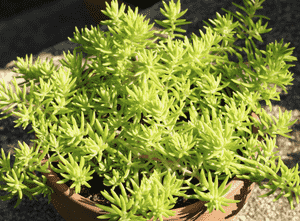
Mexican stonecrop(Sedum mexicanum)

Mexican stonecrop (Sedum mexicanum)

Also known as: Mexican Stonecrop, Goldmoss

Mexican stonecrop (Sedum mexicanum) is a succulent indigenous to Mexico. It features fleshy, needle-like leaves that often exhibit a bright green color, sometimes with a hint of yellow or red. This plant is particularly resilient, thriving in dry, rocky environments by storing water in its leaves. During the summer, it blooms with small, star-shaped yellow flowers that attract pollinators like butterflies and bees.

Uses:
1. **Ground Cover**: Ideal for use as ground cover due to its dense, mat-forming growth.
2. **Rock Gardens**: Perfect for rock gardens, where it can easily adapt to tough conditions.
3. **Container Planting**: Suitable for pots and hanging baskets, enhancing their visual appeal.
4. **Xeriscaping**: Excellent for water-conserving landscapes in arid regions.

Mexican stonecrop is appreciated for its aesthetic qualities, minimal maintenance needs, and adaptability in various horticultural applications.

Attributes of Mexican stonecrop

Lifespan
Perennial
Plant Type
Herb
Plant Height
30 cm
Spread
45 cm
Leaf Color
Green to yellow-green
Flower Size
Approx. 1 cm (0.4 inches)
Flower Color
Yellow

ForwardPlant - Identify plants with a snap

Identify and diagnose plants, get toxicity alerts, and explore safety guides for all types of fungi.

Try for Free

Images of Mexican stonecrop

Mexican stonecrop(Sedum mexicanum)

Quickly Identify Mexican stonecrop

1
Look for thin, needle-like leaves that are green to yellow-green, and yellow star-shaped flowers that bloom in clusters. The plant forms dense mats and can root at stem nodes.

Scientific Classification of Mexican stonecrop

Phylum
Vascular plants
Class
Dicotyledons
Order
Saxifragales
Family
Stonecrop
Genus
Stonecrops
Species
Mexican stonecrop

Planting and Growing of Mexican stonecrop

Care Difficulty
Easy
Watering Schedule
Every 3 days
Sunlight Requirements
Full sun
Sunshine Duration
4-8 hours
Ideal Temperature
65-75℉
Soil Type
Potting Mix, Peat Mix
Soil pH
6.5-7.5
Fertilizer Type
Balanced
Pruning Season
Spring, Summer
Pruning Area
Branches, Leaves
Pruning Frequency
2 times a year
Repotting Season
Spring
Pot Type
Plastic, Ceramic

water icon How to Water Mexican stonecrop?

When watering Sedum mexicanum, the amount should ideally allow the water to reach the root zone without waterlogging. Typically, 200 ml is sufficient, ensuring that the soil is thoroughly moist but not soggy. The goal is to mimic the natural rainfall without creating standing water, which can be damaging to the plant.
What are the symptoms of an underwatered Mexican stonecrop?
What should I do if my Mexican stonecrop is not getting enough water?
What are the symptoms of an overwatered Mexican stonecrop?
How to save an overwatered Mexican stonecrop?

sunlight icon What Are the Sunlight Requirements for Mexican stonecrop?

Sunlight Requirements: Full sun, Partial sun
Duration of light: 6 to 8 hours
Sedum mexicanum prefers full sun, thriving best under six to eight hours of sunlight. This condition ensures vibrant foliage and healthy growth, making the plant more resilient.
What is the best sun exposure?
How to achieve the ideal light conditions?
Benefits of achieving ideal lighting conditions?

temperature icon What Is the Ideal Temperature Range for Mexican stonecrop?

Ideal Temperature: 65 ~ 75℉
The ideal temperature range for growing Sedum mexicanum is between 65°F and 75°F. These temperatures provide the optimal conditions for photosynthesis, allowing the plant to thrive and develop healthy foliage. Maintaining this range will help the plant perform its physiological processes efficiently.

soil icon What Soil is Best for Mexican stonecrop?

Soil type: Sandy loam, Loam
Soil PH: 6.5 ~ 7.5
Sedum mexicanum thrives in soil that offers excellent drainage to prevent root rot. Well-draining soils help the plant stay healthy by ensuring excess water doesn't accumulate around the roots. While it can survive in poor soils, a moderately fertile soil will boost its growth. The presence of essential nutrients supports its vibrant foliage and overall resilience. This plant prefers soils that retain some moisture without becoming waterlogged. This helps to provide consistent hydration, particularly beneficial during dry spells.

fertilize icon How to Fertilize Mexican stonecrop?

Fertilizer type: Balanced
Sedum mexicanum prefers a light hand when it comes to fertilization. It's best to use a diluted liquid fertilizer at half the recommended strength to avoid over-fertilizing. This ensures that the plant receives enough nutrients without overwhelming its delicate systems.

prune icon How to Prune Mexican stonecrop?

Pruning Time: Spring, Summer, Autumn
Identify any stems that look decayed or infected and carefully remove them. This will prevent the spread of disease and keep your plant healthy and vigorous. Shape your plant by trimming any overgrown areas. Sedum mexicanum can get leggy if not maintained, so regular pruning helps keep its compact, appealing form. After blooming, cut back the flowered stems to encourage compact growth. This process not only tidies the plant but also diverts energy back into the foliage rather than seed production.

propagate icon How to Propagate Mexican stonecrop plant?

Propagate Time: Spring, Late Spring, Early Spring
1
To prepare the cuttings, select healthy, mature stems from the parent plant. Use sterilized shears to cut a segment approximately 3-4 inches long. Allow the cut ends to dry and callous over for a few days to minimize the risk of rot when planted.
2
Fill small pots with a well-draining succulent potting mix. Ensure that the containers have adequate drainage holes to prevent waterlogging, which can cause cuttings to rot before they root.
3
Insert the calloused end of each cutting into the prepared potting mix, burying it about an inch deep. Water the cuttings lightly to settle the soil around them, making sure not to overwater as this can encourage rot.

repot icon How to Repot Mexican stonecrop plant?

Repotting frequency: Every 2-3 years
1
You'll know it's time to repot Sedum mexicanum when you see roots poking out of the drainage holes, or when growth has slowed despite regular care. Repotting every 2 to 3 years is typically sufficient to provide fresh nutrients and space for the roots to expand.
2
Select a pot just slightly larger than the current one, with at least one drainage hole. The size should allow approximately an inch of space around the root ball to avoid excess soil that retains too much moisture, reducing the risk of root rot.
3
Opt for a well-draining cactus mix, which often contains sand, perlite, and organic matter. This mixture ensures adequate drainage while providing essential nutrients, preventing waterlogging – a common issue that can lead to root diseases.

ForwardPlant - Identify plants with a snap

Find the best spots for them to optimize their health, simply using your phone.

Try for Free

Toxicity

Ingestion

Identify toxic plants for your safety

Learn which plants are harmful to you and your pets, and make informed choices for a safer home!

Try for Free
WARNING
The judgment on toxicity and danger is for reference only. We DO NOT GUARANTEE any accuracy of such judgment. Therefore, you SHALL NOT rely on such judgment. It is IMPORTANT TO SEEK PROFESSIONAL ADVICE in advance when necessary.

