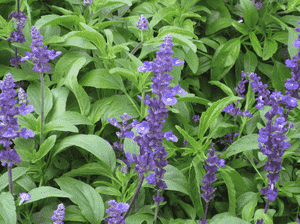
Mealycup sage (Salvia farinacea)
Also known as: Mealy sage, Blue sage
Mealycup sage (Salvia farinacea) flourishes best in full sun but can also tolerate partial sun. In temperate climates, it is typically grown as an annual, while in milder, frost-free areas, it can be a perennial. When planting in regions prone to frost, ensure it's done during frost-free periods. This adaptable plant comes in several varieties, showcasing violet, blue, or white blossoms.
In This Article
Attributes of Mealycup sage
Lifespan
Perennial, Annual, Biennial
Plant Type
Herb
Plant Height
30 cm to 90 cm
Spread
30 cm to 90 cm
Leaf Color
Green
Flower Size
2.5 cm
Flower Color
White Blue Purple Lavender
Images of Mealycup sage
Quickly Identify Mealycup sage
1
Erect, squared stems with fine trichomes
2
Opposite, ovate-lanceolate leaves with serrated edges
3
Terminal raceme of zygomorphic blue-purple flowers
4
Schizocarp fruit segmented into four nutlet chambers
5
Robust clumps reaching 2-3 feet in height and 1-2 feet in width
Scientific Classification of Mealycup sage
Phylum
Vascular plants
Class
Dicotyledons
Order
Mints plantains olives and allies
Family
Mint
Genus
Sages
Species
Mealycup sage
Planting and Growing of Mealycup sage
Care Difficulty
Easy
Watering Schedule
Every 4 days
Sunlight Requirements
Full sun
Sunshine Duration
6-10 hours
Ideal Temperature
65-80℉
Soil Type
Potting Mix, Peat Mix
Soil pH
6.5-7.5
Fertilizer Type
Balanced
Pruning Season
Spring, Summer
Pruning Area
Branches, Leaves
Pruning Frequency
2 times a year
Repotting Season
Spring
Pot Type
Terracotta, Plastic
 How to Water Mealycup sage?
When watering Salvia farinacea, aim to provide about 500 ml to ensure the soil is thoroughly moist without being waterlogged. The principle here is to water until you see some drainage but to avoid pooling water which can rot the roots.
More About Watering Techniques→
What are the symptoms of an underwatered Mealycup sage?
›
What should I do if my Mealycup sage is not getting enough water?
›
What are the symptoms of an overwatered Mealycup sage?
›
How to save an overwatered Mealycup sage?
›
 What Are the Sunlight Requirements for Mealycup sage?
Salvia farinacea thrives in full to partial sun conditions. This plant benefits from consistent, ample sunlight, which boosts its flowering and overall plant robustivity.
More About Sunlight Requirements Techniques→
Why does Salvia farinacea thrive in full sun?
›
How can Salvia farinacea receive the right amount of sunlight indoors?
›
What are the benefits of ensuring proper light for Salvia farinacea?
›
 What Is the Ideal Temperature Range for Mealycup sage?
Salvia farinacea thrives best in temperatures between 65°F and 80°F. This range provides the necessary warmth for optimal photosynthesis and robust growth, ensuring vibrant flowering and healthy foliage development. Maintaining this temperature range will help in achieving the plant's full potential and boost its overall resilience.
 What Soil is Best for Mealycup sage?
Salvia farinacea thrives in nutrient-rich soil, which provides the essential minerals and nutrients needed for healthy growth. Rich soil supports robust root development and abundant flowering. Soil with excellent drainage is crucial for Salvia farinacea to prevent root rot. Sandy loam and loam are perfect as they ensure water doesn't stagnate, allowing roots to breathe. While it prefers well-draining soil, moderate moisture retention helps maintain a consistent moisture level, preventing drought stress and promoting vigorous plant health.
More About Soil→
 How to Fertilize Mealycup sage?
For Salvia farinacea, it's ideal to apply liquid fertilizer at a concentration of 1/2 the recommended dose on the package. This ensures the plant receives the necessary nutrients without overwhelming its roots. Over-fertilization can lead to leaf burn and stunted growth, so it's critical to adhere to these guidelines.
More About Fertilizing Techniques→
 How to Prune Mealycup sage?
When pruning Salvia farinacea, it's crucial to make clean cuts. Ragged cuts can make the plant susceptible to pests and diseases. Always use sharp tools and sterilize them before use to avoid infecting the plant. Cut at a 45-degree angle to shed water and reduce the chance of rot. While Salvia farinacea can be pruned practically all year long, avoid heavy pruning late in the season. Extensive cutting back in the late fall might leave the plant vulnerable to cold damage as temperatures drop. Light pruning can be done in winter, but major reshaping is best saved for spring when the plant is actively growing.
More About Pruning Techniques→
 How to Propagate Mealycup sage plant?
1
Before sowing seeds, ensure seed trays are clean and filled with light, well-draining soil mix. Slightly moisten the soil to create a conducive environment for germination before placing seeds on the surface and covering them lightly.
2
Select healthy, disease-free branches from the parent plant during the growing season. Cut a 4-6 inch section below a node, remove the lower leaves, and dip the cut end in rooting hormone to increase the chances of successful root formation.
3
Once seedlings have developed a strong root system and are large enough to handle, carefully transplant them into individual pots or prepared garden beds. Ensure they have adequate space to grow and establish themselves.
 How to Repot Mealycup sage plant?
1
Repot Salvia farinacea when you notice roots growing out of the drainage holes of its current pot or if the plant's growth seems stunted. These are clear signals that it's time for a new home with more space for root expansion.
2
Select a pot that is one size larger than the current one. The new pot should have drainage holes to prevent waterlogging, which benefits the plant by ensuring healthy airflow and preventing root rot.
3
Choose a well-draining potting mix, ideally with a combination of perlite, peat, and pine bark. This mixture ensures optimal drainage and aeration, allowing the roots to take in oxygen while avoiding waterlogged conditions.
Learn More About Mealycup sage Diseases
Anthracnose
Bacterial Leaf Spot
Bacterial Wilt
Black Spot
Chemical Injury
Damping-off
Downy Mildew
Drought Stress
Fusarium Wilt
Gray Mold
Leaf Curl
Leaf Spot
Mosaic
Nutrient Deficiency
Nutrient Toxicity
Powdery Mildew
Root Rot
Root-knot Nematode
Rusts
Sooty Mold
Spider Mites
Temperature Stress
Thrips Damage
White Mold



