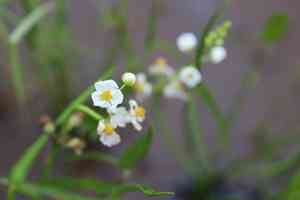
Broadleaf arrowhead (Sagittaria latifolia)
Also known as: Duckroot, Wapato, Katniss
Broadleaf arrowhead (Sagittaria latifolia) is a perennial aquatic plant that stands between 30 and 122 cm tall. Named for its characteristic arrow-shaped leaves, it displays clusters of white, three-petaled flowers with yellow or green centers from mid-summer to early fall. This plant thrives in wet environments, often found along stream banks, in marshes, or in shallow waters up to 1 foot deep. It prefers full sun but can tolerate partial shade and grows best in muddy or silty soils that remain consistently wet. Broadleaf arrowhead's robust root system makes it suitable for water gardens and erosion control.
In This Article
Attributes of Broadleaf arrowhead
Lifespan
Perennial
Plant Type
Herb
Plant Height
2 m to 20 m
Spread
30 cm to 90 cm
Leaf Color
Green
Flower Size
4 cm
Flower Color
White
Images of Broadleaf arrowhead
Quickly Identify Broadleaf arrowhead
1
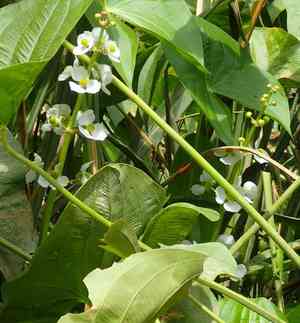
Distinctive arrow-shaped leaves up to 30 cm (12 inches) long, emerging from a cluster at the base.
2
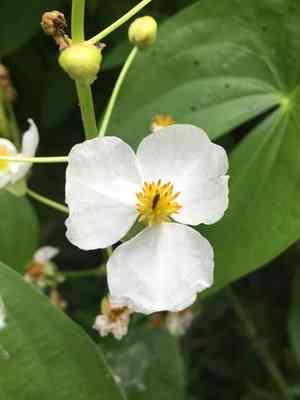
Eye-catching 3-petaled white flowers, each 2.5 to 3.8 cm (1 to 1.5 inches) in diameter.
3
Long stalked flowers in whorls of three, each measuring about 1 inch (2.5 cm) in diameter.
4
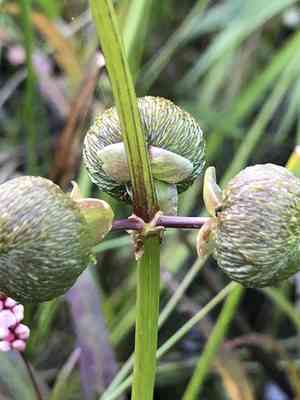
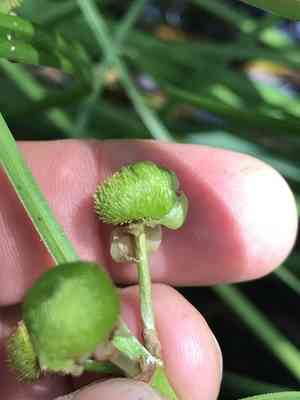
Fruit is a 3-angled achene with winged extensions, transitioning from green to brown hues.
5
Leaves are lanceolate to arrow-shaped, sagittate with long petioles and sheath-like base.
Scientific Classification of Broadleaf arrowhead
Phylum
Vascular plants
Class
Monocotyledons
Order
Alismatales
Family
Water-plantain
Genus
Arrowheads
Species
Broadleaf arrowhead
Planting and Growing of Broadleaf arrowhead
Care Difficulty
Easy
Watering Schedule
Every 4 days
Sunlight Requirements
Partial sun
Sunshine Duration
6-10 hours
Ideal Temperature
68-86℉
Soil Type
Potting Mix, Peat Mix
Soil pH
6.5-7.5
Fertilizer Type
Balanced
Pruning Season
Spring, Summer
Pruning Area
Branches, Leaves
Pruning Frequency
2 times a year
Repotting Season
Spring
Pot Type
Plastic, Ceramic
 How to Water Broadleaf arrowhead?
Sagittaria latifolia, commonly known as Broadleaf Arrowhead, thrives in moist environments. Watering should ensure the soil is consistently wet but not waterlogged, mimicking its natural marshy habitat. Aim for about 500 ml each time.
What are the symptoms of an underwatered Broadleaf arrowhead?
›
What should I do if my Broadleaf arrowhead is not getting enough water?
›
What are the symptoms of an overwatered Broadleaf arrowhead?
›
How to save an overwatered Broadleaf arrowhead?
›
 What Are the Sunlight Requirements for Broadleaf arrowhead?
Sagittaria latifolia prospers in environments with partial to full sun exposure. Ideal lighting ensures robust foliage, vigorous growth, and rich blooms, functioning in tandem with its natural aquatic habitat.
More About Sunlight Requirements Techniques→
Optimal Light Intensity
›
Adjusting Seasonal Light Levels
›
Consistent Light Monitoring
›
 What Is the Ideal Temperature Range for Broadleaf arrowhead?
Sagittaria latifolia thrives best when kept within the temperature range of 68 to 86 degrees Fahrenheit. This range supports its physiological processes, ensuring robust growth and healthy foliage.
 What Soil is Best for Broadleaf arrowhead?
Sagittaria latifolia thrives in moist soil conditions. This essential requirement ensures the plant can absorb adequate water and nutrients, which supports its robust growth and vibrant foliage. While moist conditions are vital, the soil must also offer good drainage to prevent water stagnation. Proper drainage helps avoid root rot and ensures healthy root development. A substrate rich in organic matter provides necessary nutrients. The plant benefits from such soil by developing resilient foliage and enhanced flowering owing to the rich nutrient supply.
 How to Fertilize Broadleaf arrowhead?
When fertilizing Sagittaria latifolia, it's important to provide a balanced nutrient input. Use about 1/2 to 1 teaspoon of liquid fertilizer per gallon of water, or apply approximately 20 grams of slow-release fertilizer per square meter. This ensures the plant has enough nutrients without overwhelming it.
 How to Prune Broadleaf arrowhead?
Begin by inspecting your Sagittaria latifolia for any damaged or dead leaves. Use sharp, clean scissors or pruning shears to cut these leaves at the base. Next, thin out the plant by removing some of the more crowded stems to improve air circulation. Be careful not to remove more than one-third of the plant at each pruning session to avoid stressing it unnecessarily. After removing dead and crowded growth, focus on shaping the plant. Trim back any excessively long or unwanted shoots to maintain a neat appearance. Regular shaping will encourage more robust growth and flowering, ensuring your Sagittaria latifolia remains healthy and attractive.
More About Pruning Techniques→
 How to Propagate Broadleaf arrowhead plant?
1
Sagittaria latifolia seeds should be soaked in water for 24 hours before planting to enhance the germination process. This step is crucial in breaking the seed's dormancy and speeding up germination.
2
To propagate through division, locate mature clumps during the early spring. Use a garden trowel to carefully dig around the plant, preserving as much root as possible, and gently separate the clumps ensuring each has a healthy root system.
3
After division or seed germination, transplant the seedlings or new divisions into a suitable spot or container with adequate water access. It's important to water them regularly until the plant establishes.
 How to Repot Broadleaf arrowhead plant?
1
It's time to repot Sagittaria latifolia when the roots begin to outgrow the current pot, visibly poking through the drainage holes. Another sign is if the plant's growth starts to slow down, indicating potentially compacted soil. Repotting should ideally happen in the spring when new growth naturally occurs, giving the plant ample time to adjust to its new environment throughout the growing season.
2
When selecting a new pot for Sagittaria latifolia, prefer one that is about 2 inches larger in diameter than the current container. This additional space encourages growth without overwhelming the plant with excessive moist soil, which can lead to root rot. The pot should have sufficient drainage holes to prevent waterlogging, which is vital because this plant thrives in consistently moist soils.
3
Sagittaria latifolia prefers a rich, loamy soil that provides a balance of moisture retention and drainage, mimicking its natural marshy habitats. A mix containing organic materials like peat and compost will enhance nutrient availability, crucial for robust growth. This type of soil supports healthier root systems by maintaining aeration while still being supportive of the plant's aquatic nature.



