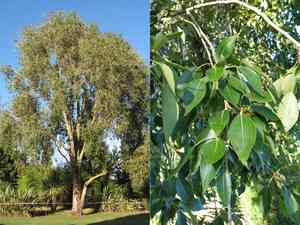
Simon's poplar (Populus simonii)
Also known as: Simon poplar
The Simon's poplar can grow up to 20 meters tall, featuring a narrow crown and a trunk diameter of up to 50 centimeters. In young trees, the stem bark is grayish-green, transitioning to dark gray and becoming furrowed as the tree matures. The branches are smooth, reddish-brown, slender, and round in cross-section, with more robust shoots sometimes displaying an angular profile. The buds are brown, elongated, pointed, and sticky.
In This Article
Attributes of Simon's poplar
Lifespan
Perennial
Plant Type
Tree
Plant Height
30 m
Spread
2 m to 6 m
Leaf Color
Green
Flower Size
Not applicable (as the flowers are catkins, not typical flowers)
Flower Color
Yellow Green
Images of Simon's poplar
Quickly Identify Simon's poplar
1
Populus simonii can be identified by its broad, ovate leaves with finely toothed margins, and its smooth, greenish-gray bark. During its flowering period in spring, it produces small, catkin-like flowers.
Scientific Classification of Simon's poplar
Phylum
Vascular plants
Class
Dicotyledons
Order
Malpighiales
Family
Willow
Genus
Populus
Species
Simon's poplar
Planting and Growing of Simon's poplar
Care Difficulty
Easy
Watering Schedule
Every 2 days
Sunlight Requirements
Full sun
Sunshine Duration
6-10 hours
Ideal Temperature
50-77℉
Soil Type
Potting Mix, Peat Mix
Soil pH
6.5-7.5
Fertilizer Type
Balanced
Pruning Season
Spring, Summer
Pruning Area
Branches, Leaves
Pruning Frequency
2 times a year
Repotting Season
Spring
Pot Type
Plastic, Ceramic
 How to Water Simon's poplar?
When watering Populus simonii, it's crucial to ensure the soil is thoroughly moistened but not waterlogged. Apply approximately 1000 ml of water, allowing it to deeply penetrate the root zone without leaving the soil overly saturated.
What are the symptoms of an underwatered Simon's poplar?
›
What should I do if my Simon's poplar is not getting enough water?
›
What are the symptoms of an overwatered Simon's poplar?
›
How to save an overwatered Simon's poplar?
›
 What Are the Sunlight Requirements for Simon's poplar?
Populus simonii thrives in full sun conditions. Ideal light exposure enhances its growth and vitality, providing energy for photosynthesis and structural development.
More About Sunlight Requirements Techniques→
What is the ideal amount of sunlight for Populus simonii?
›
How can you achieve ideal lighting for Populus simonii?
›
What are the benefits of ideal lighting conditions for Populus simonii?
›
 What Is the Ideal Temperature Range for Simon's poplar?
The ideal temperature range for cultivating Populus simonii is between 50°F and 77°F. This range provides the best conditions for enzymatic activities and physiological processes vital for growth. Within this temperature bracket, the metabolism of the plant is most efficient, allowing for steady growth and development. It is crucial to maintain this temperature range, particularly in controlled environments, to ensure optimal performance and minimize stress on the plant.
 What Soil is Best for Simon's poplar?
Populus simonii thrives in nutrient-rich soil that provides the essential minerals needed for vigorous growth. Adequate organic matter enhances soil fertility, ensuring the tree develops a strong root system, supports robust foliage, and increases its overall resilience against diseases. This species favors well-draining soil to prevent waterlogging, which can lead to root rot. Good drainage ensures the roots access oxygen efficiently, supporting optimal health and growth. Implementing a well-aerated soil structure helps in maintaining healthy moisture levels. The soil should retain moderate moisture to provide consistent hydration without becoming soggy. This balance is crucial as it allows Populus simonii to remain hydrated during dry spells, while excessive wet conditions are avoided, reducing the risk of root diseases.
 How to Fertilize Simon's poplar?
For Populus simonii, it is important to measure the right amount of fertilizer. Typically, for a young tree, about 1 pound of a balanced 10-10-10 NPK fertilizer per inch of trunk diameter is recommended annually. Mature trees may need less due to established nutrient acquisition systems. Always water thoroughly after applying to ensure even distribution and avoid root burn.
 How to Prune Simon's poplar?
Begin by inspecting your Populus simonii for any dead, diseased, or damaged branches. Prepare your tools including sharp pruning shears, loppers, and possibly a small saw for thicker branches to ensure clean cuts and minimize plant stress. Carefully identify branches that are crossing, rubbing, or growing towards the center of the tree. Cut these branches at their base, ensuring you cut at a safe angle to promote proper healing and avoid water collection. Decide on the desired shape of the tree, typically an open or slightly rounded form. Trim back branches that protrude beyond this natural shape to maintain aesthetics and light penetration through the canopy. After pruning, collect all discarded branches and leaves, disposing them properly to prevent any potential diseases from spreading. Clean your tools to maintain their quality and reduce disease transmission in future use.
More About Pruning Techniques→
 How to Propagate Simon's poplar plant?
1
Choose healthy, disease-free branches about the thickness of a pencil. These should be cut during the dormant season for best results, ensuring the plant's energy is directed towards new growth.
2
Cut the selected branches into 8-12 inch sections with at least two nodes per cutting. Remove any leaves or side branches to reduce transpiration and encourage root development.
3
Dip the cut end of the cutting in rooting hormone, then plant it in moist, well-draining soil or a propagation medium. Ensure at least one node is buried to promote rooting.
 How to Repot Simon's poplar plant?
1
Populus simonii needs repotting when you notice that roots are circling the pot or protruding from the drainage holes. These are strong indicators that the plant requires more space for growth. Repotting during the growing seasons ensures minimal shock, allowing the plant to recover more swiftly.
2
Selecting the right pot is crucial. Opt for a pot that's 2-3 inches larger in diameter than the current one. This provides sufficient room for root expansion, encouraging healthy growth. Ensure the pot has drainage holes to prevent waterlogging, which could lead to root rot.
3
The ideal soil for repotting Populus simonii should be a well-draining organic mix. This ensures that excess water can escape, preventing damp conditions that could foster root disease. A soil mix rich in organic matter also provides essential nutrients for robust growth.



