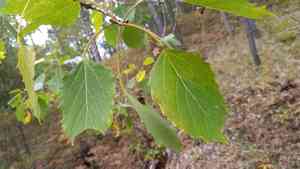
Big-tooth aspen(Populus grandidentata)

Big-tooth aspen (Populus grandidentata)

Also known as: American aspen, Canadian poplar, Large-toothed poplar

The big-tooth aspen (Populus grandidentata) is a deciduous tree that typically reaches heights of 18 to 24 meters. In its youth, it has smooth, orange-green bark that transitions to a brown, furrowed texture with age. The tree's oval leaves have distinct, coarse, toothed edges and turn a striking yellow in the fall. It is a dioecious species, meaning individual trees are either male or female. Male trees produce tan, drooping catkins, while female trees generate smaller flowers that develop seeds. The species can also propagate clonally through root suckers, aiding in rapid reforestation post-disturbance, such as after a fire. Various wildlife species feed on its leaves, bark, twigs, and flower buds, making it integral to its ecosystem.

Attributes of Big-tooth aspen

Lifespan
Perennial
Plant Type
Tree
Plant Height
18 m to 24 m
Spread
6 m to 12 m
Leaf Color
White
Flower Size
1 mm to 2 mm
Flower Color
Green

ForwardPlant - Identify plants with a snap

Identify and diagnose plants, get toxicity alerts, and explore safety guides for all types of fungi.

Try for Free

Images of Big-tooth aspen

Big-tooth aspen(Populus grandidentata)

Quickly Identify Big-tooth aspen

1
Populus grandidentata can be identified by its leaves, which are ovate and feature large, irregular teeth along their margins. The bark is smooth and greenish-white in young trees but becomes rougher and gray in older trees.

Scientific Classification of Big-tooth aspen

Phylum
Vascular plants
Class
Dicotyledons
Order
Malpighiales
Family
Willow
Genus
Populus
Species
Big-tooth aspen

Planting and Growing of Big-tooth aspen

Care Difficulty
Easy
Watering Schedule
Every 3 days
Sunlight Requirements
Full sun
Sunshine Duration
4-8 hours
Ideal Temperature
65-75℉
Soil Type
Potting Mix, Peat Mix
Soil pH
6.5-7.5
Fertilizer Type
Balanced
Pruning Season
Spring, Summer
Pruning Area
Branches, Leaves
Pruning Frequency
Once a year
Repotting Season
Spring
Pot Type
Plastic, Ceramic

water icon How to Water Big-tooth aspen?

When it comes to Populus grandidentata, you want to ensure the soil is adequately moist, but not waterlogged. The ideal watering amount is about 500 milliliters each time, allowing the water to reach deep into the root system, ensuring that the soil is moist to a depth of at least 15 centimeters.
What are the symptoms of an underwatered Big-tooth aspen?
What should I do if my Big-tooth aspen is not getting enough water?
What are the symptoms of an overwatered Big-tooth aspen?
How to save an overwatered Big-tooth aspen?

sunlight icon What Are the Sunlight Requirements for Big-tooth aspen?

Sunlight Requirements: Full sun, Partial sun
Duration of light: 6 to 8 hours
Populus grandidentata requires partial to full sun, with up to 8 hours of light. Ideal lighting promotes strong growth, robust leaf development, and overall tree health, enhancing its aesthetic and environmental contributions.
How much light does Populus grandidentata need?
Solutions for achieving ideal lighting
Benefits of ideal lighting for Populus grandidentata
More About Sunlight Requirements Techniques

temperature icon What Is the Ideal Temperature Range for Big-tooth aspen?

Ideal Temperature: 65 ~ 75℉
For Populus grandidentata, the ideal temperature range is between 65 to 75°F. This range provides optimal growth conditions, ensuring that the plant can perform photosynthesis efficiently. Maintaining these temperatures helps in achieving healthy foliage and overall plant vitality.

soil icon What Soil is Best for Big-tooth aspen?

Soil type: Loam, Sandy loam, Acidic soil
Soil PH: 6.5 ~ 7.5
Populus grandidentata thrives in nutrient-rich soils that provide essential minerals for healthy growth and development, boosting its resilience and overall vitality. Well-drained soil prevents waterlogging which can lead to root rot, ensuring that the roots of Populus grandidentata receive adequate oxygen and remain healthy. Maintaining sufficient moisture is crucial for Populus grandidentata, as it supports optimal growth and prevents drought stress, which can inhibit development.

fertilize icon How to Fertilize Big-tooth aspen?

Fertilizer type: Balanced
For Populus grandidentata, begin with a balanced fertilizer, such as 10-10-10 NPK ratio. Young trees require less than mature ones. Typically, use about 1 pound per inch of diameter measured at breast height. Avoid over-fertilizing to prevent damage.

prune icon How to Prune Big-tooth aspen?

Pruning Time: Spring, Summer
Begin by examining the overall structure of the Populus grandidentata. Identify branches that are dead, diseased, or crossing over others. This assessment will guide your pruning strategy to enhance the tree's health and aesthetic look. Use clean and sharp pruning shears for small branches and loppers for those that are thicker. For larger cuts, a pruning saw might be required. Clean tools reduce the incidence of infections. When making cuts, position your tools just outside the branch collar, which is the swollen area where the branch meets the trunk. This technique encourages proper healing and prevents future disease. If controlling the size is essential, selectively prune terminal growth to reduce height while keeping the tree's natural form intact. Balance height reduction by correspondingly thinning branch densities to prevent top-heaviness. More About Pruning Techniques

propagate icon How to Propagate Big-tooth aspen plant?

Propagate Time: Early spring, Spring, Late spring
1
Gather seeds from mature Populus grandidentata trees in the autumn. Ensure that the seeds are fully developed and dry before storing them in a cool, dry place until spring.
2
Take 6 to 12-inch long cuttings from healthy branches in late winter or early spring. Ensure each cutting has several buds and remove any leaves from the lower portion.
3
Plant seeds or cuttings in a well-draining potting mix. For cuttings, make a hole with a pencil and insert the cutting, firming the soil around it to eliminate air pockets.
More About Propagating Techniques

repot icon How to Repot Big-tooth aspen plant?

Repotting frequency: Every 1-2 years
1
Populus grandidentata shows signs of needing a new pot when roots start encircling the container, soil drains too quickly, and growth seems stunted. These indicators suggest that the plant is outgrowing its current space and now requires a fresh, spacious environment to continue thriving.
2
Select a pot that is one size larger and features good drainage. The additional size gives the roots ample room to expand, while adequate drainage prevents waterlogging, reducing the risk of root rot and ensuring a healthier plant growth trajectory.
3
Opt for a loamy, well-draining soil mix to maintain moisture without waterlogging. This type of soil ensures that the roots receive necessary nutrients and air, providing a balance that supports vascular functions critical to Populus grandidentata's growth and vitality.

ForwardPlant - Identify plants with a snap

Find the best spots for them to optimize their health, simply using your phone.

Try for Free