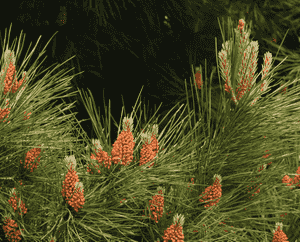
Maritime pine (Pinus pinaster)
Also known as: Boornemouth pine, Bournemouth pine
The tree you're thinking of is the **Maritime Pine (Pinus pinaster)**. This tall pine, prevalent around the Mediterranean Basin and especially on the Iberian Peninsula, can grow up to 35 meters. It thrives in acidic, sandy, and nutrient-poor soils and is widely harvested for its timber.
In This Article
Attributes of Maritime pine
Lifespan
Perennial
Plant Type
Tree
Plant Height
20 m to 35 m
Spread
7 m
Leaf Color
Green
Flower Size
8 cm to 15 cm
Flower Color
Yellow Red Brown Orange Burgundy
Images of Maritime pine
Quickly Identify Maritime pine
1
Two needles per cluster, occasionally three, measuring 4-6 inches (10-15 cm) long, with serrated margins.
2
Rugged, deeply fissured bark with a thick, scaly texture in shades of grey-brown.
3
Seed cones transitioning from green to chestnut brown, 4-8 inches (10-20 cm) long, opening gradually for seed dispersion.
4
Sturdy, robust growth reaching heights up to 100 feet (30 meters), exhibiting a high branching habit.
5
Tough, flexible leaves in clusters, exhibiting parallel vein patterns and green to yellow-green coloring.
Scientific Classification of Maritime pine
Phylum
Vascular plants
Class
Conifers
Order
Pinales
Family
Pine
Genus
Pines
Species
Maritime pine
Planting and Growing of Maritime pine
Care Difficulty
Easy
Watering Schedule
Every 2 days
Sunlight Requirements
Full sun
Sunshine Duration
4-8 hours
Ideal Temperature
55-77℉
Soil Type
Potting Mix, Peat Mix
Soil pH
4.5-8
Fertilizer Type
Balanced
Pruning Season
Spring, Summer
Pruning Area
Branches, Leaves
Pruning Frequency
2 times a year
Repotting Season
Spring
Pot Type
Plastic, Ceramic
 How to Water Maritime pine?
When watering Pinus pinaster, ensure the soil is adequately moist but not waterlogged. Aim for around 500ml per watering session, allowing excess water to drain freely. The goal is to mimic the tree's natural habitat conditions where the root zone is kept consistently damp but not overly saturated.
What are the symptoms of an underwatered Maritime pine?
›
What should I do if my Maritime pine is not getting enough water?
›
What are the symptoms of an overwatered Maritime pine?
›
How to save an overwatered Maritime pine?
›
 What Are the Sunlight Requirements for Maritime pine?
Pinus pinaster thrives best under full sun exposure, with ideal benefits including enhanced growth, healthier foliage, and increased disease resistance due to improved photosynthetic activity and energy production.
More About Sunlight Requirements Techniques→
What is the ideal lighting condition?
›
Why is full sun exposure important?
›
How can one ensure adequate sun exposure?
›
 What Is the Ideal Temperature Range for Maritime pine?
The optimal temperature range for the successful growth of Pinus pinaster is between 55°F and 77°F. Within this range, the metabolic processes of the tree function efficiently, promoting photosynthesis, nutrient uptake, and healthy development.
 What Soil is Best for Maritime pine?
Pinus pinaster thrives in well-drained soils which prevent waterlogging that can lead to root rot. Ensuring proper drainage allows the roots to access air and nutrients efficiently, promoting healthy growth. This pine species benefits from a nutrient-rich environment where organic matter contributes to its robust growth. Enriched soils offer essential nutrients needed for producing lush foliage and stronger trunks. Pinus pinaster prefers soils with a pH range from slightly acidic to neutral. This range ensures optimal nutrient availability and absorption, which is crucial for the tree's vigor and resilience.
 How to Fertilize Maritime pine?
For Pinus pinaster, apply a balanced liquid fertilizer diluted to half strength. When using slow-release fertilizer, spread approximately 40 grams per square meter evenly over the root zone to avoid nutrient burn.
 How to Prune Maritime pine?
Using appropriate, well-maintained tools is vital in pruning Pinus pinaster. Secateurs, loppers, and pruning saws should be sharp to make clean cuts, preventing damage to the plant's tissue that could invite pests and diseases. Over-pruning can stress Pinus pinaster, leading to growth setbacks. It is recommended to remove no more than one-third of the tree’s foliage in one session. A conservative approach helps the tree recover quickly and encourages healthy development. Pruning should align with the tree's growing season to minimize stress. Late winter to early spring is ideal before the onset of new growth. However, summer pruning can help maintain shape and remove unwanted new growth more easily.
More About Pruning Techniques→
 How to Propagate Maritime pine plant?
1
Begin by collecting mature cones from the tree. Open the cones by drying them in a warm place to release the seeds. Ensure seeds are viable by performing a float test, discarding any that float.
2
Select healthy scions of the current season's growth, ideally from a vigorous parent plant, and cut when dormant. Prepare rootstock plants by trimming them to the appropriate height, ready for grafting.
3
Fill seed trays with a good-quality seed-starting mix. Sow the seeds on the surface, covering lightly with a thin layer of soil. Maintain consistent moisture and provide indirect sunlight to encourage germination.
 How to Repot Maritime pine plant?
1
Look for signs like roots protruding from the pot's drainage holes, or when growth seems stunted despite proper care. Pinus pinaster benefits from repotting in early spring or autumn when the climate is milder, minimizing stress and allowing the roots to establish in new soil.
2
Select a pot with good drainage, ideally with one or more drainage holes, to prevent waterlogging. An increase in pot size by around one or two sizes should suffice, allowing ample room for root expansion while avoiding excessive soil that may retain moisture.
3
Opt for a well-draining sandy soil mix that's mildly acidic to neutral. This type of soil emulates the tree's natural environment, promotes proper root aeration, and reduces the risk of overwatering and root rot, ensuring healthy root development.



