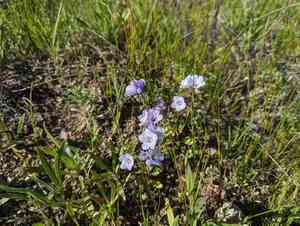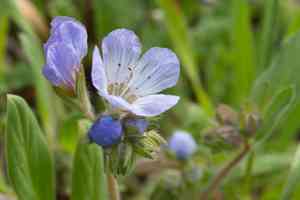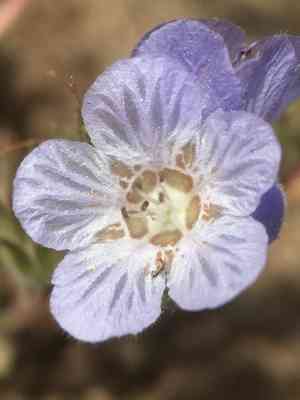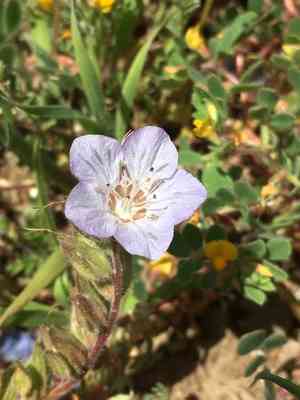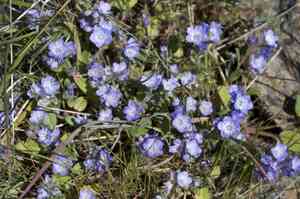
Divaricate phacelia(Phacelia divaricata)

Divaricate phacelia (Phacelia divaricata)

Also known as: Phacelia, Scorpionweed

Divaricate phacelia (Phacelia divaricata) is a notable wildflower with unique attributes and significant ecological contributions.

**Characteristics:**
1. **Growth Form:** It is an annual herb that features a branching, spreading growth habit.
2. **Leaf Structure:** The leaves are intricately lobed, often giving them a textured, somewhat fern-like appearance.
3. **Flower Description:** The plant showcases small, bell-shaped flowers, typically in shades of blue or lavender, which bloom in loose clusters.
4. **Preferred Habitat:** It prospers in dry, open habitats, often in rocky or sandy soils.

**Ecological Benefits:**
1. **Pollinator Attraction:** The vibrant flowers are a magnet for various pollinators, including bees and butterflies, which help pollinate other plants in the ecosystem.
2. **Soil Improvement:** As a pioneer species, it aids in soil stabilization and enriches the soil with organic matter as it decomposes.
3. **Biodiversity Enhancement:** By providing food and habitat, it supports a diverse array of insects and other wildlife, promoting overall ecosystem health.

In essence, divaricate phacelia is a resilient flowering plant that plays a crucial role in attracting pollinators, improving soil quality, and boosting biodiversity in its native environment.

Attributes of Divaricate phacelia

Lifespan
Annual
Plant Type
Herb
Plant Height
12-20 inches
Spread
12-18 inches
Leaf Color
Green
Flower Size
0.5-0.75 inches
Flower Color
Blue to Violet

ForwardPlant - Identify plants with a snap

Identify and diagnose plants, get toxicity alerts, and explore safety guides for all types of fungi.

Try for Free

Images of Divaricate phacelia

Divaricate phacelia(Phacelia divaricata)

Quickly Identify Divaricate phacelia

1
Phacelia divaricata can be identified by its deeply lobed or divided leaves and distinctively coiled inflorescences that unfurl as they bloom, resembling a scorpion\'s tail.

Scientific Classification of Divaricate phacelia

Phylum
Vascular plants
Class
Dicotyledons
Order
Boraginales
Family
Waterleaf
Genus
Heliotrope
Species
Divaricate phacelia

Planting and Growing of Divaricate phacelia

Care Difficulty
Easy
Watering Schedule
Every 4 days
Sunlight Requirements
Partial sun
Sunshine Duration
4-8 hours
Ideal Temperature
60-75℉
Soil Type
Potting Mix, Peat Mix
Soil pH
6.5-7.5
Fertilizer Type
Balanced
Pruning Season
Spring, Summer
Pruning Area
Branches, Leaves
Pruning Frequency
2 times a year
Repotting Season
Spring
Pot Type
Terracotta, Plastic

water icon How to Water Divaricate phacelia?

For Phacelia divaricata, watering should be enough to moisten the soil while ensuring good drainage. It's best to use about 250 ml of water each time, checking that the soil is moist but not waterlogged. Aim for the soil to dry slightly between waterings to prevent root rot.
What are the symptoms of an underwatered Divaricate phacelia?
What should I do if my Divaricate phacelia is not getting enough water?
What are the symptoms of an overwatered Divaricate phacelia?
How to save an overwatered Divaricate phacelia?

sunlight icon What Are the Sunlight Requirements for Divaricate phacelia?

Sunlight Requirements: Partial sun
Duration of light: 4 to 6 hours
Partial sun exposure, like 4 to 6 hours of diffused sunlight, supports Phacelia divaricata by aiding its photosynthesis needs, ensuring healthy growth and vibrant blooms.
How much sun does Phacelia divaricata need?
What are the best ways to provide ideal light?
What benefits does ideal light bring to the plant?

temperature icon What Is the Ideal Temperature Range for Divaricate phacelia?

Ideal Temperature: 60 ~ 75℉
Phacelia divaricata thrives best within a temperature range of 60 to 75 °F. This environment allows its physiological processes, such as photosynthesis and nutrient uptake, to occur optimally. Maintaining this temperature range is crucial for the plant's growth and overall health.

soil icon What Soil is Best for Divaricate phacelia?

Soil type: Sandy loam, Loam, Sand soil
Soil PH: 6.5 ~ 7.5
Phacelia divaricata thrives in nutrient-rich soil as it provides essential minerals necessary for its growth. A well-fertilized base ensures prolific flowering, enhancing its visual appeal and ecological benefits, such as attracting pollinators. Well-drained soil is vital for Phacelia divaricata since it prevents waterlogging and root rot. Effective drainage helps maintain the plant's health, allowing it to flourish with vigorous growth and bright blooms. Soil that retains moisture yet drains well supports continuous growth. Phacelia divaricata benefits as the soil's moisture balance helps sustain the plant during dry periods, ensuring steady development and resilience against drought stress.

fertilize icon How to Fertilize Divaricate phacelia?

Fertilizer type: Balanced
For Phacelia divaricata, it is crucial to use a balanced liquid fertilizer at a concentration of half strength. Apply approximately 100-150 ml of this diluted solution per plant to ensure adequate nutrient supply without the risk of over-fertilization.

prune icon How to Prune Divaricate phacelia?

Pruning Time: Spring, Summer
Start by removing dead or damaged stems, cutting them at the base to promote a tidy and healthy plant appearance. Next, trim the plant to shape it, ensuring to maintain an open structure that allows light and air circulation. This helps reduce the risk of fungal diseases. If your Phacelia divaricata has grown too large for its space, focus on cutting back the outer stems. Remove up to one-third of the plant’s height to encourage compact growth, making sure to cut above a leaf node for optimal recovery and regrowth. More About Pruning Techniques

propagate icon How to Propagate Divaricate phacelia plant?

Propagate Time: Spring, Early spring
1
Fill a seed tray with a light potting mix, sprinkle the Phacelia divaricata seeds on top, and lightly cover them with soil. Water gently to keep the top layer moist without flooding.
2
Choose a healthy stem and cut a 4-6 inch section below a node. Remove the lower leaves and dip the cut end in rooting hormone, then plant in a propagation tray filled with a potting mix.
3
Place the seed tray or cuttings in a warm, shaded area. Use a propagator lid or plastic cover to maintain humidity levels, essential for seed germination and rooting development.
More About Propagating Techniques

repot icon How to Repot Divaricate phacelia plant?

Repotting frequency: Every 2-3 years
1
Repot Phacelia divaricata when you notice roots outgrowing their current pot or coming out of the drainage holes. Other signals include a slowed growth rate and the soil drying out quicker than usual. Choose a time in early spring or autumn for the best transitional phase into its new pot.
2
Select a pot that's one size larger than the current one and ensures good drainage with ample holes at the bottom. The material of the pot can be terracotta or plastic, but terracotta allows for better airflow and evaporation, reducing the risk of root rot.
3
Use a well-draining loamy mix that provides both aeration and water retention. Incorporating perlite or sand into the soil mix can enhance drainage, preventing waterlogging and promoting healthy root growth.

ForwardPlant - Identify plants with a snap

Find the best spots for them to optimize their health, simply using your phone.

Try for Free

Toxicity

Ingestion, Dermal exposure

Identify toxic plants for your safety

Learn which plants are harmful to you and your pets, and make informed choices for a safer home!

Try for Free
WARNING
The judgment on toxicity and danger is for reference only. We DO NOT GUARANTEE any accuracy of such judgment. Therefore, you SHALL NOT rely on such judgment. It is IMPORTANT TO SEEK PROFESSIONAL ADVICE in advance when necessary.