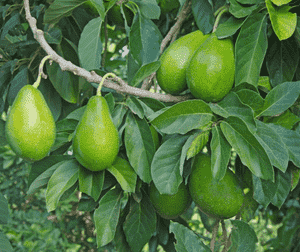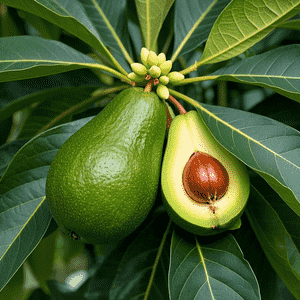
Avocado(Persea americana)

Avocado (Persea americana)

Also known as: Alligator pear

Persea americana, commonly known as the avocado tree, originates from Central America and Mexico. This evergreen tree, which may become semi-deciduous in cooler climates, is now cultivated globally for its nutrient-rich fruits. Renowned for its creamy texture and unique flavor, the avocado is a staple in various cuisines for its high levels of healthy fats and other nutrients.

Attributes of Avocado

Lifespan
Perennial
Plant Type
Tree
Plant Height
10 m to 20 m
Spread
10 m
Leaf Color
Green
Flower Size
5 mm to 1 cm
Flower Color
Yellow Green

PlantJoy - Identify plants with a snap

Identify and diagnose plants, get toxicity alerts, and explore safety guides for all types of fungi.

Try for Free

Images of Avocado

Avocado(Persea americana)

Quickly Identify Avocado

1
Oval, glossy dark green leaves, 4-10 inches (10-25 cm) long.
2
Pear-shaped fruit with rough, alligator-like skin in green to black colors.
3
Inconspicuous greenish-yellow flowers in branched panicles, bloom in spring.
4
Creamy textured edible flesh inside oval to pear-shaped fruit, 3-6 inches (7.5-15 cm).
5
Distinctive elliptic leaves with smooth texture, 4-8 inches (10-20 cm) long.

Scientific Classification of Avocado

Phylum
Vascular plants
Class
Dicotyledons
Order
Laurels, spicebushes and allies
Family
Laurel
Genus
Persea
Species
Avocado

Planting and Growing of Avocado

Care Difficulty
Hard
Watering Schedule
Every 2 days
Sunlight Requirements
Full sun
Sunshine Duration
6-8 hours
Ideal Temperature
60-85℉
Soil Type
Potting Mix, Peat Mix
Soil pH
6-7.5
Fertilizer Type
Balanced
Pruning Season
Spring, Summer
Pruning Area
Branches, Leaves
Pruning Frequency
Once a year
Repotting Season
Spring
Pot Type
Plastic, Ceramic

water icon How to Water Avocado?

For Persea americana, ensuring the soil is adequately moist but not waterlogged is key. A general guideline is to water until about 500 ml thoroughly saturates the soil, promoting root health without drowning them. It's crucial to allow the top inch of the soil to dry out before the next watering to prevent excess moisture build-up.
What are the symptoms of an underwatered Avocado?
What should I do if my Avocado is not getting enough water?
What are the symptoms of an overwatered Avocado?
How to save an overwatered Avocado?
More About Watering Techniques

sunlight icon What Are the Sunlight Requirements for Avocado?

Sunlight Requirements: Full sun, Partial sun
Duration of light: 6 to 8 hours daily
Persea americana thrives in full sun to partial sun, benefiting from 6 to 8 hours of sunlight daily. Proper light exposure promotes healthy foliage and maximizes fruit production.
How much light does Persea americana need?
What is the best location for planting?
What are the benefits of ideal lighting?
More About Sunlight Requirements Techniques

temperature icon What Is the Ideal Temperature Range for Avocado?

Ideal Temperature: 60 ~ 85℉
Persea americana, commonly known as avocado, thrives best in temperatures ranging from 60°F to 85°F. At these temperatures, the plant can perform photosynthesis efficiently, support healthy leaf development, and produce high-quality fruit.

soil icon What Soil is Best for Avocado?

Soil type: Loam, Sandy loam
Soil PH: 6 ~ 7.5
Persea americana thrives in nutrient-rich soil that is well-drained and fertile. This ensures that the plant has access to essential nutrients, promoting healthy growth and fruit production. The soil must have excellent drainage properties to prevent water logging around the roots, which can cause root rot and negatively impact plant health. High organic matter content in the soil improves its structure, enhances nutrient availability, and supports beneficial microorganisms, all of which are crucial for the plant's growth. More About Soil

fertilize icon How to Fertilize Avocado?

Fertilizer type: Balanced
When fertilizing Persea americana, provide nutrients in amounts that support decent growth without overstimulating. For liquid fertilizers, use a diluted solution with a concentration of 1-2 teaspoons per gallon of water. With slow-release fertilizers, apply approximately 1 pound per inch of trunk diameter. Always follow package instructions because over-fertilization can damage roots. More About Fertilizing Techniques

prune icon How to Prune Avocado?

Pruning Time: Spring, Summer, Autumn
Focus on removing dead, diseased, or cross-crossing branches. Maintain an open structure to improve light penetration and air circulation. Make cuts at a 45-degree angle slightly above a node. This encourages new growth and helps the plant heal quickly. For young trees, shape the canopy to establish strong central leadership. For mature trees, thin out the canopy to manage size and productivity. More About Pruning Techniques

propagate icon How to Propagate Avocado plant?

Propagate Time: Spring, Early summer
1
To propagate avocados from seed, remove the seed from a ripe avocado, wash off the fruit pulp, and let it dry for 24 hours. Remove the brown skin to aid in better sprouting rates.
2
Plant the avocado seed in a pot with its pointed end facing upward. The seed should be half-immersed in the soil to allow for proper root and stem development.
3
For grafting, select healthy avocado scions and a compatible rootstock. Make clean cuts and use grafting tape to secure the scion and rootstock together, ensuring good contact for successful grafting.
More About Propagating Techniques

repot icon How to Repot Avocado plant?

Repotting frequency: Once every two years
1
Persea americana, also known as the avocado tree, needs repotting when roots start peeking through drainage holes or when its growth stagnates despite optimal care. These signs indicate that the plant has outgrown its current pot and the soil's nutrient capacity.
2
Select a pot that is one to two sizes larger than the current one, with good drainage holes. Using a correctly-sized pot ensures root development without risking water retention issues, which can lead to root rot.
3
Opt for a well-draining soil mix rich in organic matter. A combination of potting soil, sand, and compost is ideal, as it provides necessary nutrients while preventing waterlogging, crucial for healthy growth of the avocado tree.
More About Repotting Techniques

PlantJoy - Identify plants with a snap

Find the best spots for them to optimize their health, simply using your phone.

Try for Free

Toxicity of Avocado

Is Avocado toxic to cat?

Avocado poses a significant toxicity risk to felines and can result in considerable health complications if ingested. Cats are especially vulnerable if they accidentally consume any part of the plant, particularly the fruits and seeds. If a cat is poisoned, various symptoms of distress or illness may appear. It is essential to keep a close eye on pets to avert unintentional ingestion and to restrict their access to avocados. Should a cat show symptoms of poisoning, it is imperative to seek urgent medical assistance from a veterinary facility. Swift intervention can help alleviate the impact of the toxic elements of the plant and enhance the chances of complete recovery.

Is Avocado toxic to dog?

Avocado is recognized as toxic to dogs. Canines may inadvertently consume parts of the plant, especially the fruit and seeds, which can result in poisoning. Symptoms that may arise if a dog eats avocado include gastrointestinal distress, breathing difficulties, and potentially more serious health issues based on the quantity consumed. It is essential for dog owners to keep their pets away from any part of the avocado plant and to closely monitor for signs of distress that could suggest poisoning. If a dog has ingested avocado, obtaining immediate veterinary assistance is crucial to ensure the best possible recovery for the animal.

Identify toxic plants for your safety

Learn which plants are harmful to you and your pets, and make informed choices for a safer home!

Try for Free
WARNING
The judgment on toxicity and danger is for reference only. We DO NOT GUARANTEE any accuracy of such judgment. Therefore, you SHALL NOT rely on such judgment. It is IMPORTANT TO SEEK PROFESSIONAL ADVICE in advance when necessary.
More About Toxic Techniques