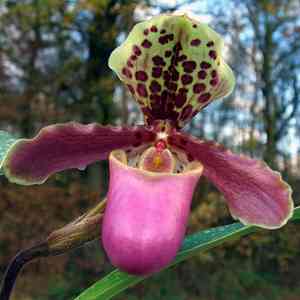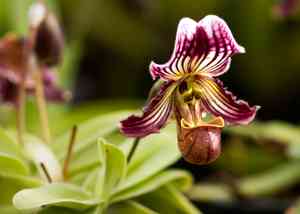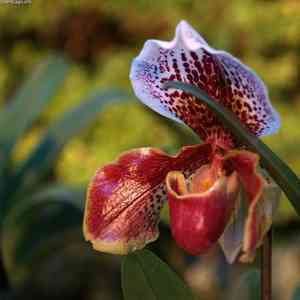
Venus' slippers (Paphiopedilum)(Paphiopedilum)

Venus' slippers (Paphiopedilum) (Paphiopedilum)

Also known as: Slipper orchids

Venus' slippers, also known as lady's slipper orchids, can be found in various natural habitats. They typically thrive on the forest floor among layers of humus, where they grow as terrestrial plants. Some species are true epiphytes, living on trees, while others are lithophytes that grow on rocks. These orchids are sympodial and do not have pseudobulbs. Their leaves, which can be either short and rounded or long and narrow, often exhibit a mottled pattern. As older shoots die, new ones emerge. Each new shoot blooms only once when fully mature, producing a raceme nestled between its fleshy, succulent leaves. The roots are thick and fleshy, forming a dense clump in potted plants that can extend up to 1 meter when untangled. The genus includes around 80 recognized taxa and is indigenous to Asia and Oceania.

Attributes of Venus' slippers (Paphiopedilum)

Lifespan
Perennial
Plant Height
30 cm
Spread
30 cm
Leaf Color
Green, often mottled
Flower Size
8-10 cm
Flower Color
Various (white, pink, yellow, green, purple)

ForwardPlant - Identify plants with a snap

Identify and diagnose plants, get toxicity alerts, and explore safety guides for all types of fungi.

Try for Free

Images of Venus' slippers (Paphiopedilum)
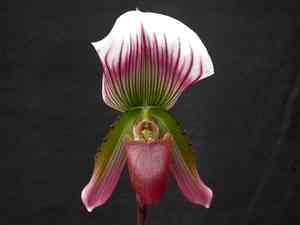
Venus' slippers (Paphiopedilum)(Paphiopedilum)

Quickly Identify Venus' slippers (Paphiopedilum)

1
Look for the distinctive slipper-shaped pouch on the flower and the typically mottled leaves. Flowers are often colorful and possess a unique labellum.

Scientific Classification of Venus' slippers (Paphiopedilum)

Phylum
Magnoliophyta
Class
Monocotyledonae
Order
Asparagales
Family
Orchidaceae
Genus
Paphiopedilum

Planting and Growing of Venus' slippers (Paphiopedilum)

Care Difficulty
Moderate
Watering Schedule
Every 8 days
Sunlight Requirements
Partial sun
Sunshine Duration
6-10 hours
Ideal Temperature
65-75℉
Soil Type
Potting Mix, Peat Mix
Soil pH
5.5-6.5
Fertilizer Type
Balanced
Pruning Season
Spring, Summer
Pruning Area
Branches, Leaves
Pruning Frequency
2 times a year
Repotting Season
Spring
Pot Type
Plastic, Ceramic

water icon How to Water Venus' slippers (Paphiopedilum)?

When watering Paphiopedilum, aim for around 120 milliliters. This amount ensures that the growing medium is moist but not soggy. The general rule is to water thoroughly, allowing excess water to drain out completely. This prevents the roots from sitting in water, which could lead to rot.
What are the symptoms of an underwatered Venus' slippers (Paphiopedilum)?
What should I do if my Venus' slippers (Paphiopedilum) is not getting enough water?
What are the symptoms of an overwatered Venus' slippers (Paphiopedilum)?
How to save an overwatered Venus' slippers (Paphiopedilum)?

sunlight icon What Are the Sunlight Requirements for Venus' slippers (Paphiopedilum)?

Sunlight Requirements: Partial sun, Full shade
Duration of light: 2 to 4 hours
The ideal light range for Paphiopedilum is partial sun to full shade, providing filtered sunlight for a few hours daily. This allows the plant to thrive, ensuring healthy growth and vibrant blooms without stress.
What is the best light level for Paphiopedilum?
How to achieve ideal light conditions?
What are the benefits of achieving ideal light conditions?

temperature icon What Is the Ideal Temperature Range for Venus' slippers (Paphiopedilum)?

Ideal Temperature: 65 ~ 75℉
The ideal temperature range for Paphiopedilum species ensures optimal growth and maximizes blooming potential. Maintaining temperatures between 65°F and 75°F will provide the best environment, as these temperatures closely mimic their natural habitat's climate. This range supports proper photosynthesis and nutrient uptake, leading to healthier and more vibrant plants.

soil icon What Soil is Best for Venus' slippers (Paphiopedilum)?

Soil type: Loam, Acidic soil, Peat soil
Soil PH: 5.5 ~ 6.5
Paphiopedilum orchids require well-drained soil to prevent root rot. The mixture of loam and peat allows excess water to drain while retaining enough moisture for orchid roots to thrive. These orchids thrive in soil that can hold moisture but does not become waterlogged. Such conditions prevent drying out and support the constant hydration needs of the plant, leading to better growth and bloom. A nutrient-rich soil supports the orchid's growth and flowering. Adding organic compost or orchid fertilizer can provide the essential nutrients these plants require, leading to robust and healthy blooms.

fertilize icon How to Fertilize Venus' slippers (Paphiopedilum)?

Fertilizer type: Balanced
For Paphiopedilum, it is crucial to apply fertilizers with caution. A balanced 20-20-20 fertilizer should be diluted to one-quarter strength. This means if the recommended amount is 1 teaspoon per gallon, you should use only 1/4 teaspoon per gallon to prevent root burn and ensure healthy growth.

prune icon How to Prune Venus' slippers (Paphiopedilum)?

Pruning Time: Spring, Summer, Autumn, Winter
Start by identifying any dead or yellowing leaves. These should be the primary focus of your pruning efforts. Clear away these materials to promote the healthy growth of new leaves and improve overall air circulation. When removing old flower spikes, cut them back to the base of the plant, taking care not to damage the healthy leaves or new growth. This will help the plant direct its energy into growing new flowers. While pruning, take the opportunity to inspect the plant for any signs of pests or disease. Removing affected areas promptly can save the plant from a larger infestation.

propagate icon How to Propagate Venus' slippers (Paphiopedilum) plant?

Propagate Time: Spring, Late spring, Early spring
1
Begin by sowing the seeds on the surface of the sterile growing medium. Do not cover them as they require light to germinate. Maintain a temperature of 20-25°C for optimal growth conditions.
2
Carefully separate clumps of Paphiopedilum when they are large enough, ensuring each division has roots and at least one shoot. Replant the divisions into individual pots with fresh orchid mix.
3
Tissue culture involves using sterilized tissue samples in a lab to propagate multiple plants. This method ensures genetic consistency and is used to produce a large number of plants efficiently.

repot icon How to Repot Venus' slippers (Paphiopedilum) plant?

Repotting frequency: Every 2-3 years
1
Repotting Paphiopedilum should be done when roots outgrow the pot or old medium decomposes. Spring is ideal, as new growth supports adaptation. Look for signs like overcrowding, roots creeping out of drainage holes, or decaying potting mix as signals to repot.
2
Choose a pot that is slightly larger than the current one, with excellent drainage. Plastic or clay pots work well, but ensure it's not too large to prevent excess moisture retention, which can lead to root rot. Amixture of airiness and snugness encourages healthy root development.
3
Use a well-draining orchid mix that retains moisture but allows air circulation, such as a bark-based mix with perlite or charcoal to prevent compaction. The right medium balances moisture and aeration, essential for orchid roots to thrive and absorb nutrients efficiently.

ForwardPlant - Identify plants with a snap

Find the best spots for them to optimize their health, simply using your phone.

Try for Free