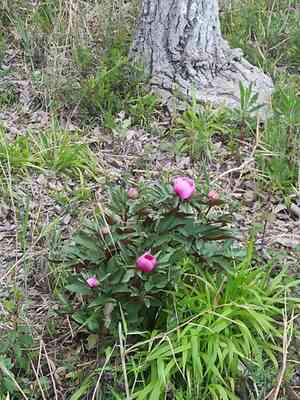
Majorcan peony (Paeonia cambessedesii)
Also known as: Balearic Peony
Paeonia cambessedesii is a perennial, clump-forming herbaceous plant that goes dormant in autumn and re-emerges in spring. It typically grows to a height of 25 to 60 cm. The stems are reddish-purple and bear several alternately arranged leaves. The basal leaves are divided into nine smooth, leathery leaflets that are lance-shaped to obovate, ending in a pointed tip.
In This Article
Attributes of Majorcan peony
Lifespan
Perennial
Plant Type
Herb
Plant Height
50 cm
Spread
50 cm
Leaf Color
Green Purple
Flower Size
Up to 10 cm (4 inches)
Flower Color
Pink
Images of Majorcan peony
Quickly Identify Majorcan peony
1
Look for rose-pink flowers, deeply lobed leaves with a reddish underside, and a herbaceous habit. The plant typically blooms in spring.
Scientific Classification of Majorcan peony
Phylum
Vascular plants
Class
Dicotyledons
Order
Saxifragales
Family
Peony
Genus
Peonies
Species
Majorcan peony
Planting and Growing of Majorcan peony
Care Difficulty
Hard
Watering Schedule
Every 2 days
Sunlight Requirements
Full sun
Sunshine Duration
6-10 hours
Ideal Temperature
60-75℉
Soil Type
Potting Mix, Peat Mix
Soil pH
6.5-7.5
Fertilizer Type
Balanced
Pruning Season
Spring, Summer
Pruning Area
Branches, Leaves
Pruning Frequency
2 times a year
Repotting Season
Spring
Pot Type
Plastic, Ceramic
 How to Water Majorcan peony?
For Paeonia cambessedesii, the watering should be thorough and consistent, with about 500 ml provided each time. This amount ensures that the soil remains moist without being waterlogged, allowing the roots to absorb necessary nutrients. Aim to moisten the soil evenly, ensuring water reaches deeper roots without causing standing water.
What are the symptoms of an underwatered Majorcan peony?
›
What should I do if my Majorcan peony is not getting enough water?
›
What are the symptoms of an overwatered Majorcan peony?
›
How to save an overwatered Majorcan peony?
›
 What Are the Sunlight Requirements for Majorcan peony?
Full sun to partial sun is ideal, supporting vibrant blooms and robust stem development. This bright exposure encourages photosynthesis, resulting in ample energy for metabolism and resilience against external stressors.
More About Sunlight Requirements Techniques→
How much sunlight does Paeonia cambessedesii need?
›
What solutions exist if conditions differ?
›
What are the benefits of proper sunlight?
›
 What Is the Ideal Temperature Range for Majorcan peony?
The ideal temperature range for cultivating Paeonia cambessedesii is between 60°F and 75°F. This range provides optimal conditions for the plant to perform photosynthesis efficiently while ensuring that cellular respiration does not outpace photosynthetic output. Maintaining this temperature allows for robust flowering and overall growth.
 What Soil is Best for Majorcan peony?
Paeonia cambessedesii thrives in well-draining soils that prevent water stagnation around its roots. This kind of soil ensures that the roots are less prone to rot and other moisture-related issues, promoting healthier growth and vibrant blooms. This peony variety demands a nutrient-rich soil which supports its robust growth. A fertile soil that offers essential minerals and organic matter significantly enhances blooming and overall plant vigor. The soil should strike a balance in moisture retention—not too wet, nor too dry. This characteristic ensures that the plant receives consistent hydration without the risk of fungal diseases, contributing to its resilience and floriferous nature.
 How to Fertilize Majorcan peony?
For Paeonia cambessedesii, the fertilizer amount should be carefully controlled. Apply a balanced fertilizer with a ratio of 10-10-10 or similar, using about a tablespoon per plant for granular types. When using liquid fertilizers, follow the package instructions but generally dilute at half strength.
 How to Prune Majorcan peony?
Begin by identifying and removing any dead wood, which can be distinguished by its brittle texture and lack of live growth. Cut back to healthy wood, ensuring cuts are clean and precise. Trim the plant to maintain its shape and encourage a compact growth habit. Focus on removing any spindly or weak stems that detract from the overall symmetry and vitality of the plant. After blooming, remove spent flower stems down to a healthy bud or leaf. This helps the plant conserve energy for next year's flowering and minimizes potential disease entry points.
More About Pruning Techniques→
 How to Propagate Majorcan peony plant?
1
Start by collecting healthy seeds in autumn. Store them in a cool, dry place until early spring. Their hard coats require stratification; therefore, immerse them in warm water for a few hours to improve germination rates.
2
In early spring, sow the stratified seeds in seed trays filled with well-draining soil mix. Press the seeds gently into the soil, cover them lightly, and mist with water to keep the soil consistently moist without overwatering.
3
For division propagation, dig around the plant to expose the root system in late spring. Gently separate the rhizomes using a sterilized knife or spade, ensuring each division has at least one healthy bud, then plant them in suitable locations.
 How to Repot Majorcan peony plant?
1
Repot Paeonia cambessedesii when you notice roots growing out of drainage holes or the soil dries out too quickly after watering. Additionally, a noticeable decline in bloom quality is a signal. Optimal repotting occurs in spring or early autumn when the plant is not actively flowering.
2
Select a pot one size larger than the current one, with sufficient drainage holes. This prevents waterlogging and root rot, critical for this peony species. A ceramic or clay pot is ideal as it allows air exchange and anchors the plant firmly.
3
Opt for well-draining sandy loam soil enriched with organic matter. This soil type prevents water stagnation while providing adequate nutrients and aeration, critical for the healthy growth of Paeonia cambessedesii.
Toxicity
Ingestion
WARNING
The judgment on toxicity and danger is for reference only. We DO NOT GUARANTEE any accuracy of such judgment. Therefore, you SHALL NOT rely on such judgment. It is IMPORTANT TO SEEK PROFESSIONAL ADVICE in advance when necessary.
Learn More About Majorcan peony Diseases
Anthracnose
Bacterial Leaf Spot
Bacterial Soft Rot
Crown Gall
Damping-off
Downy Mildew
Drought Stress
Fusarium Wilt
Gray Mold
Leaf Curl
Leaf Spot
Mosaic
Nutrient Deficiency
Nutrient Toxicity
Powdery Mildew
Root Rot
Root-knot Nematode
Rusts
Sooty Mold
Spider Mites
Temperature Stress
Thrips Damage
White Mold



