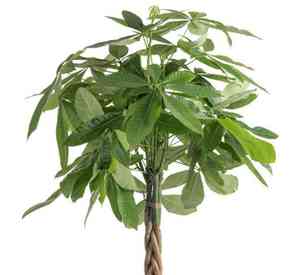
Money tree (Pachira glabra)
Also known as: Lucky tree, Saba nut
Money tree (Pachira glabra) can regularly be found in stores sold in small pots as braided Bonsai plants. Their showy trunk will stay hued with green throughout maturity. The wood is sometimes used for objects of light use, such as toys and boxes. It's often mistaken with the Malabar chestnut (Pachira aquatica), which doesn't develop a mature bulbous base like the money tree.
In This Article
Plant Comprehensive Care Guide: Beginner's Introduction and Key Details
Perfect for beginners starting their plant care journey
→
10 Secrets to Making Money tree Grow Faster (A Must-Read for Beginners)
Advanced tips to accelerate your plant's growth
→
Care "Black Tech": 10 Little-Known Highly Effective Maintenance Tips
Expert-level techniques for optimal plant care
→
Attributes of Money tree
Lifespan
Perennial
Plant Type
Tree
Plant Height
9 m to 18 m
Spread
15 m
Leaf Color
Green
Flower Size
8 cm to 10 cm
Flower Color
White
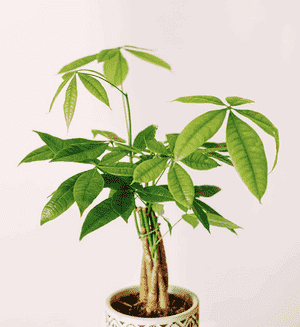
Images of Money tree
Quickly Identify Money tree
1
Identify Pachira glabra by its smooth, green to brown bark, glossy, palmate leaves that usually consist of five leaflets, and its large, woody fruit pods. The plant typically produces showy yellowish flowers with long stamens.
Scientific Classification of Money tree
Phylum
Vascular plants
Class
Dicotyledons
Order
Malvales
Family
Mallow
Genus
Pachira
Species
Money tree
Planting and Growing of Money tree
Care Difficulty
Easy
Watering Schedule
Every 2 days
Sunlight Requirements
Partial sun
Sunshine Duration
4-8 hours
Ideal Temperature
65-77℉
Soil Type
Potting Mix, Peat Mix
Soil pH
6.5-7.5
Fertilizer Type
Balanced
Pruning Season
Spring, Summer
Pruning Area
Branches, Leaves
Pruning Frequency
2 times a year
Repotting Season
Spring
Pot Type
Plastic, Ceramic
 How to Water Money tree?
For Pachira glabra, water it with approximately 250 ml at a time, ensuring that the water drains well. The key principle is to keep the soil slightly moist but never soggy, thus avoiding water pooling around the roots.
More About Watering Techniques→
What are the symptoms of an underwatered Money tree?
›
What should I do if my Money tree is not getting enough water?
›
What are the symptoms of an overwatered Money tree?
›
How to save an overwatered Money tree?
›
 What Are the Sunlight Requirements for Money tree?
Pachira glabra flourishes in partial sun conditions, benefiting from stable exposure to filtered sunlight. This balance ensures vigorous growth, robust leaves, and resilience against environmental stressors.
More About Sunlight Requirements Techniques→
What kind of sunlight is best for Pachira glabra?
›
How to ensure Pachira glabra gets the right amount of light?
›
What are the benefits of providing ideal lighting to Pachira glabra?
›
 What Is the Ideal Temperature Range for Money tree?
Pachira glabra thrives best between 65°F and 77°F. This temperature range provides the optimal environment for photosynthesis and metabolism, supporting healthy growth and vibrant foliage. Ensuring temperatures within this range aids in maintaining the plant's natural habitat conditions.
 What Soil is Best for Money tree?
Pachira glabra thrives in well-drained soils, as they prevent water from pooling around the roots. This is vital for avoiding root rot and ensuring the plant's health. Ensuring the soil has good drainage properties promotes oxygen flow to the roots, which is crucial for its growth. The plant prefers nutrient-rich soil to provide a balanced supply of essential nutrients. This promotes robust growth, strong stems, and luxuriant leaf development. A nutrient-rich medium allows Pachira glabra to develop its full aesthetic potential. Although it requires good drainage, the soil should also retain some moisture. This balance helps maintain the appropriate humidity around the roots, crucial for the plant's optimal growth and overall vitality.
More About Soil→
 How to Fertilize Money tree?
Pachira glabra, commonly known as Guiana chestnut, needs careful attention when it comes to fertilizer amounts. For liquid fertilizers, it is advisable to dilute the solution to half the recommended strength to prevent fertilizer burn. For slow-release granular fertilizers, use about 1 tablespoon per plant, evenly spread over the soil surface.
More About Fertilizing Techniques→
 How to Prune Money tree?
Begin by observing the overall structure of your Pachira glabra. Identify branches that crowd the center or cross over onto other branches, as they can impede light penetration and air circulation, both vital for vitality. When you prune, make clean cuts at a 45-degree angle just above a node or branching point. This promotes healing and encourages new growth. Avoid leaving stubs which can attract pests and pathogens, compromising the plant's health. After removing unhealthy branches, focus on shaping the plant. Determine a pleasing shape and prune to maintain balance and symmetry. This not only improves the plant's appearance but also its structural integrity, preventing it from becoming top-heavy.
More About Pruning Techniques→
 How to Propagate Money tree plant?
1
Choose strong and healthy stems for cutting propagation. The selected stems should be disease-free and have several nodes to ensure successful rooting.
2
Prepare a well-draining soil mix by combining equal parts of peat moss, perlite, and vermiculite. This mix provides optimal conditions for rooting and seed germination.
3
Insert the cuttings into the prepared soil mix, ensuring that at least two nodes are buried. Firm the soil around the cutting to provide support and water lightly to promote root growth.
 How to Repot Money tree plant?
1
Look for signs such as roots protruding from the drainage holes or a stunted growth pattern. This indicates the Pachira glabra has outgrown its current pot and needs more space to thrive. Repotting during the growing seasons of spring and summer will support its natural growth cycle.
2
Select a pot that's one size larger with adequate drainage holes to prevent waterlogging. A ceramic or plastic pot with these attributes helps maintain moisture balance while providing stability and ample space for root expansion.
3
Opt for a well-draining potting mix, ideally with components like perlite or sand to prevent soil compaction. This soil mix ensures good aeration and prevents overwatering, supporting the healthy growth of your plant.
Learn More About Money tree Diseases
Anthracnose
Bacterial Leaf Spot
Bacterial Soft Rot
Bacterial Wilt
Black Spot
Chemical Injury
Crown Gall
Damping-off
Drought Stress
Fusarium Wilt
Gray Mold
Leaf Curl
Leaf Spot
Mosaic
Nutrient Deficiency
Nutrient Toxicity
Powdery Mildew
Root Rot
Root-knot Nematode
Sooty Mold
Spider Mites
Temperature Stress
Thrips Damage
White Mold



