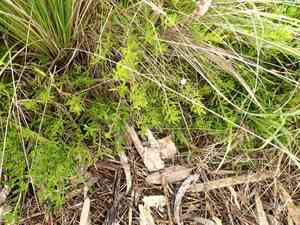
Creeping myoporum(Myoporum parvifolium)

Creeping myoporum (Myoporum parvifolium)

Also known as: Dwarf native myrtle, Small leaf myoporum

Creeping myoporum, or Myoporum parvifolium, is an excellent choice for landscaping due to its versatile and hardy nature. Here are some benefits and uses:

1. **Effective Ground Cover**: Forms a thick, low-lying mat, ideal for covering large areas and replacing lawns in areas with minimal foot traffic.
2. **Attractive Blooms**: Produces small, white or pink flowers that can attract pollinators like bees, adding ecological value.
3. **Drought Resistance**: Thrives in dry conditions, making it a suitable option for water-efficient landscaping.
4. **Frost Tolerance**: Can endure frost, broadening its usability in varied climates.
5. **Erosion Prevention**: The dense growth helps stabilize soil, making it perfect for slopes and preventing erosion.
6. **Low Upkeep**: Requires little maintenance once established, reducing the need for frequent watering and mowing.

Overall, creeping myoporum is a practical and visually appealing solution for enhancing landscapes with minimal effort.

Attributes of Creeping myoporum

Lifespan
Perennial
Plant Type
Shrub
Plant Height
15 cm
Spread
80 cm
Leaf Color
Green
Flower Size
0.5 - 1 cm
Flower Color
White

ForwardPlant - Identify plants with a snap

Identify and diagnose plants, get toxicity alerts, and explore safety guides for all types of fungi.

Try for Free

Images of Creeping myoporum

Creeping myoporum(Myoporum parvifolium)

Quickly Identify Creeping myoporum

1
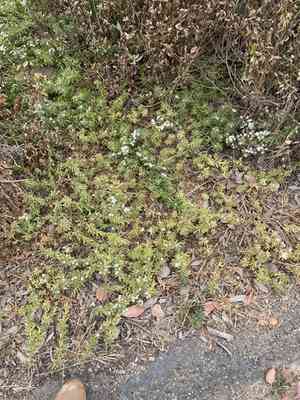
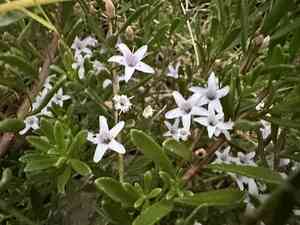
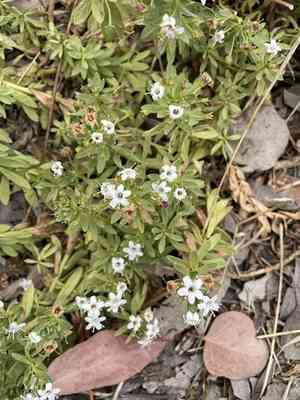
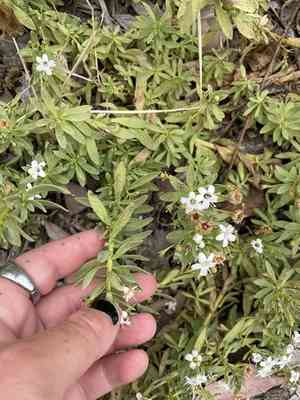
Identify Myoporum parvifolium by its prostrate growth habit, small, narrow leaves arranged alternately along stems, and its small, star-shaped flowers which are white to pale pink in color.

Scientific Classification of Creeping myoporum

Phylum
Vascular plants
Class
Dicotyledons
Order
Lamiales
Family
Figwort
Genus
Myoporum
Species
Creeping myoporum

Planting and Growing of Creeping myoporum

Care Difficulty
Easy
Watering Schedule
Every 4 days
Sunlight Requirements
Full sun
Sunshine Duration
6-10 hours
Ideal Temperature
50-77℉
Soil Type
Potting Mix, Peat Mix
Soil pH
6.5-7.5
Fertilizer Type
Balanced
Pruning Season
Spring, Summer
Pruning Area
Branches, Leaves
Pruning Frequency
2 times a year
Repotting Season
Spring
Pot Type
Terracotta, Plastic

water icon How to Water Creeping myoporum?

For Myoporum parvifolium, it’s essential to water deeply but infrequently. This plant prefers around 500ml per watering session to allow moisture to reach the root zone, ensuring healthy growth and preventing surface-level root development.
What are the symptoms of an underwatered Creeping myoporum?
What should I do if my Creeping myoporum is not getting enough water?
What are the symptoms of an overwatered Creeping myoporum?
How to save an overwatered Creeping myoporum?

sunlight icon What Are the Sunlight Requirements for Creeping myoporum?

Sunlight Requirements: Full sun, Partial sun
Duration of light: 6-8 hours of sunlight
Partial to full sun lighting promotes lush growth in Myoporum parvifolium, encouraging a healthy, dense foliage cover and enhancing the plant's ability to flower effectively.
What is the best location for Myoporum parvifolium?
How to ensure Myoporum parvifolium receives adequate sunlight?
What benefits does ideal lighting bring to Myoporum parvifolium?

temperature icon What Is the Ideal Temperature Range for Creeping myoporum?

Ideal Temperature: 50 ~ 77℉
The ideal temperature range for Myoporum parvifolium is between 50°F to 77°F. This range is crucial for optimal growth and development, ensuring the plant maintains its vibrant appearance and forms strong, healthy roots. These temperatures mimic its native conditions, allowing for excellent photosynthesis, nutrient uptake, and water use efficiency.

soil icon What Soil is Best for Creeping myoporum?

Soil type: Sandy loam, Loam
Soil PH: 6.5 ~ 7.5
Myoporum parvifolium thrives in soil with excellent drainage, preventing waterlogging that can lead to root rot. Well-draining soil ensures that the plant roots receive adequate air, promoting robust growth and vibrant foliage. For vigorous growth, this plant performs best in nutrient-rich soil. The availability of essential nutrients supports healthy leaf development and enhances the plant's ability to resist environmental stressors. The soil should have balanced fertility to support the growth of Myoporum parvifolium. A well-balanced soil provides sufficient macro and micronutrients that are crucial for the plant's overall health and flowering capability.

fertilize icon How to Fertilize Creeping myoporum?

Fertilizer type: Balanced
When fertilizing Myoporum parvifolium, it is important to use moderate amounts. For liquid fertilizers, a diluted solution of half the recommended strength is ideal. For slow-release fertilizers, use approximately 2 tablespoons per square meter.

prune icon How to Prune Creeping myoporum?

Pruning Time: Spring, Summer, Autumn
Begin by removing any dead or damaged branches from the Myoporum parvifolium. Cut these at their base, near the point where they meet a healthy branch. Next, selectively prune to shape the plant, focusing on maintaining a full, dense look. Trim the outer branches slightly to encourage bushier growth. Always cut just above a leaf node to encourage new shoots. After pruning, water the plant well to help it recover and stimulate new growth. Check the soil moisture and adjust watering accordingly to avoid stress. Additionally, remove any debris from around the base of the plant to prevent pest issues. More About Pruning Techniques

propagate icon How to Propagate Creeping myoporum plant?

Propagate Time: Spring, Late spring, Early autumn
1
Choose a healthy, non-flowering stem from the Myoporum parvifolium. It should be approximately 10 cm long with several leaves, ensuring a strong start for the rooting process.
2
Remove the leaves from the lower half of the cutting and trim it just below a node. This will focus the plant's energy on root development.
3
Dip the cut end into rooting hormone to accelerate root growth. Place the cutting into a small pot filled with a damp potting mix, ensuring at least one node is submerged.
More About Propagating Techniques

repot icon How to Repot Creeping myoporum plant?

Repotting frequency: Every 2-3 years
1
Look for roots emerging from the drainage holes, this indicates that the plant has outgrown its current pot. Other signs include slowing growth despite optimal care and the soil drying out faster than usual. Spring or autumn are ideal times to repot due to moderate temperatures and growth conditions.
2
Select a pot that is about one size larger than the current one, ensures adequate room for growth without excessive soil that can lead to overwatering. Also, make sure the pot has sufficient drainage holes to prevent waterlogging, allowing excess moisture to exit easily.
3
Opt for a well-draining potting mix to ensure that excess water can easily move through the soil, preventing root rot. A mix containing sand, perlite, or small pebbles is ideal, as it mimics the plant’s natural growing environment and maintains appropriate moisture levels.

ForwardPlant - Identify plants with a snap

Find the best spots for them to optimize their health, simply using your phone.

Try for Free

Toxicity

Ingestion

Identify toxic plants for your safety

Learn which plants are harmful to you and your pets, and make informed choices for a safer home!

Try for Free
WARNING
The judgment on toxicity and danger is for reference only. We DO NOT GUARANTEE any accuracy of such judgment. Therefore, you SHALL NOT rely on such judgment. It is IMPORTANT TO SEEK PROFESSIONAL ADVICE in advance when necessary.