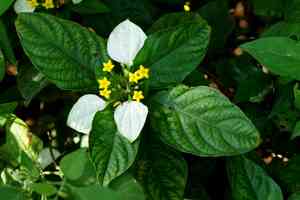
Buddha's lamp (Mussaenda pubescens)
Also known as: Splash-of-white
**Mussaenda pubescens**, commonly known as Buddha's lamp, is an ornamental shrub native to China and part of the coffee family (Rubiaceae). It is easily identified by its distinctive five-pointed yellow flowers accompanied by white, rounded calyx bracts.
In This Article
Attributes of Buddha's lamp
Lifespan
Perennial
Plant Type
Shrub
Plant Height
91 cm to 1.8 m
Spread
90 cm to 1.8 m
Leaf Color
Green
Flower Size
2.5 cm
Flower Color
Yellow White Green Orange
Images of Buddha's lamp
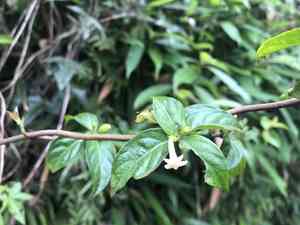
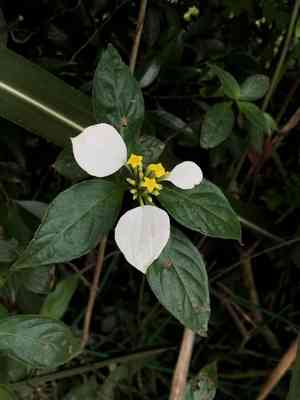
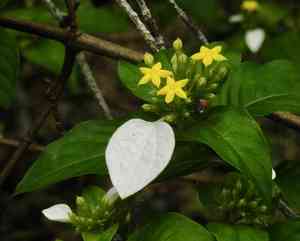
Quickly Identify Buddha's lamp
1
Identify Mussaenda pubescens by its hairy stems, elliptic leaves with soft hair, and striking sepals that are often mistaken for petals. The true flowers are usually small and yellow.
Scientific Classification of Buddha's lamp
Phylum
Vascular plants
Class
Dicotyledons
Order
Gentians, dogbanes, madders, and allies
Family
Madder
Genus
Paper-rose
Species
Buddha's lamp
Planting and Growing of Buddha's lamp
Care Difficulty
Easy
Watering Schedule
Every 8 days
Sunlight Requirements
Partial sun
Sunshine Duration
4-8 hours
Ideal Temperature
68-86℉
Soil Type
Potting Mix, Peat Mix
Soil pH
5.5-7.5
Fertilizer Type
Balanced
Pruning Season
Spring, Summer
Pruning Area
Branches, Leaves
Pruning Frequency
2 times a year
Repotting Season
Spring
Pot Type
Plastic, Ceramic
 How to Water Buddha's lamp?
Mussaenda pubescens requires a fairly generous amount of water, approximately 500 milliliters at each watering. The goal is to keep the soil consistently moist, without allowing it to become waterlogged. A good rule of thumb is to water until you see moisture beginning to drain out of the bottom of the pot, ensuring the roots receive ample hydration yet avoiding standing water.
What are the symptoms of an underwatered Buddha's lamp?
›
What should I do if my Buddha's lamp is not getting enough water?
›
What are the symptoms of an overwatered Buddha's lamp?
›
How to save an overwatered Buddha's lamp?
›
 What Are the Sunlight Requirements for Buddha's lamp?
Mussaenda pubescens prefers a semi-shady to well-lit environment. Such conditions support optimal photosynthetic activity which translates to healthy growth and vibrant blooming, ensuring the plant's long-term health and beauty.
More About Sunlight Requirements Techniques→
What is the best environment for Mussaenda pubescens to thrive?
›
What should you do if your Mussaenda pubescens is not getting enough light?
›
What are the benefits of providing ideal lighting to Mussaenda pubescens?
›
 What Is the Ideal Temperature Range for Buddha's lamp?
The ideal temperature range for Mussaenda pubescens is between 68°F and 86°F. This range provides an optimal warm environment that fosters healthy growth, adequate moisture levels, and vibrant flowering. Staying within this range encourages the plant’s natural development cycles and promotes a robust root system.
 What Soil is Best for Buddha's lamp?
Mussaenda pubescens requires well-drained soil to prevent waterlogging, which can lead to root rot. This ensures the roots receive adequate oxygen and prevents fungal infections, promoting robust growth. A moderate moisture level is crucial for Mussaenda pubescens. The soil should be consistently moist but not soggy. This condition supports steady nutrient absorption for healthy foliage and blooms. Incorporating organic matter into the soil enriches it, providing essential nutrients to Mussaenda pubescens. This practice enhances soil structure, improving water retention and aeration.
 How to Fertilize Buddha's lamp?
Mussaenda pubescens generally requires moderate amounts of fertilizer. For liquid fertilizers, it is ideal to mix a balanced 10-10-10 NPK solution at the rate of 1/4 to 1/2 teaspoon per gallon of water. For slow-release fertilizers, a handful (approximately 2 tablespoons) dispersed around the root zone is adequate. Be mindful not to over-fertilize, as this plant is somewhat nutrient-sensitive.
 How to Prune Buddha's lamp?
Begin by sterilizing your pruning shears with alcohol to prevent the spread of disease. Identify any dead or diseased branches and remove them entirely. Focus on thinning out inner branches to improve air circulation. Trim back any overly long stems to promote a bushier appearance. When cutting, always make clean cuts just above a node or bud to encourage healthy new growth. Prioritize shaping the plant to maintain its natural contour.
More About Pruning Techniques→
 How to Propagate Buddha's lamp plant?
1
Choose a healthy and mature Mussaenda pubescens as your parent plant. Ensure it's free from pests and diseases to increase the likelihood of successful propagation.
2
Using sterilized pruning shears, take cuttings that are about 4-6 inches long. Remove leaves from the lower half of the cutting to reduce moisture loss.
3
Dip the cut end into rooting hormone and plant in a pot filled with well-draining potting mix. Maintain high humidity and indirect light for best results.
 How to Repot Buddha's lamp plant?
1
Repot Mussaenda pubescens when its roots outgrow the current pot. Signs include slow growth, roots emerging from drainage holes, and water not penetrating the soil. Spring or early summer is ideal, as warm months promote recovery and root establishment.
2
Select a pot slightly larger than the current one, with proper drainage holes to prevent waterlogging. The material can be terracotta or plastic, each offering different benefits—terracotta allows for breathability, while plastic retains moisture.
3
Opt for a loamy, well-draining soil mix with organic matter. This maintains moisture while ensuring excess water drains away, helping to prevent root rot. Such soil anchors the plant well, promoting robust root and foliage growth.
Learn More About Buddha's lamp Diseases
Anthracnose
Bacterial Leaf Spot
Bacterial Wilt
Crown Gall
Damping-off
Downy Mildew
Fusarium Wilt
Gray Mold
Leaf Curl
Leaf Spot
Mosaic
Powdery Mildew
Root Rot
Root-knot Nematode
Rusts
Sooty Mold
Spider Mites
Thrips Damage
White Mold
Chemical Injury
Drought Stress
Nutrient Deficiency
Nutrient Toxicity
Temperature Stress



