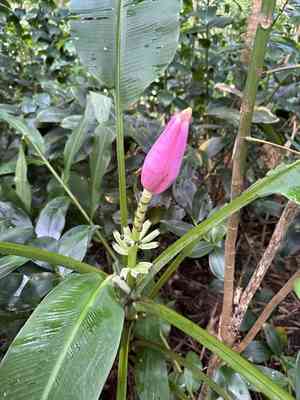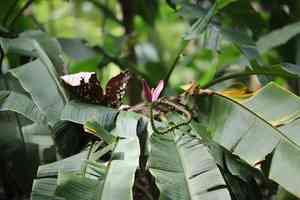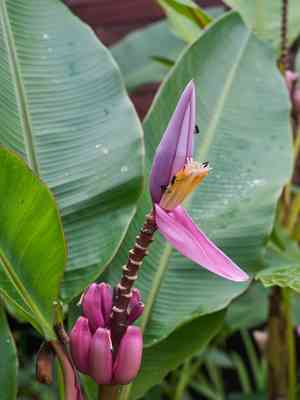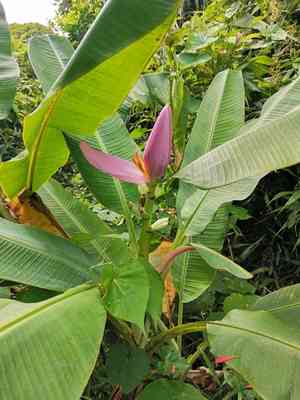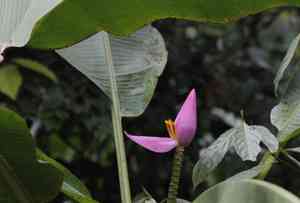
Flowering banana(Musa ornata)

Flowering banana (Musa ornata)

Also known as: Pink Banana, Flowering Banana

Musa ornata is part of the Musa section Rhodochlamys, which is characterized by brightly colored bracts. Unlike the Australimusa and Callimusa sections that have a chromosome number of 2n = 20, Rhodochlamys, including M. ornata, has a chromosome number of 2n = 22. Native to India, M. ornata is a small, ornamental species that has naturalized in Central and South America since the early 19th century. It typically grows to a height of 1.5 to 3 meters (5 to 10 feet) and features green foliage with pink accents. The leaves can reach lengths of up to 1.8 meters (6 feet) and are often used in tropical floral arrangements.

Musa ornata is noted for its pink flowers and small, dark pink or crimson, inedible fruit. The inflorescence is yellow-orange, and both its male and female flowers are arranged in single rows of 3-5 per bract, sometimes up to 7. The male flowers have purple anthers, while the female style is green. This species also readily hybridizes with other Musa species, resulting in numerous hybrids in tropical regions.

Attributes of Flowering banana

Lifespan
Perennial
Plant Type
Herb
Plant Height
1.8 m to 2.5 m
Spread
1.5 m
Leaf Color
Green
Flower Size
2.5 cm to 5 cm
Flower Color
Yellow Orange Pink

ForwardPlant - Identify plants with a snap

Identify and diagnose plants, get toxicity alerts, and explore safety guides for all types of fungi.

Try for Free

Images of Flowering banana

Flowering banana(Musa ornata)

Quickly Identify Flowering banana

1
Large 9 feet (2.7 meters) paddle-shaped leaves
2
Vibrant pink or purple bracts on inflorescences
3
Clusters of small non-edible fruits below bracts
4
Robust stature reaching 5-7 feet (1.5-2.1 meters) tall
5
Glossy green foliage adds ornamental appeal

Scientific Classification of Flowering banana

Phylum
Vascular plants
Class
Monocotyledons
Order
Zingiberales
Family
Banana
Genus
Musa
Species
Flowering banana

Planting and Growing of Flowering banana

Care Difficulty
Moderate
Watering Schedule
Every 3 days
Sunlight Requirements
Partial sun
Sunshine Duration
4-8 hours
Ideal Temperature
68-86℉
Soil Type
Potting Mix, Peat Mix
Soil pH
6.5-7.5
Fertilizer Type
Balanced
Pruning Season
Spring, Summer
Pruning Area
Branches, Leaves
Pruning Frequency
2 times a year
Repotting Season
Spring
Pot Type
Plastic, Ceramic

water icon How to Water Flowering banana?

For Musa ornata, it's essential to water thoroughly, ensuring the soil is evenly moist without being waterlogged. The plant thrives with consistent moisture but be cautious of standing water. A good rule of thumb is to water until you see a little drainage from the pot's bottom, which usually indicates that about 500 ml is sufficient.
What are the symptoms of an underwatered Flowering banana? ›
What should I do if my Flowering banana is not getting enough water? ›
What are the symptoms of an overwatered Flowering banana? ›
How to save an overwatered Flowering banana? ›

sunlight icon What Are the Sunlight Requirements for Flowering banana?

Sunlight Requirements: Partial sun
Duration of light: 4 to 6 hours
Partial sun promotes balanced growth and optimal flowering, providing 4-6 hours of filtered sunlight replicates native tropical environments.
Optimal Sun Exposure ›
Solution for Ideal Lighting ›
Effects of Ideal Lighting ›
More About Sunlight Requirements Techniques→

temperature icon What Is the Ideal Temperature Range for Flowering banana?

Ideal Temperature: 68 ~ 86℉
Musa ornata thrives best when the ambient temperature is maintained between 68°F and 86°F. This range supports optimal growth, flowering, and overall plant health, ensuring vibrant foliage and robust development.

soil icon What Soil is Best for Flowering banana?

Soil type: Loam, Sandy loam
Soil PH: 6.5 ~ 7.5
The soil must have excellent drainage capabilities to prevent waterlogging, which can lead to root rot. Well-drained soil helps Musa ornata absorb nutrients effectively. Rich in organic matter, the soil should provide ample nutrients for vigorous growth. Nutrients support flowering and fruiting, ensuring the plant thrives. While drainage is important, the soil should also retain enough moisture to keep the plant hydrated. Consistent moisture helps sustain growth during dry periods.

fertilize icon How to Fertilize Flowering banana?

Fertilizer type: Balanced
For Musa ornata, the fertilizer amount should be guided by its growth phase. During the active growing season, apply approximately 1/2 strength of recommended liquid fertilizer every two weeks. For granular fertilizers, roughly 1 ounce every 4 months is suitable.

prune icon How to Prune Flowering banana?

Pruning Time: Spring, Summer
Start by trimming away any leaves that are yellowed or brown at the edges, cutting as close to the stalk as possible without damaging the main stem. Trim back any overly long or crossing stems to keep the plant compact. This ensures the Musa ornata maintains its aesthetic and structural integrity. More About Pruning Techniques→

propagate icon How to Propagate Flowering banana plant?

Propagate Time: Early spring, Spring, Late spring
1
Before sowing, soak the seeds in lukewarm water for 24 hours to enhance germination rates. This process helps to soften the seed coat and kickstart the growing process.
2
For division propagation, carefully dig up the plant and separate the rhizomes. Ensure that each division has at least one growing eye to promote successful regrowth.
3
In tissue culture propagation, small tissue samples are grown in a sterile medium. This method requires controlled environmental conditions but can produce large numbers of uniform plants.

repot icon How to Repot Flowering banana plant?

Repotting frequency: Once every two years
1
Musa ornata shows signs it's time to repot when the roots begin circling the pot or sprouting from the drainage holes. Additionally, when the plant seems stunted or is drying out quickly, these are indicators that it has outgrown its current home. Ideally, repotting should be done during its active growing season, in the warmth of spring or summer, to help minimize transplant shock.
2
For Musa ornata, it's crucial to select a container that is 2-3 inches larger in diameter than the previous pot. This provides ample space for root growth without overwhelming the plant. A pot with drainage holes is important to prevent waterlogging, which can lead to root rot. Using a well-sized pot ensures the plant's stability and health, promoting optimum growth and flowering.
3
Musa ornata thrives in a soil mix that is rich, loose, and drains well. A potting soil formulated for palms or a blend with equal parts of peat, compost, and perlite works well. Such a mix retains adequate moisture while allowing excess water to drain away, providing the roots the aeration they require to prevent rot and facilitate nutrient uptake.

ForwardPlant - Identify plants with a snap

Find the best spots for them to optimize their health, simply using your phone.

Try for Free