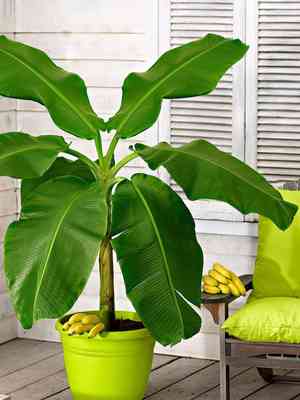
Hardy banana (Musa basjoo)
Also known as: Japanese banana
The cold-hardy Japanese Fiber Banana (*Musa basjoo*) is known for its lush, ornamental leaves rather than its inedible fruit. Originally from Japan, this plant can thrive in North American climates, even reaching as far north as New England, provided its roots are well-mulched for winter protection.
In This Article
Attributes of Hardy banana
Lifespan
Perennial
Plant Type
Herb
Plant Height
2.5 m to 4 m
Spread
1.8 m to 2.5 m
Leaf Color
Green
Flower Size
2 cm to 3 cm
Flower Color
Yellow White Green Cream Violet
Images of Hardy banana
Quickly Identify Hardy banana
1
Large paddle-shaped leaves, up to 6 feet (180 cm) long and 2 feet (60 cm) wide.
2
Robust, smooth pseudo-stem reaching 6.5 feet (2 meters) in height without branching.
3
Striking yellow-orange torpedo-shaped flowers with reddish-brown to purple bracts.
4
Inedible oblong capsule fruit, 2-4 inches (5-10 cm) long, transitioning from green to yellow.
5
Distinctive petiole up to 12 inches (30 cm) long, enhancing the plant's appearance.
Scientific Classification of Hardy banana
Phylum
Vascular plants
Class
Monocotyledons
Order
Gingers, bananas, and allies
Family
Banana
Genus
Musa
Species
Hardy banana
Planting and Growing of Hardy banana
Care Difficulty
Easy
Watering Schedule
Every 3 days
Sunlight Requirements
Full sun
Sunshine Duration
6-10 hours
Ideal Temperature
65-75℉
Soil Type
Potting Mix, Peat Mix
Soil pH
5.5-7
Fertilizer Type
Balanced
Pruning Season
Spring, Summer
Pruning Area
Branches, Leaves
Pruning Frequency
2 times a year
Repotting Season
Spring
Pot Type
Plastic, Ceramic
 How to Water Hardy banana?
Water the Musa basjoo so that the soil is consistently and evenly moist but not waterlogged. Ensure water reaches the roots, usually around 1000 ml per session, adjusting based on the plant's size and pot drainage.
More About Watering Techniques→
What are the symptoms of an underwatered Hardy banana?
›
What should I do if my Hardy banana is not getting enough water?
›
What are the symptoms of an overwatered Hardy banana?
›
How to save an overwatered Hardy banana?
›
 What Are the Sunlight Requirements for Hardy banana?
Musa basjoo prefers full sun to partial sun conditions, thriving most efficiently with 6 to 8 hours of daily sun exposure. This lighting fosters robust growth, broader leaves, and enhances the plant's ability to store energy and withstand adverse conditions.
More About Sunlight Requirements Techniques→
Amount of Sunlight Needed
›
Solution for Ideal Sunlight
›
Benefits of Ideal Lighting
›
 What Is the Ideal Temperature Range for Hardy banana?
The ideal temperature range for growing Musa basjoo is between 65°F to 75°F. This range provides optimal conditions for photosynthesis, growth, and overall plant health. Maintaining temperatures within this range ensures that the plant can efficiently metabolize nutrients and develop a strong root system while promoting lush foliage growth.
 What Soil is Best for Hardy banana?
Musa basjoo thrives in soils with excellent drainage, preventing waterlogging and root rot. This characteristic is crucial for the plant's vigorous growth, as it ensures the roots get ample oxygen while also retaining essential moisture. The plant benefits significantly from soils enriched with organic matter. Organic matter boosts soil fertility, providing necessary nutrients that promote lush foliage and robust stem development. While good drainage is essential, the soil should also retain some moisture to keep the plant hydrated. This balance is vital for Musa basjoo, especially during the warmer months when evaporation rates are higher.
More About Soil→
 How to Fertilize Hardy banana?
For Musa basjoo, apply a balanced, water-soluble fertilizer at a rate of approximately 1 tablespoon per gallon of water for liquid fertilizers. For slow-release granular fertilizers, use about 1 to 2 pounds per 100 square feet of garden space. Adjust the amount based on the plant's size and growth stage.
More About Fertilizing Techniques→
 How to Prune Hardy banana?
Begin by removing any dead or brown leaves, as these detract from the plant's health and aesthetics. Cut them close to the pseudostem using clean, sharp scissors. Focus on maintaining a symmetrical shape by trimming any overly long or drooping leaves. Always sanitize your tools before and after pruning to prevent the spread of diseases. Musa basjoo can benefit from cutting back to promote sturdier growth. Cut back to the ground level after the plant has fruited or if you're preparing it for winter. This step ensures the plant uses its energy to develop new, strong shoots and fresh leaves rather than sustaining older growth.
More About Pruning Techniques→
 How to Propagate Hardy banana plant?
1
Choose a mature, healthy Musa basjoo plant that shows vigorous growth. A strong parent ensures that the divisions will be equally healthy and capable of establishing themselves quickly.
2
Carefully dig around the base of the plant to expose the rhizomes. Ensure to retain some soil with the root ball and select sections with at least one growth node.
3
Replant the divided sections in well-prepared soil, ensuring the growth node is above the surface. Water thoroughly to help settle the soil around the roots and facilitate establishment.
 How to Repot Hardy banana plant?
1
Repotting Musa basjoo is best done when you notice the roots becoming crowded or growing out of the drainage holes. Additionally, if the plant is stunted or not growing as expected, these are signals it's time to consider repotting. Spring and summer are ideal for repotting, providing optimal growing conditions after the process.
2
When selecting a pot for your Musa basjoo, opt for one that is only slightly larger than the current container. A pot that is 1-2 inches wider in diameter provides enough space for root expansion without excess soil retaining too much moisture. Ensuring the pot has adequate drainage holes prevents waterlogging, crucial for this plant's health.
3
Choose a well-draining potting mix for repotting. A mix containing perlite or sand improves aeration and prevents compaction. This kind of soil allows for proper water drainage, ensuring the roots do not stay overly wet—key for maintaining the health of Musa basjoo and preventing root rot.



