Sierra blazingstar (Mentzelia crocea)
Also known as: Golden Blazing Star
The Sierra blazingstar (Mentzelia laevicaulis) has various adaptations for thriving in arid environments:
1. **Vivid Flowers**: Its bright yellow-orange flowers attract pollinators, ensuring successful reproduction.
2. **Slender Stems**: Tall and thin stems help reduce water loss.
3. **Hairy Leaves**: Rough, hairy leaves minimize water evaporation by reflecting sunlight.
4. **Seed Dispersal**: Seeds with sticky coatings adhere to animals, facilitating spread across the landscape.
5. **Water Conservation**: Efficient water use and drought resilience allow it to withstand dry periods.
In This Article
Attributes of Sierra blazingstar
Lifespan
Biennial
Plant Type
Herb
Plant Height
1 to 3 feet (30 to 90 cm)
Spread
Approximately 1 to 2 feet (30 to 60 cm)
Leaf Color
Green with a slightly silvery appearance due to fine, stiff hairs
Flower Size
1 to 1.5 inches (2.5 to 4 cm)
Flower Color
Golden-yellow
Images of Sierra blazingstar
Quickly Identify Sierra blazingstar
1
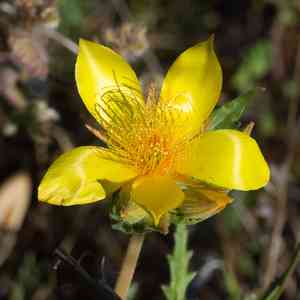
Mentzelia crocea can be identified by its vibrant golden-yellow flowers, which typically have five petals and can reach up to an inch in diameter. The plant has coarse, stiff hairs on its stems and leaves, and it often grows in a bushy, upright form.
Scientific Classification of Sierra blazingstar
Phylum
Vascular plants
Class
Dicotyledons
Order
Cornales
Family
Loasa
Genus
Blazing star
Species
Sierra blazingstar
Planting and Growing of Sierra blazingstar
Care Difficulty
Easy
Watering Schedule
Every 2 days
Sunlight Requirements
Full sun
Sunshine Duration
4-8 hours
Ideal Temperature
60-75℉
Soil Type
Potting Mix, Peat Mix
Soil pH
6.5-7.5
Fertilizer Type
Balanced
Pruning Season
Spring, Summer
Pruning Area
Branches, Leaves
Pruning Frequency
2 times a year
Repotting Season
Spring
Pot Type
Plastic, Ceramic
 How to Water Sierra blazingstar?
Mentzelia crocea thrives best when watered following the 'soak and dry' method. This means the soil should be soaked thoroughly with about 250 milliliters of water, ensuring that it's moist but not waterlogged. Avoid watering again until the top inch of soil has dried out completely, as the plant prefers dry conditions.
What are the symptoms of an underwatered Sierra blazingstar?
›
What should I do if my Sierra blazingstar is not getting enough water?
›
What are the symptoms of an overwatered Sierra blazingstar?
›
How to save an overwatered Sierra blazingstar?
›
 What Are the Sunlight Requirements for Sierra blazingstar?
Mentzelia crocea performs best under full sunlight conditions, benefiting significantly from 6 to 8 hours of direct exposure daily. Ideal lighting improves flower production and overall plant health by leveraging full-spectrum light energy.
What are the ideal lighting conditions for Mentzelia crocea?
›
How can I ensure Mentzelia crocea gets its ideal lighting conditions?
›
What are the benefits of providing ideal lighting to Mentzelia crocea?
›
 What Is the Ideal Temperature Range for Sierra blazingstar?
The ideal temperature range for growing Mentzelia crocea is between 60 and 75°F. This range provides optimal conditions for the plant's physiological processes, ensuring healthy growth and blooming. It is crucial to maintain this temperature range during the growing season to maximize the plant's potential.
 What Soil is Best for Sierra blazingstar?
Mentzelia crocea thrives best in well-drained soils as it prevents waterlogging, which can be detrimental to its root system. Well-drained soil ensures that excess water is efficiently outflowed, thus maintaining optimal moisture levels for the plant's health and robust growth. For optimal growth, Mentzelia crocea requires soils abundant in organic matter, which provide essential nutrients and enhance soil structure. These nutrients support the plant's flowering capabilities and overall vigor, making the environment conducive for lush growth. This plant prefers a soil pH range from neutral to slightly alkaline, which supports its nutrient uptake and metabolic functions. A balanced pH ensures easy absorption of essential minerals, promoting strong and healthy development.
 How to Fertilize Sierra blazingstar?
For Mentzelia crocea, the recommended amount of liquid fertilizer is typically diluted to half-strength compared to what is usually suggested for general plants. It's crucial to avoid over-fertilization as the plant thrives in naturally nutrient-poor soils.
 How to Prune Sierra blazingstar?
Begin by sterilizing your cutting tools to prevent disease transmission. 2. Identify and remove any dead or diseased stems by cutting them back to a healthy point. 3. Trim back any overly long or untidy branches to maintain your desired shape. 4. Ensure all cuts are at a 45-degree angle, angled away from any buds. 5. Regularly step back to survey the plant's overall appearance, ensuring a balanced look.
More About Pruning Techniques→
 How to Propagate Sierra blazingstar plant?
1
Harvest seeds from mature Mentzelia crocea plants by collecting them once the seed pods have dried and turned brown. Make sure to gather the seeds before they naturally disperse, usually in late summer or early autumn.
2
Use a well-draining potting mix to fill your seed trays. It is beneficial to pre-moisten the soil before seeding to ensure even moisture distribution and promote faster germination.
3
Scatter the seeds evenly over the prepared soil surface. Cover them lightly with a thin layer of soil, as the seeds need some light to germinate efficiently. Maintain a consistent moisture level until germination occurs.
 How to Repot Sierra blazingstar plant?
1
You'll know it's time to repot Mentzelia crocea when its roots begin circling inside the pot or when the plant becomes root-bound. Noticeably stunted growth and yellowing leaves can also indicate a need for repotting. Spring is the ideal time as the plant enters its active growing phase after its winter dormancy.
2
Select a pot that is one size larger than its current one. Ensure the new pot has drainage holes to prevent waterlogging, which can lead to root rot. Terra cotta pots can be a good choice as they allow airflow and provide an earthy look that complements the natural habitat of Mentzelia crocea.
3
Opt for a well-draining cactus mix, which replicates the plant's natural sandy, rocky environment. This type of soil minimizes the risk of overwatering and ensures the roots have the necessary aeration. Additionally, it supports healthy growth by providing essential nutrients and stability.
Learn More About Sierra blazingstar Diseases
Anthracnose
Bacterial Leaf Spot
Bacterial Soft Rot
Bacterial Wilt
Chemical Injury
Crown Gall
Cyst Nematode
Damping-off
Downy Mildew
Drought Stress
Fusarium Wilt
Gray Mold
Leaf Curl
Leaf Spot
Mosaic
Nutrient Deficiency
Nutrient Toxicity
Powdery Mildew
Root Rot
Root-knot Nematode
Rusts
Sooty Mold
Spider Mites
Temperature Stress
Thrips Damage
White Mold


