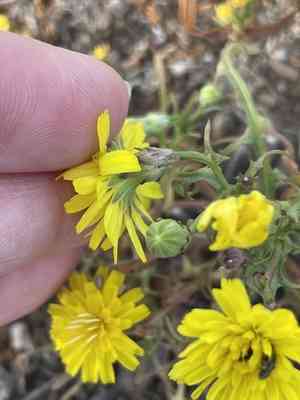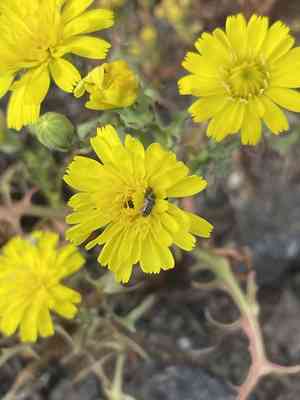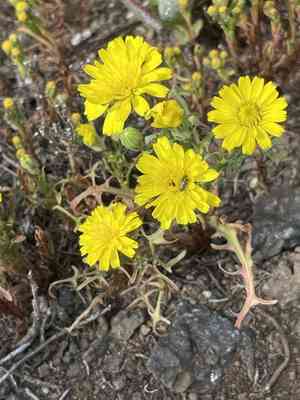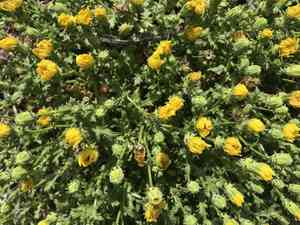
Leafy desertdandelion(Malacothrix foliosa)

Leafy desertdandelion (Malacothrix foliosa)

Also known as: Philbrick's malacothrix, Many-headed malacothrix

The leafy desertdandelion (Malacothrix leucantha) is a perennial herb native to arid regions. It features a rosette of lobed, somewhat succulent leaves at its base, which help in water conservation. The plant produces slender, leafy stems that culminate in bright yellow, dandelion-like flowers. These blooms attract pollinators and are a common sight in deserts such as the Mojave and Sonoran.

**Habitat**:
- Prefers sandy or gravelly soils.
- Grows in open, sunny desert areas.
- Adapted to survive with minimal water in harsh, dry climates.

This plant's ability to thrive in extreme conditions makes it a resilient component of desert ecosystems.

Attributes of Leafy desertdandelion

Lifespan
Annual
Plant Type
Herb
Plant Height
30-60 cm
Spread
N/A
Leaf Color
Green
Flower Size
2-4 cm
Flower Color
Yellow

ForwardPlant - Identify plants with a snap

Identify and diagnose plants, get toxicity alerts, and explore safety guides for all types of fungi.

Try for Free

Images of Leafy desertdandelion

Leafy desertdandelion(Malacothrix foliosa)

Quickly Identify Leafy desertdandelion

1
Malacothrix foliosa can be recognized by its leafy, hairy stem and yellow flowering heads. The leaves are usually toothed or lobed, giving it a distinctive appearance.

Scientific Classification of Leafy desertdandelion

Phylum
Vascular plants
Class
Dicotyledons
Order
Asterales
Family
Daisy
Genus
Desert dandelions
Species
Leafy desertdandelion

Planting and Growing of Leafy desertdandelion

Care Difficulty
Easy
Watering Schedule
Every 2 days
Sunlight Requirements
Full sun
Sunshine Duration
6-10 hours
Ideal Temperature
60-75℉
Soil Type
Potting Mix, Peat Mix
Soil pH
6.5-7.5
Fertilizer Type
Balanced
Pruning Season
Spring, Summer
Pruning Area
Branches, Leaves
Pruning Frequency
2 times a year
Repotting Season
Spring
Pot Type
Plastic, Ceramic

water icon How to Water Leafy desertdandelion?

The watering amount for Malacothrix foliosa should be guided by the 'soak and dry' principle. Water thoroughly until the soil is moist throughout, allowing water to reach the plant's roots without leaving standing water. Ensure the excess water drains away to prevent root rot.
What are the symptoms of an underwatered Leafy desertdandelion? ›
What should I do if my Leafy desertdandelion is not getting enough water? ›
What are the symptoms of an overwatered Leafy desertdandelion? ›
How to save an overwatered Leafy desertdandelion? ›

sunlight icon What Are the Sunlight Requirements for Leafy desertdandelion?

Sunlight Requirements: Full sun, Partial sun
Duration of light: 6-8 hours of sunlight
Malacothrix foliosa's ideal light range falls under full sun conditions. This promotes healthy growth and vibrant blooming, offering the plant ample energy for metabolic activities.
How much light does Malacothrix foliosa need? ›
Are there specific seasons when Malacothrix foliosa requires more light? ›
What are the best solutions if natural sunlight isn't consistent? ›

temperature icon What Is the Ideal Temperature Range for Leafy desertdandelion?

Ideal Temperature: 60 ~ 75℉
The ideal temperature range for Malacothrix foliosa to thrive is between 60°F to 75°F. This range provides optimal conditions for growth and helps prevent stress-related issues. Maintaining this consistent temperature aids in photosynthesis efficiency and nutrient uptake. Would you like to know why these specific temperatures are ideal for this plant?

soil icon What Soil is Best for Leafy desertdandelion?

Soil type: Sandy soil, Sandy loam
Soil PH: 6.5 ~ 7.5
Malacothrix foliosa thrives best in well-drained soil as it prevents waterlogging, which can lead to root rot. This ensures oxygen reaches the roots and helps the plant absorb nutrients effectively. Enriching the soil with organic matter benefits Malacothrix foliosa by providing essential nutrients. This boosts growth and helps the plant withstand adverse conditions. The plant prefers a soil pH range of 6.5 to 7.5. Maintaining this pH range facilitates optimal nutrient uptake, ensuring healthy growth and vibrant foliage.

fertilize icon How to Fertilize Leafy desertdandelion?

Fertilizer type: Balanced
For Malacothrix foliosa, a balanced approach to fertilization is vital. When using liquid fertilizer, apply approximately 1 tablespoon per gallon of water, ensuring not to over-saturate the soil, as this plant prefers well-drained environments.

prune icon How to Prune Leafy desertdandelion?

Pruning Time: Spring, Summer
Carefully inspect the plant for blooms that have begun to fade or wilt. Removing these old flowers encourages new growth and preserves energy for the plant. By eliminating these spent blooms, you help Malacothrix foliosa direct its resources towards healthier parts, resulting in a more robust appearance. To maintain a compact and tidy form, cut back any elongated stems that disrupt the plant's overall shape. This prevents your plant from becoming too sparse or leggy, which is essential for promoting a bushier growth pattern. Use sharp shears to cleanly snip these parts just above a node or lateral branch to encourage branching. More About Pruning Techniques→

propagate icon How to Propagate Leafy desertdandelion plant?

Propagate Time: Spring, Early summer
1
Before sowing, it's important to prepare the seeds by soaking them overnight. This helps in softening the seed coat, which allows for easier germination. Ensure to use fresh seeds for higher germination success rates.
2
Sow the seeds shallowly in a seed tray filled with well-draining potting mix. Cover lightly with soil and water gently. Place the tray in a warm, well-lit location to encourage germination. Ensure consistent moisture levels, but avoid overwatering.
3
Select healthy stems for cutting propagation. Use sharp pruners to cut just below a node. Remove the lower leaves and dip the cut end in rooting hormone powder. Plant the cutting in a mix of perlite and peat moss for optimal root development.
More About Propagating Techniques→

repot icon How to Repot Leafy desertdandelion plant?

Repotting frequency: Every two years
1
Repot Malacothrix foliosa when you notice roots are circling the pot's bottom or emerging through the drainage holes. Additionally, a reduction in plant growth or yellowing leaves might hint at the need to change the soil and upgrade the pot.
2
Select a pot that is marginally larger than the current one, with ample drainage holes. A slightly bigger size helps prevent overwatering, while drainage holes ensure excess water doesn't stay stagnant, protecting the plant roots from rot.
3
Opt for a well-draining sandy mix, ideal for Malacothrix foliosa's natural habitat. A mix like this aids in preventing waterlogged soil, mimicking its native terrain and promoting healthy root growth.

ForwardPlant - Identify plants with a snap

Find the best spots for them to optimize their health, simply using your phone.

Try for Free