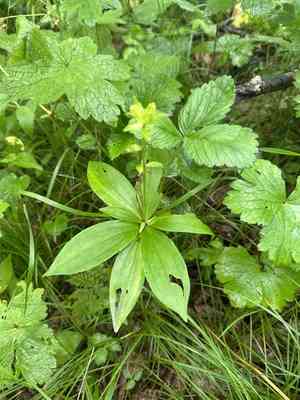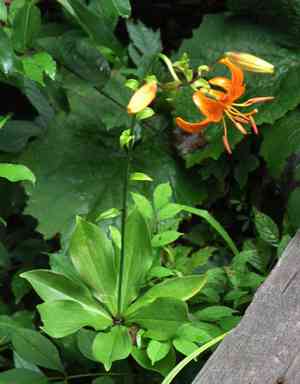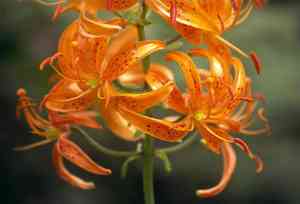
Manchurian turk's cap lily(Lilium distichum)

Manchurian turk's cap lily (Lilium distichum)

Also known as: Distichous Lily

Lilium distichum, an herbaceous plant of the lily family, is native to northeastern China (Heilongjiang, Jilin, Liaoning), Korea, and eastern Russia (Primorye, Amur Krai, Khabarovsk). This species thrives in shrublands and forested areas.

The plant reaches a height of 61-122 cm (2-4 feet) and has a slender, cylindrical stem. Midway up the stem, you can find a single whorl of leaves, while the upper part of the stem features smaller, oval leaves arranged sparsely in an alternate pattern.

The flowers of Lilium distichum are yellow-orange to orange-vermilion, with purple spots. The flowers have a somewhat flat-faced appearance, with petals irregularly distributed to form a fan shape. The tips of the petals are reflexed. During the summer, the plant produces 2-10 flowers on an inflorescence. The name "distichum" is derived from the two distinct types of leaves the plant exhibits.

Attributes of Manchurian turk's cap lily

Lifespan
Perennial
Plant Type
Herb
Plant Height
61 cm to 1.2 m
Spread
30 cm
Leaf Color
Green
Flower Size
2.5 cm to 5 cm
Flower Color
Yellow Orange

ForwardPlant - Identify plants with a snap

Identify and diagnose plants, get toxicity alerts, and explore safety guides for all types of fungi.

Try for Free

Images of Manchurian turk's cap lily
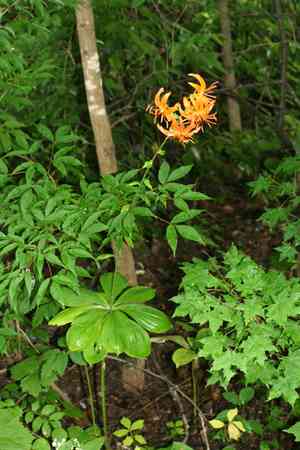
Manchurian turk's cap lily(Lilium distichum)

Quickly Identify Manchurian turk's cap lily

1
Lilium distichum can be identified by its unique distichous leaf arrangement (leaves appearing in two opposite rows) and its colorful, star-shaped flowers which typically have six petals. The plant also has prominent stamens and pistils.

Scientific Classification of Manchurian turk's cap lily

Phylum
Vascular plants
Class
Monocotyledons
Order
Lilies, supplejacks and allies
Family
Lily
Genus
Lilies
Species
Manchurian turk's cap lily

Planting and Growing of Manchurian turk's cap lily

Care Difficulty
Moderate
Watering Schedule
Every 3 days
Sunlight Requirements
Partial sun
Sunshine Duration
4-8 hours
Ideal Temperature
60-75℉
Soil Type
Potting Mix, Peat Mix
Soil pH
6.5-7.5
Fertilizer Type
Balanced
Pruning Season
Spring, Summer
Pruning Area
Branches, Leaves
Pruning Frequency
2 times a year
Repotting Season
Spring
Pot Type
Plastic, Ceramic

water icon How to Water Manchurian turk's cap lily?

Lilium distichum prefers moist but well-drained soil. When watering, aim for approximately 500 ml, ensuring the soil is evenly moist without being waterlogged. This plant thrives best when the top inch of soil dries slightly between waterings, balancing moisture to mimic its natural habitat.
What are the symptoms of an underwatered Manchurian turk's cap lily?
What should I do if my Manchurian turk's cap lily is not getting enough water?
What are the symptoms of an overwatered Manchurian turk's cap lily?
How to save an overwatered Manchurian turk's cap lily?

sunlight icon What Are the Sunlight Requirements for Manchurian turk's cap lily?

Sunlight Requirements: Partial sun
Duration of light: 4 to 6 hours
Lilium distichum's ideal light range is partial sun, receiving 4 to 6 hours of sunlight with afternoon shade. Light in this range boosts growth, enhances blooming, and sustains vibrant foliage while preventing damage.
What is the ideal light level for Lilium distichum?
How can you ensure Lilium distichum receives ideal lighting?
What benefits does Lilium distichum get from ideal light conditions?

temperature icon What Is the Ideal Temperature Range for Manchurian turk's cap lily?

Ideal Temperature: 60 ~ 75℉
Lilium distichum thrives best in temperatures between 60°F and 75°F. These conditions mimic its natural habitat, promoting optimal growth and blooming. Consistent temperatures within this range help the plant to absorb nutrients effectively and maintain healthy cellular function.

soil icon What Soil is Best for Manchurian turk's cap lily?

Soil type: Loam, Sandy loam
Soil PH: 6.5 ~ 7.5
Lilium distichum thrives in soil that offers excellent drainage to prevent root rot, which can occur if water accumulates around the roots. The well-draining soil ensures the roots remain aerated and healthy. This plant flourishes in soil that's rich in organic matter. The nutrients support robust growth and vibrant flowering, providing the plant with the necessary elements for its development. Soil that holds moderate moisture levels is ideal, as it maintains a consistent supply of water without becoming soggy. This ensures the plant remains hydrated during dry periods.

fertilize icon How to Fertilize Manchurian turk's cap lily?

Fertilizer type: Balanced
For Lilium distichum, the right fertilizer dosage is pivotal. During the growing season, feed with a balanced, water-soluble fertilizer diluted to half strength every two weeks. For solid fertilizers, use a slow-release type, typically around 1 oz (28 grams) per plant, applied at the beginning of the growing season.

prune icon How to Prune Manchurian turk's cap lily?

Pruning Time: Spring, Summer
Start by removing dead or damaged stems. Cut back the stems to a healthy set of leaves or the base of the plant if necessary. Ensure to prune at an angle, which facilitates water runoff and prevents rot. During the growing season, pinch off faded flowers to encourage more blooming. In late spring, you can cut back to control height or shape, keeping your plant neat. More About Pruning Techniques

propagate icon How to Propagate Manchurian turk's cap lily plant?

Propagate Time: Spring, Early summer
1
Begin by filling a seed tray with moist seed-starting mix. Sow the Lilium distichum seeds on the surface and cover them lightly. Maintain a consistent temperature and moisture level to promote germination.
2
Gently dig up the bulbs in early summer. Using a sharp knife, separate the bulbs ensuring each has roots attached. Replant them at the same depth they were growing, and water thoroughly to settle the soil.
3
Once seedlings have established, gradually acclimate them to outdoor conditions by exposing them to direct sunlight for increasing periods each day over the span of a week.
More About Propagating Techniques

repot icon How to Repot Manchurian turk's cap lily plant?

Repotting frequency: Every 2-3 years
1
The ideal time to repot Lilium distichum is when you notice the plant becoming root-bound or when the soil appears depleted. Signs such as roots growing out of the drainage holes or slow growth indicate it's time for repotting. Choose a period when the plant is just beginning to show new growth or is slightly dormant to avoid stressing it.
2
Opt for a pot that is one size larger than the current one, with ample drainage holes to ensure water does not stagnate. A larger pot provides more room for root growth, which is crucial for the healthy development of Lilium distichum. Good drainage prevents waterlogging and root rot, which are common issues with lilies.
3
Select a well-draining loam soil mix with added perlite or sand to enhance drainage and aeration. This will help prevent waterlogged conditions that can lead to root rot. Rich, organic soil ensures that the plant receives necessary nutrients, while a loose mix facilitates root expansion and development.

ForwardPlant - Identify plants with a snap

Find the best spots for them to optimize their health, simply using your phone.

Try for Free

Toxicity

Ingestion of leaves or sap contact

Identify toxic plants for your safety

Learn which plants are harmful to you and your pets, and make informed choices for a safer home!

Try for Free
WARNING
The judgment on toxicity and danger is for reference only. We DO NOT GUARANTEE any accuracy of such judgment. Therefore, you SHALL NOT rely on such judgment. It is IMPORTANT TO SEEK PROFESSIONAL ADVICE in advance when necessary.