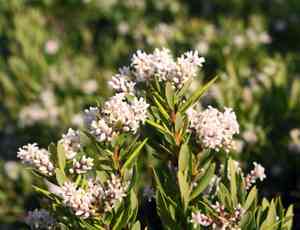
Beard-heath (Leucopogon) (Leucopogon)
Also known as: Long-flowered Beard-heath
Beard-heath, belonging to the genus Leucopogon, comprises roughly 150-160 species of shrubby flowering plants within the Ericaceae family. These plants are indigenous to regions including Australia, New Zealand, New Caledonia, the western Pacific Islands, and Malaysia. Southeastern Australia, in particular, boasts the highest species diversity.
In This Article
Attributes of Beard-heath (Leucopogon)
Lifespan
Perennial
Plant Height
0.5 - 1.5 meters
Spread
0.5 - 1 meters
Leaf Color
Dark green to grey-green
Flower Size
2 - 5 millimeters
Flower Color
White, sometimes pink
Images of Beard-heath (Leucopogon)
Quickly Identify Beard-heath (Leucopogon)
1
Leucopogon can be identified by its small, tubular flowers that often have a \'beard-like\' appearance due to the hairs inside them. The leaves are small, often linear to lance-shaped, and the plants are generally low-growing shrubs.
Scientific Classification of Beard-heath (Leucopogon)
Phylum
Magnoliophyta
Class
Magnoliopsida
Order
Ericales
Family
Ericaceae
Genus
Leucopogon
Planting and Growing of Beard-heath (Leucopogon)
Care Difficulty
Moderate
Watering Schedule
Every 2 days
Sunlight Requirements
Partial sun
Sunshine Duration
4-8 hours
Ideal Temperature
60-75℉
Soil Type
Potting Mix, Peat Mix
Soil pH
4.5-6.5
Fertilizer Type
Balanced
Pruning Season
Spring, Summer
Pruning Area
Branches, Leaves
Pruning Frequency
2 times a year
Repotting Season
Spring
Pot Type
Plastic, Terracotta
 How to Water Beard-heath (Leucopogon)?
Leucopogon plants require a moderate amount of water, approximately 250 milliliters each time. The guiding principle is to ensure the soil remains slightly moist but not waterlogged. This involves watering until you see the first drops draining from the bottom of the pot, indicating the soil has absorbed enough moisture without drowning the roots.
What are the symptoms of an underwatered Beard-heath (Leucopogon)?
›
What should I do if my Beard-heath (Leucopogon) is not getting enough water?
›
What are the symptoms of an overwatered Beard-heath (Leucopogon)?
›
How to save an overwatered Beard-heath (Leucopogon)?
›
 What Are the Sunlight Requirements for Beard-heath (Leucopogon)?
Leucopogon thrives with partial to full sun exposure. Adequate sunlight supports vibrant foliage and optimal flowering, ensuring plant health and aesthetic appeal.
What is the best lighting condition for Leucopogon?
›
How can I achieve ideal lighting?
›
What benefits does optimal lighting provide?
›
 What Is the Ideal Temperature Range for Beard-heath (Leucopogon)?
The ideal temperature range for Leucopogon is between 60°F to 75°F. This range supports optimal growth, allowing the plant to effectively photosynthesize and maintain its physiological processes. Exposure to these temperatures ensures a healthy metabolism and productivity in terms of flowering and overall structural development.
 What Soil is Best for Beard-heath (Leucopogon)?
The Leucopogon plant thrives in free-draining soils, which prevent waterlogging and root rot. Good drainage ensures that the roots have access to sufficient oxygen, promoting healthy growth and vibrant foliage. Leucopogon is adapted to survive in nutrient-poor conditions, often found in native sandy soils. This adaptation allows it to conserve resources and thrive where many other plants cannot, reducing competition. This plant prefers slightly acidic soil with a pH between 4.5 to 6.5. Acidic conditions aid in nutrient availability, facilitating optimal absorption for continued health and flowering.
 How to Fertilize Beard-heath (Leucopogon)?
Leucopogon plants prefer a modest amount of fertilizer. When using liquid fertilizer, dilute to half the recommended strength. For slow-release fertilizers, apply thinner layers to avoid overwhelming the plant's roots. This ensures that nutrients are absorbed gradually, promoting steady growth without risk of burning the roots.
 How to Prune Beard-heath (Leucopogon)?
Start by sterilizing your pruning tools to prevent disease. Trim back any dead or damaged wood, making clean cuts just above a healthy node. Shape the plant by cutting back long, wayward branches to promote a compact form. Regularly trim within the crown to improve air circulation and sunlight penetration. To encourage blooming, selectively prune branches that have finished flowering. Cut just above the point where new shoots are emerging. This will channel the plant’s energy into new growth, resulting in a more abundant display of flowers in subsequent seasons.
 How to Propagate Beard-heath (Leucopogon) plant?
1
Collect fresh seeds from a mature Leucopogon plant. Ensure the seeds are fully developed and dry before using them for propagation.
2
Select healthy stems to take cuttings from. The cuttings should be about 10 cm long and gathered from new growth to ensure vitality.
3
Place seeds or cuttings in prepared seed trays or pots filled with well-draining soil. Water regularly but avoid waterlogging to promote healthy root growth.
 How to Repot Beard-heath (Leucopogon) plant?
1
Leucopogon plants should be repotted when their roots begin to outgrow the current container, typically visible as roots emerging from drainage holes. Another sign is when the plant exhibits stunted growth even with regular care. Early spring or early autumn are ideal to minimize stress, providing milder temperatures for recovery.
2
Select a pot slightly larger than the current one, ideally 1-2 inches wider in diameter. This allows room for root expansion without overcommitting to a too-large container, which can hold excess moisture and lead to root rot. It's also beneficial to choose pots with good drainage to prevent waterlogging.
3
Opt for an acidic, well-draining soil mix, similar to those used for ericaceous plants. This type of soil matches Leucopogon's native environment, promoting healthy root growth and ensuring that the plant doesn't dry out too quickly, while also preventing water from pooling around the roots.
Toxicity
Ingestion
WARNING
The judgment on toxicity and danger is for reference only. We DO NOT GUARANTEE any accuracy of such judgment. Therefore, you SHALL NOT rely on such judgment. It is IMPORTANT TO SEEK PROFESSIONAL ADVICE in advance when necessary.
Learn More About Beard-heath (Leucopogon) Diseases
Anthracnose
Bacterial Leaf Spot
Black Spot
Chemical Injury
Crown Gall
Damping-off
Downy Mildew
Drought Stress
Fusarium Wilt
Gray Mold
Leaf Curl
Leaf Spot
Mosaic
Nutrient Deficiency
Nutrient Toxicity
Powdery Mildew
Root Rot
Root-knot Nematode
Rusts
Sooty Mold
Spider Mites
Temperature Stress
Thrips Damage
White Mold

