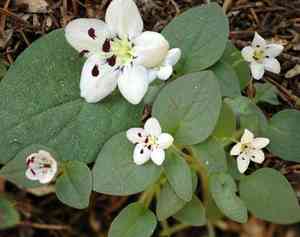
Scott mountain phacelia(Howellanthus dalesianus)

Scott mountain phacelia (Howellanthus dalesianus)

Also known as: Howell's false meadowfoam

Phacelia dalesiana, known as Scott Mountain phacelia, is a perennial herb that typically forms a low-growing patch with a few sprawling stems, reaching up to approximately 15 centimeters in length. This plant features a glandular and hairy texture. Its leaves are primarily arranged in a rosette at the base, with some smaller leaves distributed along the stems. These leaves are oval-shaped and have smooth edges. The plant produces a small, curved cluster of bell-shaped flowers, each measuring just under a centimeter in width. The flowers are pale blue to lavender and bloom from late spring to early summer. Phacelia dalesiana thrives in rocky, serpentine soils and open, sunny habitats, and is specifically adapted to dry conditions.

Attributes of Scott mountain phacelia

Lifespan
Perennial
Plant Type
Herb
Plant Height
10-30 cm
Spread
N/A
Leaf Color
Green Blue
Flower Size
1-2 cm
Flower Color
White, often with a yellow center

ForwardPlant - Identify plants with a snap

Identify and diagnose plants, get toxicity alerts, and explore safety guides for all types of fungi.

Try for Free

Images of Scott mountain phacelia

Scott mountain phacelia(Howellanthus dalesianus)

Quickly Identify Scott mountain phacelia

1
Look for its small, herbaceous form with branching stems. The leaves are typically lance-shaped and the flowers are star-shaped, white, often with a yellow center.

Scientific Classification of Scott mountain phacelia

Phylum
Vascular plants
Class
Dicotyledons
Order
Boraginales
Family
Waterleaf
Genus
Howell's phacelia
Species
Scott mountain phacelia

Planting and Growing of Scott mountain phacelia

Care Difficulty
Hard
Watering Schedule
Every 3 days
Sunlight Requirements
Partial sun
Sunshine Duration
6-10 hours
Ideal Temperature
60-75℉
Soil Type
Potting Mix, Peat Mix
Soil pH
6.5-7.5
Fertilizer Type
Balanced
Pruning Season
Spring, Summer
Pruning Area
Branches, Leaves
Pruning Frequency
2 times a year
Repotting Season
Spring
Pot Type
Plastic, Terracotta

water icon How to Water Scott mountain phacelia?

When watering Howellanthus dalesianus, it's crucial to ensure the soil is moist but not waterlogged. Water until you see a slight amount draining from the bottom of the pot. It's important to avoid water sitting on the surface, which can lead to excess moisture in the soil.
What are the symptoms of an underwatered Scott mountain phacelia?
What should I do if my Scott mountain phacelia is not getting enough water?
What are the symptoms of an overwatered Scott mountain phacelia?
How to save an overwatered Scott mountain phacelia?

sunlight icon What Are the Sunlight Requirements for Scott mountain phacelia?

Sunlight Requirements: Partial sun, Full sun
Duration of light: 4-6 hours of sunlight
Partial to full sun exposure ensures healthy growth. Ideal light supports stronger stems, vibrant leaf color, and enhances overall plant resilience.
Optimal Light Duration
Setting in the Right Spot
Adapting to Varying Light Conditions

temperature icon What Is the Ideal Temperature Range for Scott mountain phacelia?

Ideal Temperature: 60 ~ 75℉
The optimal temperature range for Howellanthus dalesianus is between 60°F and 75°F. These temperatures allow the plant to photosynthesize efficiently and maintain metabolic functions. At this range, the plant can flourish, producing vibrant foliage and strong stems. Growing Howellanthus dalesianus within this range helps in avoiding temperature stress, ensuring robust growth and longevity.

soil icon What Soil is Best for Scott mountain phacelia?

Soil type: Loam, Sandy loam, Acidic soil
Soil PH: 6.5 ~ 7.5
Howellanthus dalesianus thrives in soil that is rich in organic matter and nutrients. Nutrient-rich soil ensures robust growth and vibrant foliage by providing essential minerals and elements that the plant requires for photosynthesis and healthy development. This plant benefits from soil that drains well, preventing waterlogging around the roots. Well-draining soil prevents root rot and promotes healthy root systems, which are vital for water and nutrient uptake. While Howellanthus dalesianus enjoys well-draining properties, slight moisture retention supports prolonged hydration during dry spells. Adequate soil moisture levels help maintain consistent growth and resilience against drought conditions.

fertilize icon How to Fertilize Scott mountain phacelia?

Fertilizer type: Balanced
For Howellanthus dalesianus, applying a balanced liquid fertilizer at half-strength ensures optimal growth without overwhelming the plant. Using 1 tablespoon of liquid fertilizer per gallon of water is generally effective. This measurement allows the plant to access essential nutrients in a controlled manner, encouraging healthy foliage and flowering without burning the roots.

prune icon How to Prune Scott mountain phacelia?

Pruning Time: Spring, Summer
While regular pruning is beneficial, over-pruning can stress the plant and impede its growth. Always assess how much foliage really needs to be removed and avoid cutting back more than one-third of the plant at any single time. To prevent the spread of diseases, always disinfect pruning tools before and after use. A simple solution of one part bleach to nine parts water works well, and ensures that your plant remains in good health.

propagate icon How to Propagate Scott mountain phacelia plant?

Propagate Time: Spring, Early summer
1
Fill the seed tray or pots with a well-draining potting mix. Ensure the soil is moist but not waterlogged before sowing the seeds or inserting cuttings. Proper soil preparation facilitates root growth.
2
Sow seeds evenly over the surface of the prepared soil and cover them lightly with a thin layer of soil. Ensure enough spacing to prevent overcrowding as this facilitates healthy growth.
3
Take semi-hardwood cuttings, about 4-6 inches long, from a healthy plant. Remove leaves from the lower part and plant them into moist potting soil, ensuring at least one node is below the soil.
More About Propagating Techniques

repot icon How to Repot Scott mountain phacelia plant?

Repotting frequency: Once every two years
1
Observe for signs like roots poking out from drainage holes or soil compacting. Early spring and summer are ideal as the plant enters its growth phase, making it resilient to changes.
2
Select a pot slightly larger than the previous one with ample drainage holes. A terracotta pot is beneficial as it allows airflow and prevents soil from becoming waterlogged, mimicking the plant’s natural rocky habitat.
3
Opt for a soil mix with good drainage properties, usually a combination of gritty and organic components. This composition not only replicates the plant’s native conditions but also prevents root rot by allowing excess water to escape quickly.

ForwardPlant - Identify plants with a snap

Find the best spots for them to optimize their health, simply using your phone.

Try for Free

