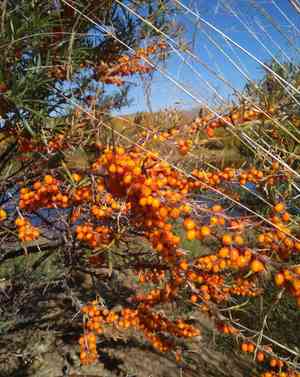
Sea Buckthorns (Hippophae) (Hippophae)
Also known as: Sallowthorn
Sea buckthorns, abundant across Europe and Asia, are notably resilient to cold climates and thrive in challenging conditions. These deciduous shrubs yield bright orange berries, serving as a crucial food source for birds and small mammals. Additionally, their leaves support the larvae of numerous moth and butterfly species. With their capacity to stabilize soil and prevent erosion, coupled with their visually appealing winter berries, sea buckthorns are frequently utilized in landscaping and land management practices.
In This Article
Attributes of Sea Buckthorns (Hippophae)
Lifespan
Perennial
Plant Height
2 to 6 meters
Spread
1.5 to 3 meters
Leaf Color
Silver-green
Flower Size
0.3 to 0.5 cm
Flower Color
Yellow
Images of Sea Buckthorns (Hippophae)
Quickly Identify Sea Buckthorns (Hippophae)
1
Hippophae can be identified by its narrow, silver-green leaves, thorny branches, and bright orange berries that grow in clusters. The plant often forms dense thickets.
Scientific Classification of Sea Buckthorns (Hippophae)
Phylum
Magnoliophyta
Class
Magnoliopsida
Order
Rosales
Family
Elaeagnaceae
Genus
Hippophae
Planting and Growing of Sea Buckthorns (Hippophae)
Care Difficulty
Moderate
Watering Schedule
Every 2 days
Sunlight Requirements
Full sun
Sunshine Duration
6-10 hours
Ideal Temperature
60-77℉
Soil Type
Potting Mix, Peat Mix
Soil pH
6.5-7.5
Fertilizer Type
Balanced
Pruning Season
Spring, Summer
Pruning Area
Branches, Leaves
Pruning Frequency
Once a year
Repotting Season
Spring
Pot Type
Plastic, Ceramic
 How to Water Sea Buckthorns (Hippophae)?
For Hippophae, the amount of water should be around 500 ml per session. The key is to ensure that the soil is moist but not waterlogged. Wait for the top inch of the soil to dry out before watering again. This prevents root rot and helps maintain healthy growth.
What are the symptoms of an underwatered Sea Buckthorns (Hippophae)?
›
What should I do if my Sea Buckthorns (Hippophae) is not getting enough water?
›
What are the symptoms of an overwatered Sea Buckthorns (Hippophae)?
›
How to save an overwatered Sea Buckthorns (Hippophae)?
›
 What Are the Sunlight Requirements for Sea Buckthorns (Hippophae)?
Hippophae thrives in full sun conditions, requiring 6-8 hours of direct sunlight daily. This light range is crucial for optimal berry production and robust growth, ensuring proper photosynthesis and development, vital for the plant's long-term health and productivity.
Best Location
›
Solutions to Achieve Ideal Lighting
›
Benefits of Ideal Lighting
›
 What Is the Ideal Temperature Range for Sea Buckthorns (Hippophae)?
The ideal temperature range for growing Hippophae is between 60°F to 77°F. This range is optimal for ensuring efficient photosynthesis and nutrient absorption. Maintaining these temperatures helps the plant grow steadily without stress, leading to healthy development.
 What Soil is Best for Sea Buckthorns (Hippophae)?
Hippophae thrives in well-drained soil, which prevents waterlogging that can lead to root rot. This condition ensures adequate aeration around the roots, promoting healthy plant growth. While Hippophae is hardy, it benefits from soil enriched with organic matter. This provides essential nutrients that support vigorous growth and fruit production, enhancing overall plant health. The soil should retain enough moisture without becoming soggy. This balance helps sustain the plant during dry spells while ensuring roots remain healthy and robust.
 How to Fertilize Sea Buckthorns (Hippophae)?
Hippophae requires a balanced fertilizer application. For liquid fertilizers, use around 1 liter of a diluted (1:10 ratio with water) balanced fertilizer per plant per monthly application. For slow-release fertilizers, apply about 100 grams per plant annually.
 How to Prune Sea Buckthorns (Hippophae)?
Start by identifying and removing any dead, damaged, or diseased branches. This prevents pests and diseases and stimulates new growth. Make cuts just above healthy buds or intersections. Prune to shape the plant, aiming for an open center to enhance sunlight and airflow. This practice minimizes fungal infections and supports more even ripening of the berries. Remove older, less productive branches to encourage the growth of new, more productive shoots. Focus your cuts on older wood to stimulate the plant's rejuvenation.
 How to Propagate Sea Buckthorns (Hippophae) plant?
1
Gather healthy seeds directly from the plant or cut cuttings from a mature stem. Ensure the seeds are fully matured and the cuttings include several nodes.
2
Use a well-draining potting mix for seeds or a soilless medium for cuttings. The medium should be moist but not waterlogged to support new root development.
3
Place seeds or cuttings in a warm, shaded area to root. Regularly mist the cuttings to maintain humidity, while seeds should be lightly watered to keep the soil damp.
 How to Repot Sea Buckthorns (Hippophae) plant?
1
Repotting of Hippophae should be considered when you observe signs such as roots growing out of the drainage holes, soil drying out too quickly, or the plant becoming top-heavy. Ideally, aim to repot it during its dormant season to minimize stress, typically in early spring or autumn.
2
Select a pot that is 2-3 inches larger in diameter than the current one. Ensure it has ample drainage holes to prevent waterlogging. The size upgrade should provide sufficient space for growth without risking overwatering due to excessive soil volume.
3
Opt for a well-draining sandy loam soil mix to replicate its natural habitat. Such soil ensures good aeration and proper drainage, reducing the risk of root rot. It supports nutrient availability, promoting healthy growth.

