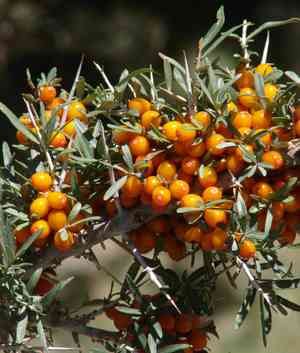
Sea-buckthorn (Hippophae rhamnoides)
Also known as: Seaberry
Sea Buckthorn, scientifically known as Hippophae rhamnoides, originates from the cold-temperate regions of Asia and Europe. This versatile plant is widely used in the food and cosmetic industries due to its nutrient-rich properties. Additionally, it plays a significant role in ecological applications and serves as a source of fodder for animals.
In This Article
Attributes of Sea-buckthorn
Lifespan
Perennial
Plant Type
Shrub
Plant Height
2.5 m to 3.5 m
Spread
7 m
Leaf Color
Silver Green Gray
Flower Size
0.3-0.5 cm
Flower Color
Yellow Green
Images of Sea-buckthorn


Quickly Identify Sea-buckthorn
1
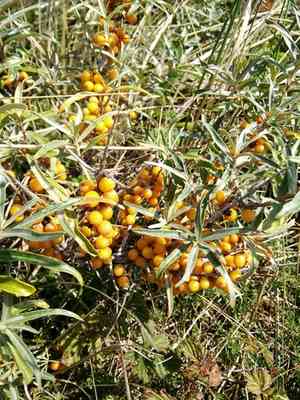
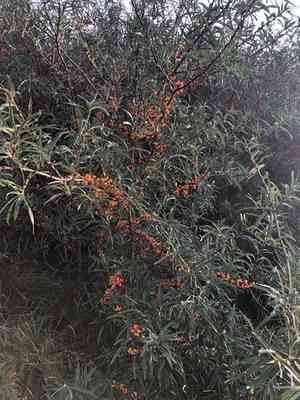
Identifying Hippophae rhamnoides involves looking for its narrow, lance-shaped leaves which are silvery-green on the upper surface and covered with a scale-like layer on the underside. The plant bears small, yellowish flowers followed by dense clusters of orange berries.
Scientific Classification of Sea-buckthorn
Phylum
Vascular plants
Class
Dicotyledons
Order
Roses, elms, figs, and allies
Family
Oleaster
Genus
Sea Buckthorns
Species
Sea-buckthorn
Planting and Growing of Sea-buckthorn
Care Difficulty
Easy
Watering Schedule
Every 2 days
Sunlight Requirements
Full sun
Sunshine Duration
6-10 hours
Ideal Temperature
60-75℉
Soil Type
Potting Mix, Peat Mix
Soil pH
6.5-7.5
Fertilizer Type
Balanced
Pruning Season
Spring, Summer
Pruning Area
Branches, Leaves
Pruning Frequency
2 times a year
Repotting Season
Spring
Pot Type
Plastic, Ceramic
 How to Water Sea-buckthorn?
For Hippophae rhamnoides, known as sea buckthorn, the watering amount should follow the 'deep watering' principle, wherein each session ensures thorough soaking of the soil without waterlogging it. Generally, providing around 500 milliliters per watering session suffices, but ensure the soil surface dries out slightly between waterings to prevent root rot.
What are the symptoms of an underwatered Sea-buckthorn?
›
What should I do if my Sea-buckthorn is not getting enough water?
›
What are the symptoms of an overwatered Sea-buckthorn?
›
How to save an overwatered Sea-buckthorn?
›
 What Are the Sunlight Requirements for Sea-buckthorn?
Hippophae rhamnoides thrives in conditions allowing for full sun exposure. This ideal light range promotes optimal photosynthesis, ensuring robust growth and high-quality fruiting.
More About Sunlight Requirements Techniques→
What conditions are ideal for Hippophae rhamnoides?
›
How can I achieve these conditions?
›
What benefits does this provide?
›
 What Is the Ideal Temperature Range for Sea-buckthorn?
The ideal temperature range for cultivating Hippophae rhamnoides, commonly known as sea buckthorn, lies between 60°F to 75°F. This moderate climate allows the plant to thrive without stress, optimizing photosynthesis and growth. Maintaining this temperature range provides the best conditions for flower and fruit development.
 What Soil is Best for Sea-buckthorn?
Hippophae rhamnoides thrives in soil that allows water to pass through swiftly without pooling. This characteristic is vital as it prevents root rot and ensures aeration, promoting healthy root growth and optimal nutrient uptake. While not overly demanding, this plant benefits from soils enriched with organic matter. Such soil supplies essential nutrients that aid in the vigorous growth, berry production, and overall health of the plant. The plant prefers a slightly acidic to neutral pH range, enabling it to access nutrients more efficiently. This pH balance also supports beneficial microbial activity in the soil, further nurturing plant growth.
 How to Fertilize Sea-buckthorn?
For Hippophae rhamnoides, a balanced fertilizer is recommended with a ratio of 10-10-10. When using liquid fertilizer, apply 250 ml per square meter. For slow-release fertilizer, apply 50 grams per square meter in the early spring. It is important to ensure even distribution to avoid root burn.
 How to Prune Sea-buckthorn?
Ensure you have sharp and sanitized pruning shears to make clean cuts. This reduces the risk of disease transmission and ensures the branches heal quickly. Focus on removing dead, damaged, or crossing branches. This step helps in opening the bush to sunlight and air, promoting healthier growth and fruit production. Cut branches at a 45-degree angle, about a quarter-inch above a bud facing outward. This encourages new growth to develop away from the plant's center, maintaining an open structure.
More About Pruning Techniques→
 How to Propagate Sea-buckthorn plant?
1
After harvesting, the seeds of Hippophae rhamnoides require stratification to break dormancy. They should be kept in a moist medium in a cold environment for several months before sowing.
2
Select healthy stems for cuttings, ideally those that are about 10-15 cm long. Cut below a node, ensuring there are a few leaves at the top. Remove leaves from the lower half of the cutting.
3
Dip the base of the cutting in rooting hormone before planting it in a prepared soil mix. Maintain moisture without overwatering to encourage root development.
 How to Repot Sea-buckthorn plant?
1
Signs that your Hippophae rhamnoides needs repotting include reduced growth, roots emerging from the drainage holes, or the soil drying out too quickly. Ideally, repotting should be done in spring or early summer when the plant enters its growth phase, allowing it to adapt to the new pot and soil more effectively.
2
Choose a pot that is 1-2 inches larger in diameter than the current one, ensuring it has adequate drainage holes. A slightly larger pot provides more room for root expansion, promoting healthier growth. The material of the pot also matters; terracotta is ideal as it allows better air exchange.
3
Opt for well-drained sandy soil to replicate the plant's natural environment. This type of soil ensures adequate drainage, reducing the risk of root rot and maintaining an ideal moisture level for your plant to thrive.



